The Transmission DHM® (DHM-T) from Lyncée Tec are high-precision Digital Holographic Microscopes (DHM®) to quantify transparent and semi-transparent samples. Engineered for precision and versatility, the series includes two primary configurations: the DHM® T-1000 (single laser) and the DHM® T-2100 (dual laser). These systems enable fast, non-invasive quantitative phase imaging (QPI) for life sciences and material science applications.
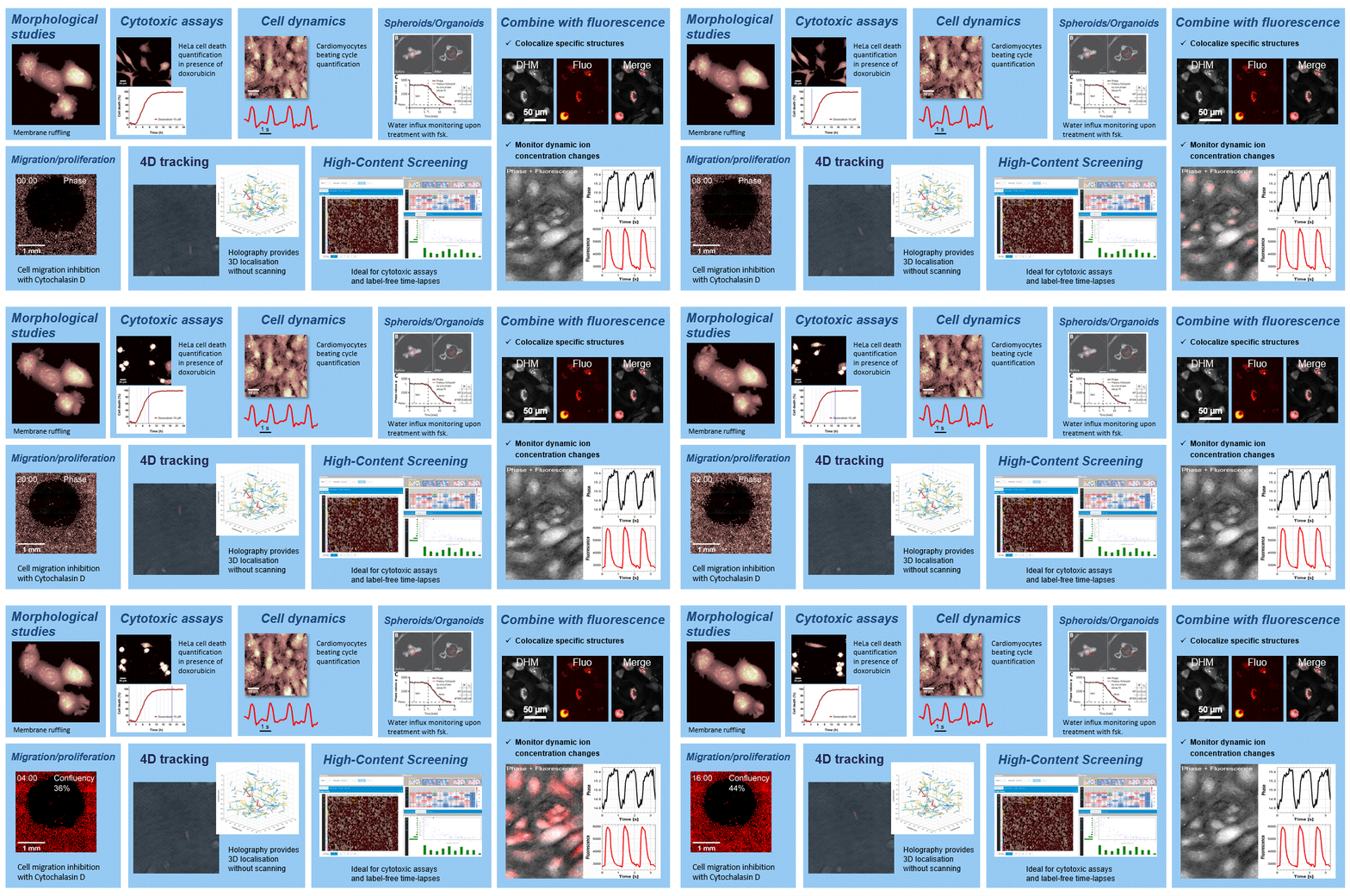
Life Sciences - Unique Advantages
- Label-free and non-perturbing: Measures endogenous biomarkers such as cell morphology, thickness, dry mass, and 3D position without staining, washing, or special substrates.
- Live-cell compatible and fast: Continuous monitoring from milliseconds (up to ~200 fps) to multi-day time-lapse experiments with minimal illumination.
- Simple, robust workflow: Cells are cultured as usual; acquisition and analysis are fully software-driven, reducing assay complexity and variability.
- High-content ready: Automated, multi-site imaging of multi-well plates for quantitative, statistically robust high-content and high-throughput screening.
- Correlative imaging: Optional fluorescence module enables simultaneous DHM® and fluorescence acquisition to take advantage of the specificity of fluorescence for spatial or temporal correlation between the two modalities.
Key Life Sciences Applications
- Cell viability and culture monitoring: Quantitative assessment of cell health based on morphology and dry mass, ideal for long-term assays and cell therapy workflows.
- 4D tracking and cell dynamics: Real-time tracking of cells and swimmers, capturing trajectories and dynamic processes without mechanical scanning.
- High-content screening: Label-free cytotoxicity, proliferation, morphology, migration, and phenotypic profiling in drug development.
- Cardiomyocyte functional assays: Quantitative analysis of beating amplitude, kinetics, and rhythm for cardiotoxicity and drug safety studies.
- Advanced cell biology: Spheroids/organoids, membrane dynamics, lipid droplets, ion and much more.
In Material Sciences
DHM®-T assesses a sample's shape, surface, and optical properties, including internal features and flaws. Key applications include the analysis of microfluidic devices, 3D particle flow velocimetry, and micro-optics characterization, delivering shape, refractive index, and optical transfer function data. Use of refractive index liquids enables to analyzing samples with large slopes, such as micro-corner cubes and high-NA micro-lenses.
These systems are comptible with motorized stages for multisite measurment automation and large area acquisition, with the stroboscopic synchronization module for measuring transparent MEMS, MOEMS, and acousto-fluidic devices operating at high frequencies, and with the post-analysis software MEMSTool for their dynamical response analysis.
Lyncée Tec's DHM® technology evolved from its inception to its current product form. The company possesses the expertise and adaptability to provide customized and OEM systems.
T-Series Specifications
Distinctiveness Between the Three Series of Transmission DHM®
When utilizing a single wavelength, all Transmission DHM® models exhibit consistent performance.
Source: Park Systems
| Series |
T100 |
T1000 |
T2100 |
| Latest model |
T105 |
T1005 |
T2105 |
| Objective |
Single, fixed |
Multiple on a turret |
Multiple on a turret |
| Configuration |
One laser source |
One laser source |
Two laser sources |
| Measurement modes |
Single wavelength |
Single wavelength |
Single and dual wavelength |
| Accuracy (as demonstrated by taking the temporal standard deviation on 1 pixel over 30 measurements) |
1.0 nm 1 |
1.0 nm 1 |
1.0 / 5.0 nm 1 * |
| Vertical resolution (defined as twice the accuracy) |
2.0 nm 1 |
2.0 nm 1 |
2.0 / 10.0 nm 1 * |
| Repeatability (as demonstrated by taking the one sigma Rq value of 30 repeatability measurements on SiC reference mirror) |
0.02 nm 1 |
0.02 nm 1 |
0.02 / 0.05 nm 1 * |
| Vertical measuring range (without any scanning) |
up to 500 μm for continuous structures
|
up to 500 μm for continuous structures
|
up to 500 μm for continuous structures
|
| Max. height of steps with sharp edges (Depends on the laser source(s) and operating wavelength(s) |
- up to 1 μm 1
- up to 3.5 μm 2
|
- up to 1 μm 1
- up to 3.5 μm 2
|
- up to 7 μm 1
- up to 22 μm 2
|
1) Converted value for measurements in air and with sample refractive index n = 1.5
2) Converted value for measurements in water and with sample refractive index n = 1.5
* With / Without single wavelength mapping