Introduction
Antibody Design and Engineering
Analytical Characterization and Quality Assessment
Pathway to Clinical Translation
Future Directions in Antibody Development
References and Further Reading
This article examines the scientific and manufacturing principles that underpin successful therapeutic monoclonal antibody development, highlighting the critical role of cell-line engineering, bioprocess optimization, analytical characterization, and quality-focused manufacturing. It also explores emerging technologies, including artificial intelligence and advanced genome engineering, that are shaping the next generation of antibody therapeutics.
 Image credit: Krot_Studio/Shutterstock.com
Monoclonal antibodies (mAbs) have transformed modern medicine by binding specific molecular targets with high affinity, enabling precision therapies across multiple disease areas. However, translating this potential into safe and effective biologics requires robust manufacturing processes, stringent quality control strategies, and early consideration of developability attributes that influence manufacturability, stability, and clinical success.2,8
This article examines the mAb pipeline, exploring how antibody engineering, Chinese hamster ovary (CHO) cell expression systems, and analytical characterization techniques collectively support the development of antibody therapeutics, from early discovery and lead optimization through commercial manufacturing and quality assurance.7,8
Antibody Design and Engineering
Following lead antibody selection, recombinant production represents the next major stage of development. CHO cells remain the dominant mammalian expression system for therapeutic antibodies, accounting for the production of the majority of approved recombinant therapeutic proteins (RTPs) due to their high productivity, scalability, and established regulatory track record.3,4
CHO cells offer several advantages over alternative expression systems. As mammalian cells, they perform complex post-translational modifications (PTMs) essential for antibody folding, disulfide bond formation, and glycosylation. Although their glycosylation patterns differ slightly from those of human cells, they remain well-suited for therapeutic antibody production and support numerous approved biologics. They can also be adapted to chemically defined, serum-free suspension culture, supporting scalable manufacturing while reducing reliance on animal-derived medium components.3,4
Even with these advantages, antibody production is influenced by multiple biological and manufacturing variables, including cell line genetics, gene copy number, promoter strength, culture conditions, and bioreactor parameters. These factors influence antibody productivity and critical quality attributes (CQAs) that can affect therapeutic performance. In particular, changes in culture conditions can alter glycosylation and other product attributes, meaning that increases in yield must be evaluated alongside product quality.3,6
Cell line development therefore represents a major component of biologics manufacturing. Stable, high-producing clones are generated through transfection, selection, and screening, then evaluated for productivity, genetic stability, and consistency. Recent advances in genome-editing technologies, including CRISPR-based techniques, have enabled more precise CHO cell engineering to enhance productivity and product quality. These approaches can also support targeted glycosylation control, site-specific transgene integration, and reduction of undesirable host-cell proteins.3,5
Once high-performing cell lines are established, upstream process optimization further improves manufacturing performance. Modern fed-batch processes achieve high antibody titers, while intensified and continuous manufacturing strategies aim to enhance efficiency and flexibility. However, increased productivity must be balanced with product quality to maintain therapeutic performance. Feed composition, feeding strategy, temperature, pH, dissolved oxygen, and nutrient availability therefore require careful control because they can influence cell growth, metabolic by-product accumulation, antibody yield, and CQAs.3
Analytical Characterization and Quality Assessment
Comprehensive analytical characterization is essential because subtle molecular differences can influence antibody stability, biological activity, and immunogenicity. A combination of complementary analytical methods is therefore required to evaluate key attributes, including identity, purity, potency, and structural integrity, throughout antibody development. Because monoclonal antibodies are structurally complex glycoproteins, no single analytical technique can comprehensively assess all critical quality attributes (CQAs).6
At the molecular level, mass spectrometry (MS)-based approaches enable detailed characterization of antibody structure and composition, including intact mass analysis, peptide mapping, sequence confirmation, PTM assessment, and identification of product variants.6
For higher-order structural analysis, size-exclusion chromatography (SEC) is used to assess antibody size heterogeneity and structural integrity, particularly by detecting aggregates and fragments. This technique enables quantification of high-molecular-weight species and supports evaluation of product quality during antibody development and manufacturing.6
In addition to size-based analysis, antibody heterogeneity can be characterized using capillary electrophoresis (CE). This technique provides high-resolution separation of charge variants and molecular differences with high sensitivity and reproducibility, facilitating both development and commercial production.6
Complementing these physicochemical assessments, glycan analysis evaluates antibody glycosylation, a CQA that can influence pharmacokinetics, immunogenicity, stability, and biological activity. Characterization of glycan profiles is therefore essential for monitoring antibody attributes and ensuring consistent manufacturing.7
At the functional level, binding and cell-based assays are used to evaluate antibody activity and biological function. Techniques such as enzyme-linked immunosorbent assays (ELISA), surface plasmon resonance (SPR), and biolayer interferometry (BLI) assess antigen binding, affinity, and molecular interactions, while cell-based potency assays evaluate the antibody's biological activity under relevant experimental conditions. BLI is also commonly used for epitope binning and real-time analysis of antibody–antigen interactions during therapeutic antibody development.6,8
Pathway to Clinical Translation
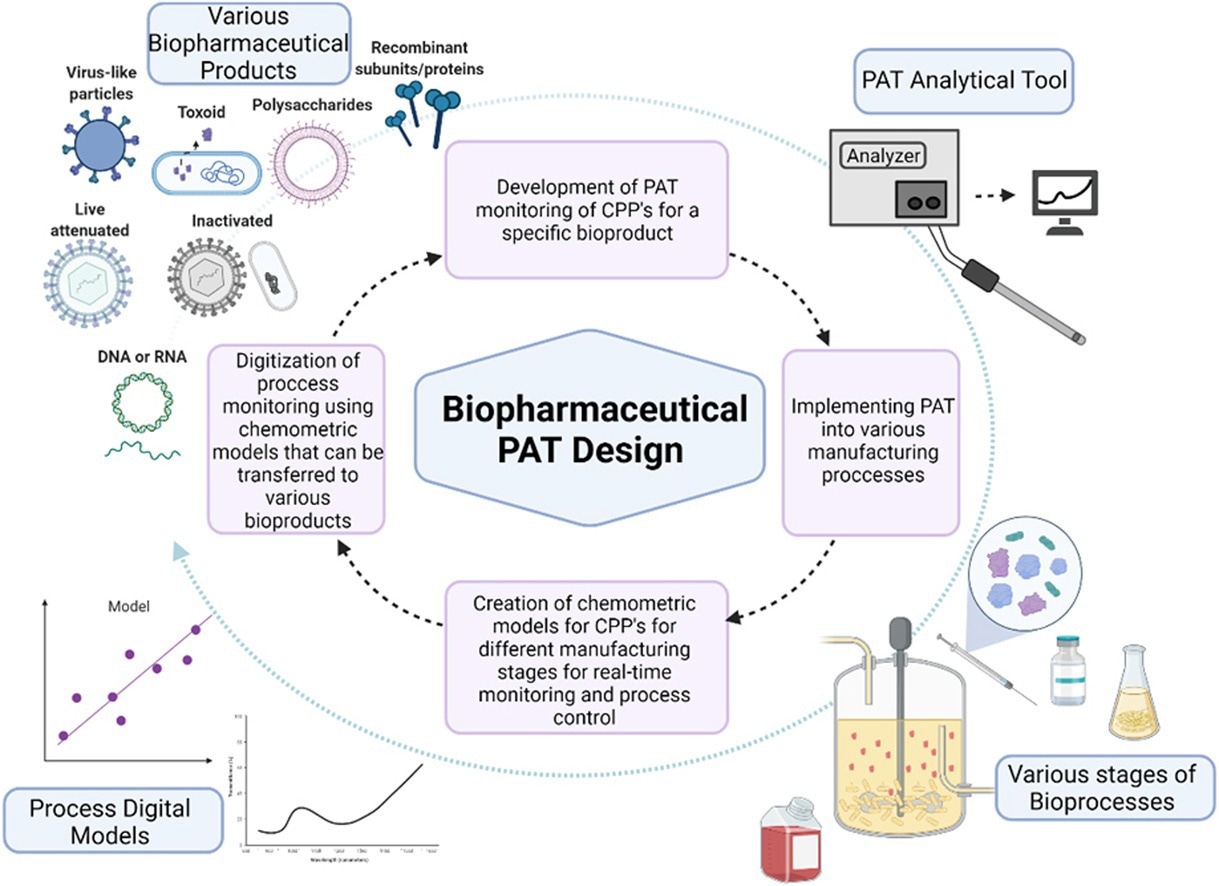 Process Analytical Technology (PAT) integrates analytical measurements, process models, and real-time monitoring to improve process understanding, maintain manufacturing consistency, and support quality-focused biopharmaceutical production. As part of a Quality by Design (QbD) framework, PAT enables proactive control of critical process parameters throughout biologics manufacturing. Image credit: Gerzon et al., 2022.
Manufacturing consistency is critical for regulatory approval because biologics are complex molecules whose quality depends on both product attributes and the processes used to generate them. Manufacturers must therefore demonstrate that their processes reliably produce material with predefined CQAs linked to clinical performance. Because no single analytical method can fully characterize a biologic, manufacturers rely on multiple complementary techniques to demonstrate product consistency throughout development.6
Quality by Design (QbD) has become an established framework for biologics development and regulatory expectations. Rather than relying primarily on end-product testing, QbD emphasizes understanding how raw materials and process parameters influence product quality. This approach includes identifying the critical quality attributes (CQAs) and critical process parameters (CPPs) that influence product performance. This knowledge enables manufacturers to establish robust processes and maintain consistent product performance despite controlled adjustments to the process.9
To enhance manufacturing insight, Process Analytical Technology (PAT) is utilized to strengthen control by incorporating real-time monitoring and advanced analytics into production. Continuous monitoring of process parameters enables earlier detection of deviations, promotes consistent manufacturing, and facilitates data-driven decision-making. These capabilities also support greater process understanding and may facilitate real-time release strategies where appropriate.10
This integrated approach enhances confidence in product quality throughout the lifecycle. Combining analytical characterization with manufacturing data enables comparability assessments following process changes, technology transfer, or scale-up, helping demonstrate that manufacturing changes do not adversely affect product quality, safety, or efficacy while ensuring continued delivery of reliable therapies to patients. These assessments are especially important following process optimization, technology transfer, manufacturing scale-up, or facility changes.6,9,11
Future Directions in Antibody Development
Antibody development is being reshaped by advances in computational approaches, automation, and synthetic technologies across discovery, manufacturing, and characterization workflows.
Artificial intelligence (AI), including machine-learning models trained on structural and experimental datasets, is increasingly applied in antibody discovery to predict antigen binding, protein stability, developability risks, and potential sequence improvements. Recent advances in AI, including antibody-specific language models and structure-prediction tools, are also supporting antibody design, humanization, and early developability assessment. These approaches help prioritize promising candidates while reducing experimental screening burden and development timelines. Computational prediction complements rather than replaces experimental testing, and predicted candidates still require biochemical, biophysical, functional, and manufacturing validation.2,8
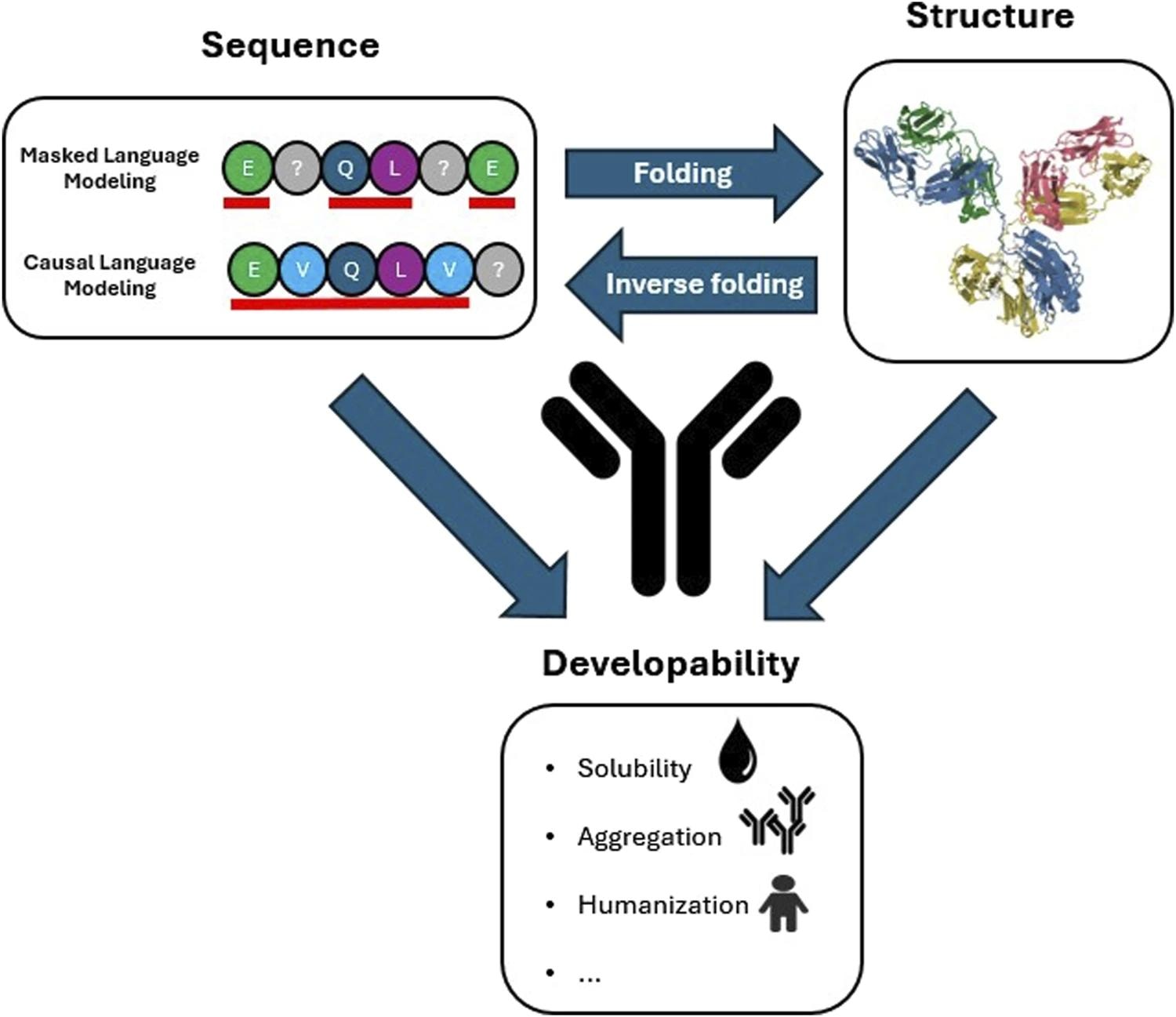 Artificial intelligence (AI) approaches are increasingly used in therapeutic antibody development to predict relationships between antibody sequence, three-dimensional structure, and developability attributes such as solubility, aggregation risk, and humanization. These computational methods enable earlier identification and optimization of promising antibody candidates before experimental validation. Imae credit: Santuari L et al., 2024.
In parallel, expression technologies are evolving beyond established mammalian systems. Although CHO cells are expected to remain the industry standard, engineered host cell lines with improved productivity, glycosylation profiles, and metabolic efficiency are being developed to expand antibody manufacturing capabilities. Genome-editing technologies such as CRISPR are expected to further improve CHO cell productivity, product quality, and manufacturing efficiency.5
Analytical characterization is becoming increasingly automated and data-driven. High-throughput mass spectrometry, automated glycan analysis, multi-attribute methods (MAM), and integrated digital workflows enable faster, more comprehensive characterization while facilitating more efficient process development.6,7,10
The expanding pipeline of bispecific antibodies, multispecific antibodies, antibody-drug conjugates (ADCs), nanobodies, and other engineered antibody formats is driving progress across antibody engineering, manufacturing, and analytical technologies. Although their structural complexity presents additional challenges, these next-generation therapeutics offer new opportunities to address diseases that remain difficult to treat with conventional mAbs.1,3,5
The future of therapeutic antibodies will increasingly depend on the convergence of antibody engineering, manufacturing, and analytical science, which together provide the foundation for translating increasingly complex antibody designs into safe, effective, and clinically reliable therapies.
References and Further Reading
- Lu RM, Hwang YC, Liu IJ, Lee CC, Tsai HZ, Li HJ, Wu HC. Development of therapeutic antibodies for the treatment of diseases. Journal of Biomedical Science. 2020;27:1. DOI:10.1186/s12929-019-0592-z, https://jbiomedsci.biomedcentral.com/articles/10.1186/s12929-019-0592-z.
- Zhang W, Wang H, Feng N, Li Y, Gu J, Wang Z. Developability assessment at early-stage discovery to enable development of antibody-derived therapeutics. Antibody Therapeutics. 2023;6(1):13–29. DOI:10.1093/abt/tbac029, https://academic.oup.com/abt/article/6/1/13/6962455.
- Xu WJ, Lin Y, Mi CL, Pang JY, Wang TY. Progress in fed-batch culture for recombinant protein production in CHO cells. Applied Microbiology and Biotechnology. 2023;107:1063–1075. DOI:10.1007/s00253-022-12342-x, https://link.springer.com/article/10.1007/s00253-022-12342-x.
- Liu HN, Dong WH, Lin Y, Zhang ZH, Wang TY. The effect of microRNA on the production of recombinant protein in CHO cells and its mechanism. Frontiers in Bioengineering and Biotechnology. 2022;10:832065. DOI:10.3389/fbioe.2022.832065, https://www.frontiersin.org/articles/10.3389/fbioe.2022.832065/full.
- Glinšek K, Bozovičar K, Bratkovič T. CRISPR technologies in Chinese hamster ovary cell line engineering. International Journal of Molecular Sciences. 2023;24:8144. DOI:10.3390/ijms24098144, https://www.mdpi.com/1422-0067/24/9/8144.
- Edwards E, Livanos M, Krueger A, Dell A, Haslam SM, Smales CM, Bracewell DG. Strategies to control therapeutic antibody glycosylation during bioprocessing: synthesis and separation. Biotechnology and Bioengineering. 2022;119:1343–1358. DOI:10.1002/bit.28066, https://onlinelibrary.wiley.com/doi/10.1002/bit.28066.
- Alhazmi HA, Albratty M. Analytical techniques for the characterization and quantification of monoclonal antibodies. Pharmaceuticals. 2023;16:291. DOI:10.3390/ph16020291, https://www.mdpi.com/1424-8247/16/2/291.
- Santuari L, Bachmann Salvy M, Xenarios I, Arpat B. AI-accelerated therapeutic antibody development: practical insights. Frontiers in Drug Discovery. 2024;4:1447867. DOI:10.3389/fddsv.2024.1447867, https://www.frontiersin.org/articles/10.3389/fddsv.2024.1447867/full.
- ter Horst JP, Turimella SL, Metsers F, Zwiers A. Implementation of Quality by Design (QbD) principles in regulatory dossiers of medicinal products in the European Union between 2014 and 2019. Therapeutic Innovation & Regulatory Science. 2021;55:583–590. DOI:10.1007/s43441-020-00254-9, https://link.springer.com/article/10.1007/s43441-020-00254-9.
- Gerzon G, Sheng Y, Kirkitadze M. Process Analytical Technologies - advances in bioprocess integration and future perspectives. Journal of Pharmaceutical and Biomedical Analysis. 2021;207:114379. DOI:10.1016/j.jpba.2021.114379, https://www.sciencedirect.com/science/article/pii/S0731708521006882.
- Schrieber SJ, Putnam WS, Chow ECY, Cieslak J, Zhuang Y, Martin SW, Hanson P, Maggio F, Rivera Rosado LA. Comparability considerations and challenges for expedited development programs for biological products. Drugs in R&D. 2020;20:301–306. DOI:10.1007/s40268-020-00321-4, https://link.springer.com/article/10.1007/s40268-020-00321-4.
- Noy-Porat T, Alcalay R, Mechaly A, Peretz E, Makdasi E, Rosenfeld R, Mazor O. Characterization of antibody-antigen interactions using biolayer interferometry. STAR Protocols. 2021;2:100836. DOI:10.1016/j.xpro.2021.100836, https://www.cell.com/star-protocols/fulltext/S2666-1667(21)00478-7.
Last Updated: Jul 30, 2026