Scientists for years have known that squids have cells with bundles of tiny, hair-like protrusions on their heads and arms like those buried deep inside the human ear that allow us to hear.
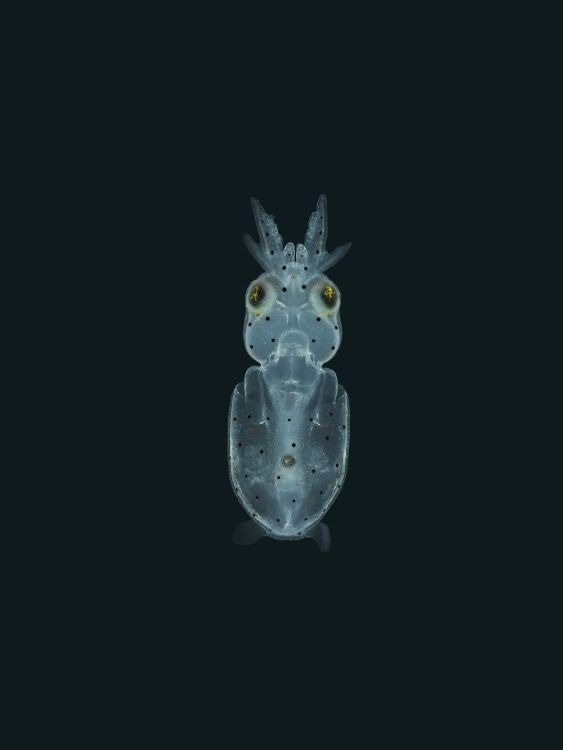 An image of a squid taken with light sheet microscopy at the Marine Biological Laboratory in Woods Hole, Massachusetts. Image Credit: Carsten Wolff
Now, researchers at Case Western Reserve University have discovered that these animals have hundreds more of these cells, called hair cells, lining the entire surface of their bodies.
The discovery may provide researchers an unprecedented window into how humans use-and lose-their hearing.
Squid are cephalopods with a diverse population of hair cells on the surface of their bodies, which may yield insights not only into how these fascinating animals detect water movement to survive, but also into how hearing and deafness occur in humans."
Brian McDermott, Associate Professor, Case Western Reserve School of Medicine
The findings appear in the current issue of Current Biology and include the first full-body mapping of lateral lines on squid, which are made up of arrays of hair cells.
McDermott's team, including Case Western Reserve graduate and undergraduate students, conducted part of its research at the Marine Biological Laboratory (MBL) in Woods Hole, Massachusetts, as part of a three-year fellowship program to study how squid hear. Carsten Wolff, associate director of Imaging Service and Imaging Scholar at MBL, worked with the CWRU team.
The team discovered the previously unknown hair cells using what is known as light sheet microscopy, a state-of-the-art imaging process that uses a laser to create a thin sheet of light, illuminating just one plane of the specimen at a time, and allowing researchers to build detailed 3D images while minimizing damage to the tissue.
In humans, sound vibrations travel to the cochlea, a snail-shaped organ in the inner ear lined with thousands of hair cells. Each hair cell has a bundle of tiny, hair-like projections called stereocilia. Bundles of these cilia are taller where low pitches are detected and shorter where high pitches are detected, which helps tune each cell to a particular frequency of sound.
The sound vibrations set the hair-like protrusions in motion. The hair cells, which are attached to the nervous system, send messages to the brain, where they are ultimately converted into meaningful sounds.
Sea creatures, including fish and cephalopods like squid and octopuses, have similar bundles of cilia on their bodies because their survival seems to require sensing different frequencies of water movement-similar to how the human ear detects pitches of sound. So the skin of the squid seems to act like a human ear, the researchers concluded.
The team's work indicates that, unlike fish lateral lines-which have hair bundles that do not vary in length-squid seem to regulate hair bundle length to tune their hair cells to different frequencies, much like the human ear. This makes squid a promising model for studying how human hearing works.
"Often, when a child is born deaf or a hearing person loses their hearing, it is the hair bundle that has been damaged," McDermott said. "So, studying the squid's hair bundle holds promise for understanding how hearing loss occurs."
 Researchers Propose Roadmap for Brain-Wide Lifetime Electrophysiology in Mammalian Models