Solar-induced chlorophyll fluorescence (SIF) is attractive because it can be monitored non-invasively from leaves to satellites, but its mechanistic link to photosynthesis remains uncertain under combined stress. Drought alters non-photochemical quenching (NPQ), the fraction of open PSII reaction centers (qL), stomatal conductance (gs), the maximum photochemical quantum yield of PSII (ΦPSIImax), and photorespiration. Fluctuating light adds rapid shifts in energy dissipation and carbon assimilation, creating temporal mismatches. These processes can weaken or break the relationship between fluorescence and carbon uptake, especially at the leaf scale. Given these challenges, deeper research is needed to determine when SIF reliably tracks photosynthesis and which physiological drivers cause decoupling under drought and fluctuating light.
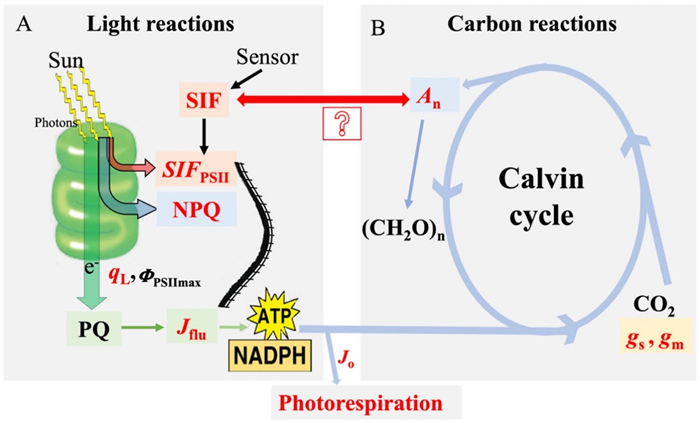
A simplified integrated framework for enhancing the understanding of the connection between chlorophyll fluorescence and photosynthesis. Photosynthesis consists of the light and carbon reactions. The light reactions generate reducing energy (ATP and NADPH), which is then used in the carbon reactions. A: The light reactions describe the possible fates of an absorbed photon, including photochemical quenching (PQ), non-photochemical quenching (NPQ), and chlorophyll fluorescence. Solar-induced chlorophyll fluorescence (SIF) refers to the chlorophyll fluorescence detected by a sensor, with SIFPSII specifically representing chlorophyll fluorescence from photosystem II. The fraction of open reaction centers in photosystem II (qL) and the maximum photochemical quantum yield (ΦPSIImax) are key limiting factors for the linear electron transport rate (Jflu). Jo refers to the electron transport rate attributable to oxygenative reactions of the active RuBisCO enzyme. B: The carbon reactions of photosynthesis focus on the processes that influence the final assimilation of CO2 into sugars. The CO2 concentration available for the Calvin cycle is regulated by stomatal conductance (gs) and mesophyll conductance (gm). Note that we assume gm to be infinite in our study. Image Credit: Plant Phenomics
Researchers at Nanjing Forestry University in China conducted the study, published (DOI: 10.1016/j.plaphae.2026.100187) in Plant Phenomics and Biochemistry in 2026. The team measured leaf-level SIF, gas exchange, and active fluorescence in Ginkgo biloba seedlings exposed to well-watered or drought conditions and to high and low light. They tested whether SIF can reliably infer photosynthesis when drought and fluctuating light occur together, and they analyzed the roles of gs, NPQ, qL, and ΦPSIImax. The study aimed to improve non-invasive phenotyping.
The study found a clear drought-induced decoupling. Photosynthesis was strongly suppressed, mainly because gs fell rapidly, limiting carbon dioxide (CO2) supply. Yet photosystem II (PSII)-emitted chlorophyll fluorescence (SIFPSII) decreased only slightly. This was driven by a stable fluorescence yield (ΦSIF), maintained by the interplay between NPQ and qL, and by the weak responsiveness of ΦSIF to changes in ΦPSIImax. Fluctuating light phases did not significantly alter this decoupling. However, when high- and low-light data were combined, SIFPSII and photosynthesis remained tightly coupled, likely because both respond to absorbed photosynthetically active radiation (APAR). The researchers also found that drought reduced the linear electron transport rate (Jflu) not through stronger NPQ, but through downregulation of ΦPSIImax. At the same time, photorespiration increased as an alternative electron sink. This coordinated response helped balance light and carbon reactions, protecting the photosynthetic apparatus while carbon assimilation declined. The ratio of net photosynthetic rate (An) to Jflu dropped under drought, and electron flow shifted toward oxygenation (Jo) and away from carboxylation (Jc). The authors conclude that apparent coupling under changing light can arise from shared light dependence rather than a direct mechanistic link.
The authors said the finding does not mean SIF is useless. Rather, they said, it means SIF needs context. “During early drought, stomatal closure can cut photosynthesis before fluorescence shows a comparable decline,” they said. “That is why SIF alone may miss the first signs of water stress. Pairing it with canopy temperature, which reflects transpiration, or with near-infrared reflectance of vegetation (NIRv), which helps separate structure from physiology, could make early stress detection much more reliable.”
The results have broad implications for plant phenotyping and remote sensing. SIF-based monitoring should not assume a universal link to photosynthesis. Instead, future models should integrate SIF with traits such as ΦPSIImax, photorespiration, gs, canopy temperature, and NIRv. Such multi-parameter approaches could distinguish light-driven changes from water-driven stress, improving early drought diagnostics. They could also support process-based models, including mechanistic light-reaction frameworks, that explicitly represent energy partitioning. For field and satellite applications, the study argues for caution when interpreting SIF alone and for combining complementary signals to make fluorescence-based stress monitoring more robust. Growers and breeders could use these combined signals to screen for drought resilience.
 Biomimetic Protein Scaffolds Enable Living Dentin Regeneration in Dental Cavities