A protein crucial for the human body in managing energy and regulating appetite depends on a partner protein, as indicated by recent research. These findings may assist researchers in gaining a deeper understanding of genetic obesity.

Image credit: ronstik/Shutterstock.com
In a study published in Science Signaling, an international team of researchers led by academics from the University of Birmingham examined the supportive function of a partner protein known as MRAP2 in relation to an appetite-regulating protein called MC3R, which determines whether the body stores or burns energy.
Prior research has demonstrated that MRAP2 plays a significant supportive role for a related protein (MC4R), which manages hunger, and this recent study aimed to investigate whether MRAP2 functions similarly for the structurally analogous protein MC4R.
Using cell models, the research team discovered that the presence of the MRAP2 protein, in a 1:1 ratio with MC3R, enhanced cellular signaling. These results indicate that this auxiliary protein may assist MC3R in fulfilling its function of regulating energy intake and expenditure. Additionally, the team pinpointed essential components of MRAP2 that are necessary for its role in supporting both MC3R and MC4R signaling.
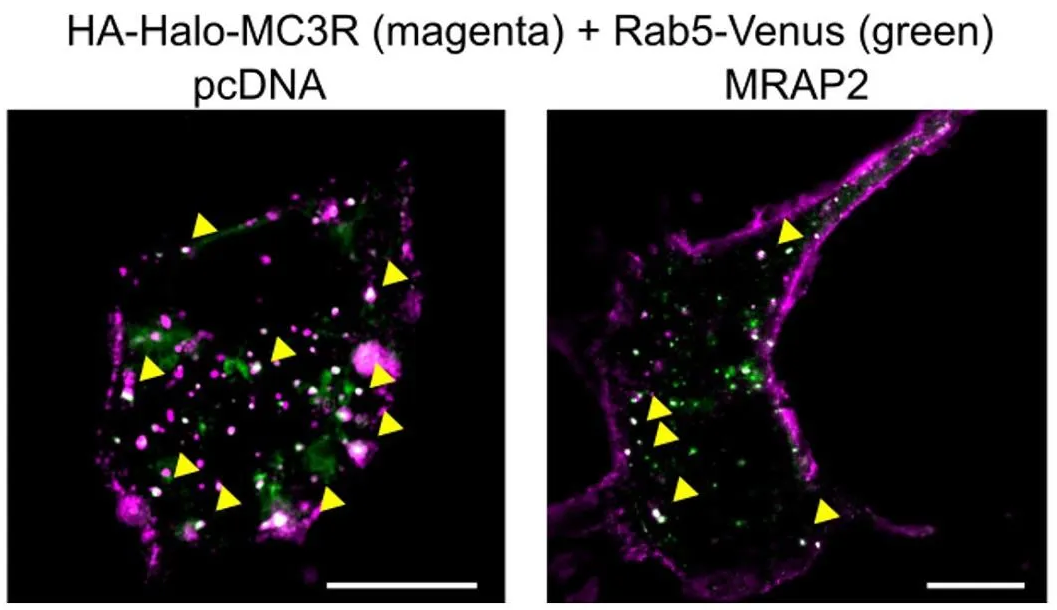
Microscopy image showing cells expressing MC3R (magenta) exposed to agonist. After 30 minutes MC3R should internalize (move away from cells surface) to Rab5 positive endosomes (seen as white dots in merge and some highlighted with arrows). In cells co-expressing MRAP2, MC3R internalization is reduced (fewer white dots), which means MC3R is at the cell surface for longer and can initiate more signaling. Image Credit: University of Birmingham
Subsequent analysis examined whether the same improved signaling effect was observed with MRAP2 in conjunction with genetic mutations found in certain individuals with obesity. The team determined that when mutated supporting proteins (MRAP2) were combined with MC3R, there was no improvement in the signaling of the appetite-regulating protein. These findings imply that mutations in the MRAP2 protein may hinder the normal operation of the hormonal system responsible for maintaining energy balance.
The findings give us some important insights into what’s going on in the hormonal system, related to some key functions like energy balance, appetite, and puberty timing. The identification of this protein, MRAP2, as a key aide or supporter to these essential appetite-regulating proteins also gives us new clues for people who have a genetic predisposition to obesity, and how MRAP2 mutations are a clear indication of risk.
Dr. Caroline Gorvin, Study Lead Author and Associate Professor, University of Birmingham
Gaining insight into the tools utilized by MRAP2 for signaling assistance will enable researchers to ascertain if drugs aimed at MRAP2 could enhance its capacity to modulate MC3R and MC4R. Such drugs may improve sensations of satiety, curb excessive eating, and optimize the body’s energy equilibrium, thereby facilitating weight loss that cannot be achieved through dieting alone.
Source:
Journal reference:
Jamaluddin, A., et al. (2025) The accessory protein MRAP2 directly interacts with melanocortin-3 receptor to enhance signaling. Science Signaling. DOI: 10.1126/scisignal.adu4315. https://www.science.org/doi/10.1126/scisignal.adu4315.
 Icosagen Develops Manufacturing-Ready CHO Cell Line for EPOK Therapeutics' Complex Tetravalent Antibody-Like Protein