One important area of the brain involved in memory formation and spatial orientation is the hippocampus. It helps people remember and expand upon their experiences by converting short-term memories into long-term ones.
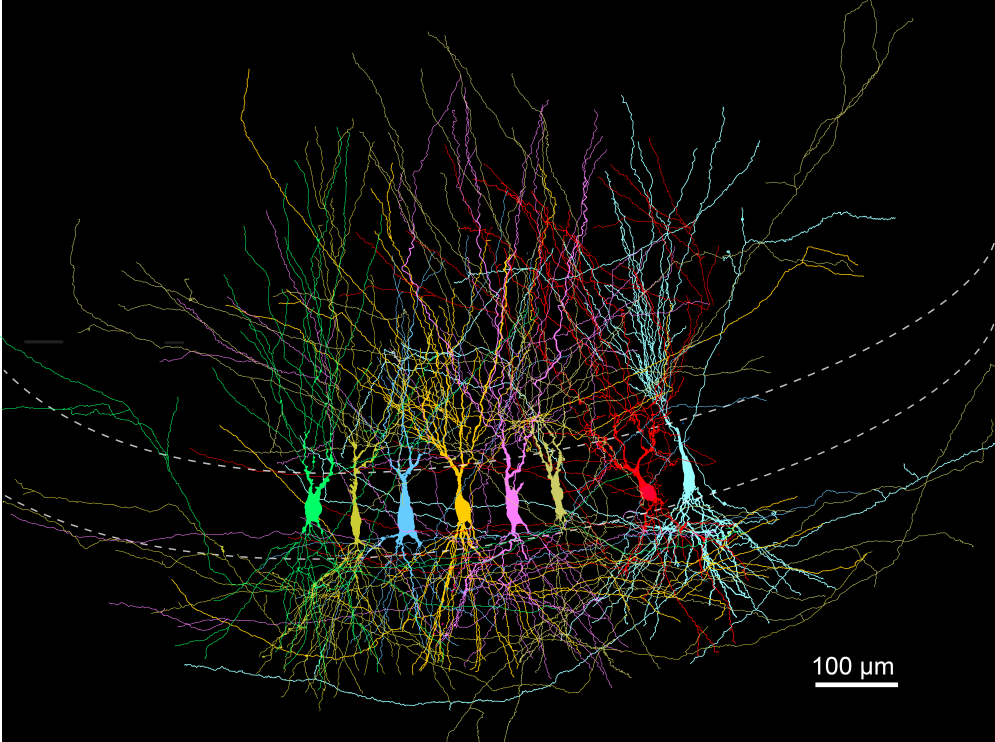 Collage of CA3 pyramidal neurons. Neurons filled with biocytin – a tracer that labels them during recording – are fixed and stained to allow full reconstruction of their shapes. Image Credit: ©Jose Guzman/Jonas group.
Researchers at the Institute of Science and Technology Austria (ISTA), under the direction of Magdalena Walz Professor for Life Sciences Peter Jonas, concentrate specifically on this region of the brain. Their most recent study, published in Nature Communications, sheds light on how the hippocampus's central neural network evolves after birth.
Consider a blank sheet of paper. With nothing on it, writing begins, gradually adding more information. This reflects the principle of tabula rasa – the “blank slate.”
In contrast, when the sheet already has markings, new information must either build upon or replace what is present. This represents tabula plena – the “full slate.”
At the core of this philosophical idea is a key question: Is everything predetermined from the outset, or do experiences shape what a person becomes?
Biology reflects this conflict, as well, between genes that supply the fundamental blueprint and environmental circumstances that shape the final organism.
This topic was specifically examined by neuroscientists in the Jonas group at the Institute of Science and Technology Austria (ISTA) in relation to the hippocampus, the part of the brain that creates memories and directs spatial navigation. They specifically inquired as to how the hippocampus network changes after birth. Is it related to tabula plena or tabula rasa?
First More, Then Less
The study concentrated on a network of interconnected CA3 pyramidal neurons in the central hippocampus. These cells use a mechanism called plasticity – the capacity of neurons to continuously alter, such as by altering their shape or strengthening or weakening their connections – to store and retrieve memories.
Victor Vargas-Barroso, an ISTA alumnus, studied mouse brains at three developmental periods for his project: early after birth (days 7–8), adolescence (days 18–25), and adulthood (days 45–50).
He used the patch-clamp method to examine the networks. This enables researchers to monitor minute electrical signals in certain regions of neurons, such as the branching sites that receive signals (dendrites) or the signal-sending ends (presynaptic terminals). Additionally, processes inside the cells were seen, and specific connections were precisely activated using laser-based techniques and sophisticated microscopy.
The CA3 network is extremely dense in the beginning, and the connections seem random. However, the arrangement changes as the animals become older; the network gets sparser but more organized and sophisticated.
This discovery was quite surprising. Intuitively, one might expect that a network grows and becomes denser over time. Here, we see the opposite. It follows what we call a pruning model: it starts out full, and then it becomes streamlined and optimized.
Peter Jonas, Magdalena Walz Professor for Life Sciences, Institute of Science and Technology Austria (ISTA)
An Efficient Network Thanks to Tabula Plena?
It is still unclear why this occurs. Jonas believes that an initially extensive network facilitates fast and effective neuronal connections, which is a significant benefit in the hippocampus. This area connects the dots between visual, smell, and auditory information.
That’s a complex task for neurons. An initially exuberant connectivity, followed by selective pruning, might be exactly what enables this integration.
Peter Jonas, Magdalena Walz Professor for Life Sciences, Institute of Science and Technology Austria (ISTA)
On the other hand, neurons would be too far apart and would have to "find" one another first if the network began as a genuine tabula rasa, with no prior connections, making effective communication all but impossible.
Source:
Journal reference:
Vargas-Barroso, V., et al. (2026) Developmental emergence of sparse and structured synaptic connectivity in the hippocampal CA3 memory circuit. Nature Communications. DOI: 10.1038/s41467-026-71914-x. https://www.nature.com/articles/s41467-026-71914-x.
 Study Challenges Traditional Nutrition Assumptions Regarding Equivalent Dietary Calorie Impacts