Swimming through the blood, sweat, cells, and tears of all humans are tiny proteins referred to as peptides. Numerous peptides have the ability to destroy bacteria upon contact, yet bacteria do not appear to develop resistance to them. Mass-produced peptides could serve as a novel class of antibiotics that evade resistance; however, working with peptides poses challenges. They tend to have a brief lifespan and are costly to produce.
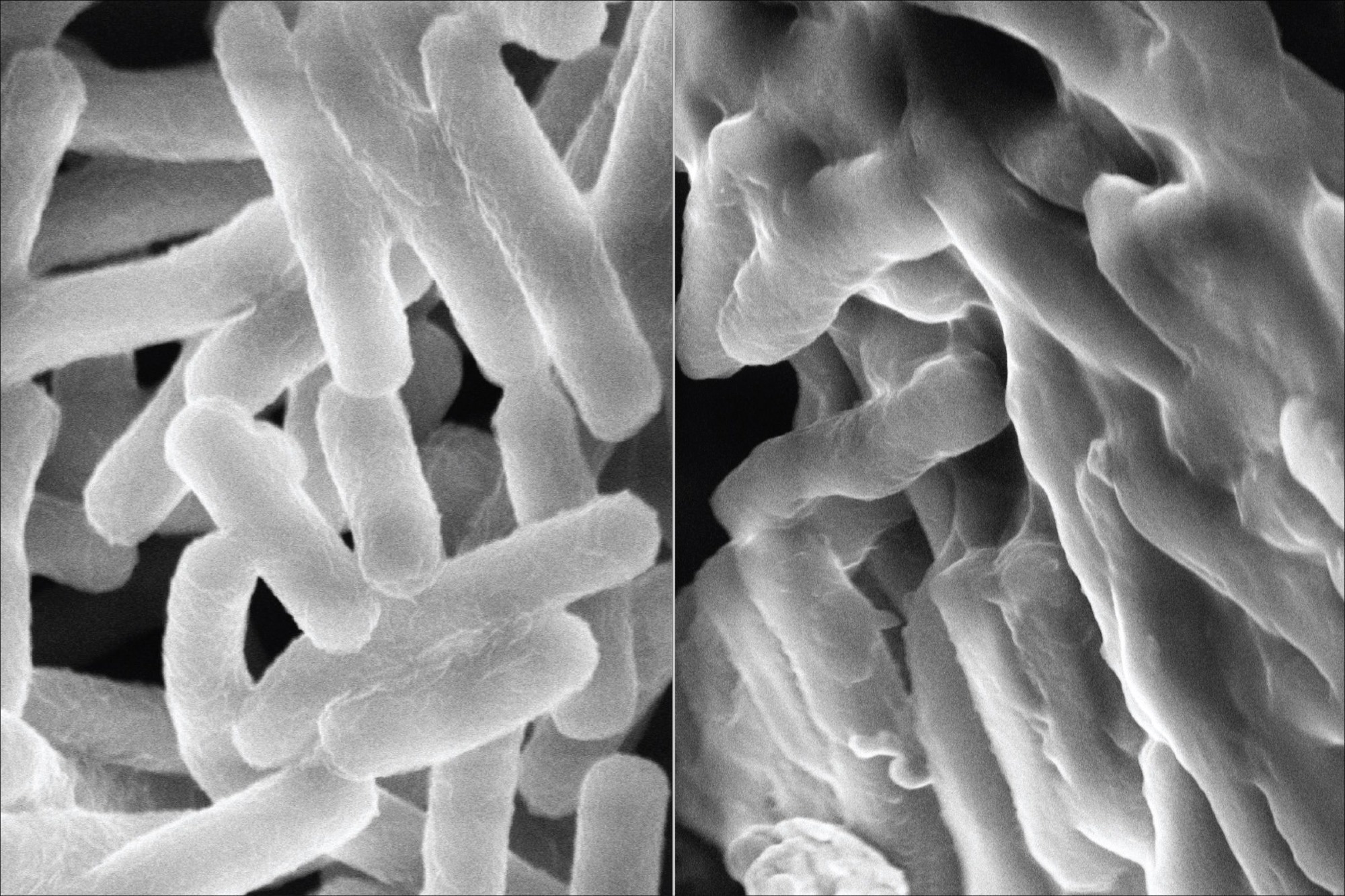 Left: Unperturbed bacteria. Right: Bacteria exhibiting damaged cell membranes after treatment with an antimicrobial polymer. Image Credit: Changxin Dong and Shoshana Williams
In a recent study, researchers at Stanford School of Engineering explain their development of an artificial intelligence model designed to examine millions of various molecules – specifically polymers – for candidates that replicate the methods employed by peptides in effectively eliminating bacteria.
These newly discovered polymers have the same ability as peptides to thwart or evade microbial resistance that significantly hinders many conventional antibiotics, offering optimism for the public health sector. Each year, millions of people worldwide die from infections caused by microbes that are resistant to or immune to currently available treatments.
Antimicrobial peptides are chemically able to get very close to and disrupt the cell membrane, killing the bacteria. Importantly, they don’t need to get inside the cell to work, like a typical drug would. Nor do they work on one specific protein or pathway, like drugs do.
Shoshana Williams, Former Graduate Student Chemist, Stanford Engineering
The key strategy for avoiding resistance is that these novel molecules use a physical mechanism, rather than a biochemical one, to target bacteria.
The peptides permeabilize the microbes … they literally rip holes in the cell membrane to kill them. It’s much harder for a bacterium to change the entire lipid structure of its membrane or the electrical charge of its surface than to learn to reject a chemical drug or turn off its narrow pathway.
Eric Appel, Study Senior Author and Professor, Materials Science, Stanford University
Uncertainty Principles
The researchers clarify that the novel chemicals are not synthetic peptides; instead, they are an entirely distinct class of molecules known as polymers. These elongated, chain-like structures are less complex and less costly to produce than peptides and are more stable, allowing worldwide distribution and access for communities with limited resources. Furthermore, Appel emphasized that polymers are exceptionally safe.
The researchers created a collection of 1.7 million possible polymer options to select from, an extensive quantity that would be impractical to examine by hand, so they approached the task using computational methods. They developed a novel model that predicts polymer chemical traits by analyzing chemical structures and identifying those with antimicrobial properties similar to peptides.
Here, the researchers encountered a problem that affects numerous fields within medical artificial intelligence: insufficient data. While extensive datasets exist for antimicrobial peptides, those for polymers are limited.
The dataset of antimicrobial polymers simply was nowhere near big enough. With a chemist’s intuition, however, we pivoted to train on the chemical properties of antimicrobial peptides first and applied that knowledge to the polymers. It worked!
Shoshana Williams, Former Graduate Student Chemist, Stanford Engineering
Leaps and Bounds
The team devised an innovative, somewhat unexpected strategy to address the data gap. It relied on the concept of uncertainty. Initially, they requested numerous models to forecast which polymers would perform best. However, rather than accepting the polymers endorsed by the majority of the models, the team focused exclusively on the areas where the models disagreed most.
“We figured that if you want to improve the models, it’s really a good space to feed in more actual experimental data,” Williams explained.
The team combined the 20 most contentious candidates, with certain models suggesting that the polymers would serve as outstanding antibiotics while others believed they would perform poorly. They then tested these candidates and fed the results back into the models to improve the polymer dataset.
“At this point, we had a much more robust system able to select the greatest hits from among the polymers in the library,” Williams added.
“The primary intellectual leap was training on the antimicrobial peptide data first and then to use that data to make predictions on the polymers, an entirely different class of molecules. There are thousands of peptides that have been evaluated where all of the chemical content is known. We just ‘featurized’ each one of those and connected them to standardized data outputs for the polymers,” Appel added.
Using their enhanced, more powerful AI tool, the team reduced the polymer candidates to a final ten, which they then synthesized and evaluated for antimicrobial activity. In examinations involving E. coli bacteria, all ten candidates exceeded anticipated outcomes, with one demonstrating exceptional efficacy against biofilms - an intricate form of microbial community that poses significant challenges for conventional antibiotic treatments.
These 10 candidates are among the most potent antimicrobial polymers ever reported, as far as I’m aware.
Shoshana Williams, Former Graduate Student Chemist, Stanford Engineering
Above and Beyond
In addition to showcasing a remarkable proof-of-concept for molecular design methodology, Appel and Williams believe that the system may be successful in creating drugs that target specific microbes. They primarily evaluated their technique on E. coli, which is categorized as a type of double-membraned microbe known as Gram-negative bacteria, a group that also encompasses Salmonella and cholera.
“We haven’t had a new class of antibiotics against Gram-negatives in decades,” Williams pointed out. But it also works against Gram-positive bacteria, like Staphylococcus aureus, as well.”
Appel can envision creating custom antibiotic polymers that target and eliminate only the specific strains of bacteria responsible for an infection, while preserving human tissue and good bacteria.
“We really do need better drugs,” Appel concluded. “This new process opens a promising path to identifying novel antibiotics that work in new and different ways to treat serious and complicated infections and combat resistance.”
Source:
Journal reference:
Williams, S. C., et al. (2026) Cross-molecular active learning for the discovery of antimicrobial polyacrylamides. Matter. DOI:10.1016/j.matt.2026.103026. https://www.cell.com/matter/fulltext/S2590-2385(26)00389-9.
 Researchers Identify Genetic Factors Enabling Deadly E. coli Strains to Infect