What are Peptide-Oligonucleotide Conjugates?
Why Targeted Nucleic Acid Drugs are Important
Toward Modular Targeted Therapeutic Platforms with POCs
Approaches and Tools Shaping the Field
Challenges and Toward the Future of POCs
References and Further Reading
Peptide–oligonucleotide conjugates are hybrid biomolecules that enhance the delivery and effectiveness of nucleic acid therapeutics by improving cellular uptake and targeting. Their modular design enables precise control over gene expression and offers a promising platform for next-generation precision medicine.
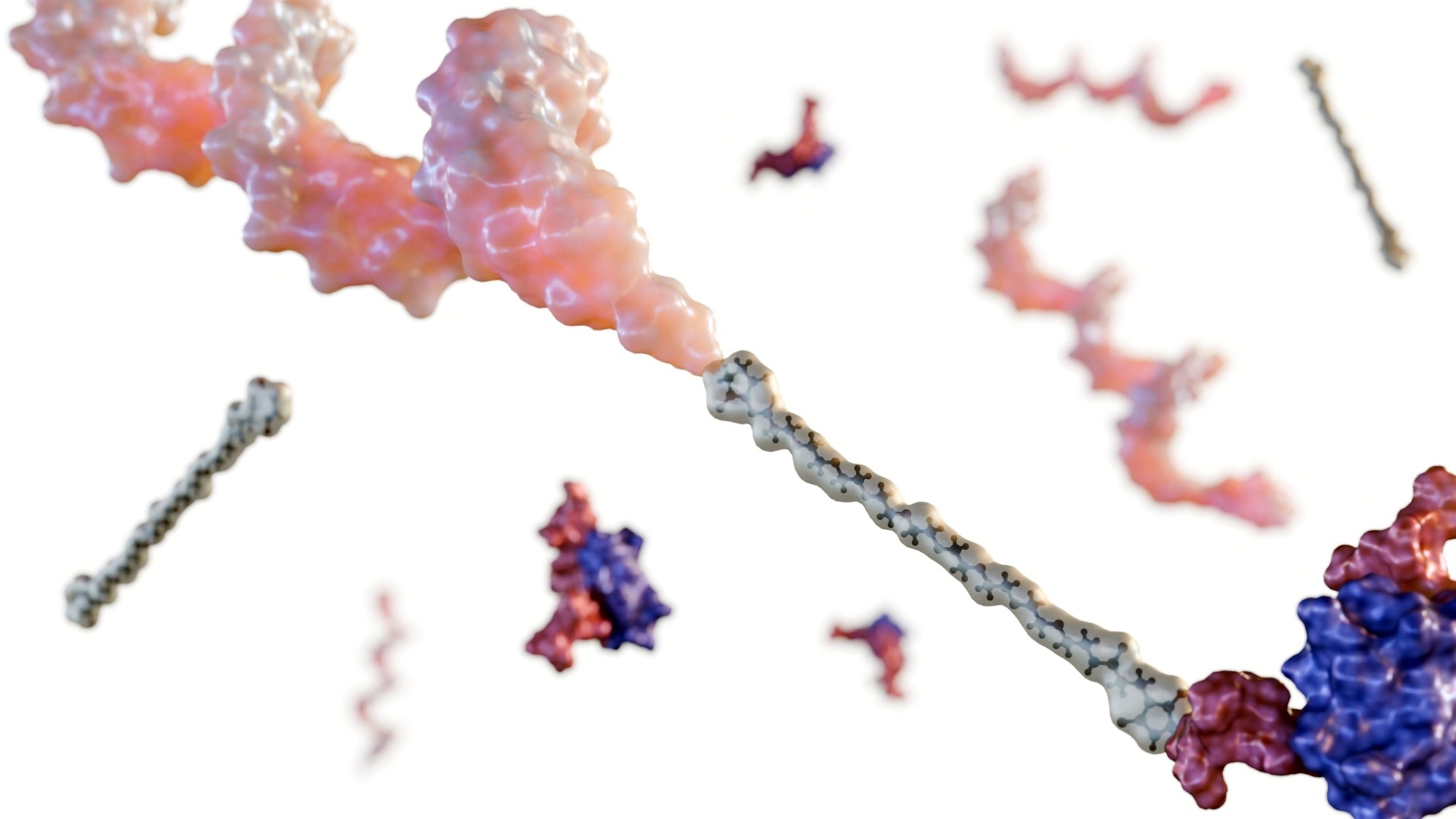 Image credit: Love Employee
Peptide-oligonucleotide conjugates (POCs) are emerging therapeutic tools for targeting genetic disease in patients. The potential for their use as smart, modular therapeutic platforms rather than simple drug carriers has been a focus of research in the field of nucleic acid drugs in recent years. This article will explore this exciting, emerging field of biomedical research.2
What are Peptide-Oligonucleotide Conjugates?
Peptide-oligonucleotide conjugates (POCs) are synthetic chimeric molecules that have emerged as a strategy to overcome the intrinsic delivery limitations of nucleic acid therapeutics, particularly their poor cellular uptake and bioavailability.2
These are chimeric compounds that combine both peptides and oligonucleotides, covalently bonded. Typically, a linear peptide residue and an oligonucleotide or oligonucleotide analog are covalently bonded, but sometimes a cyclical peptide residue is used. Cell-penetrating peptides (CPPs) are widely used in POCs, and typically contain fewer than 30 amino acids. CPPs are generally classified into cationic, amphipathic, and hydrophobic types, each influencing uptake mechanisms such as direct translocation or endocytosis. Many different CPPs have been designed for this therapeutic application.2
This combination of parent molecules gives a POC multiple benefits over conventional nucleic acid drug delivery platforms, combining the ability of nucleotides to alter gene expression and the functionality and bioavailability of the peptide components.1
POCs have their origins in research on antisense technology and the development of therapeutic oligonucleotides in the 1980s. Additionally, the discovery of cell-penetrating peptides in the 1990s has led to increased research interest in these innovative tools for drug delivery.1
How Does It Work? | Peptide-Oligonucleotide Conjugates
Video credit: WuXiAppTecOfficial/Youtube.com
Why Targeted Nucleic Acid Drugs are Important
Nucleic acid drugs such as antisense oligonucleotides, small interfering RNA (SiRNA), Messenger RNA (mRNA), and emerging classes of RNA-based tools are highly effective at telling cells what to do, but are generally very bad at getting to where they are needed in the cell and working efficiently once they arrive. This limitation is largely due to their size, polarity, and negative charge, which prevent passive diffusion across cellular membranes and necessitate active delivery strategies. They can, for instance, modulate gene expression with potential therapeutic benefits.2
However, because they are inefficient at targeting the specific areas where they are needed within human cells, there is a need for an approach that can carry out this function effectively. Targeted therapeutic approaches utilizing emerging tools and drug delivery platforms are a key area of research in precision medicine.
The genetic underpinnings of diseases such as non-alcoholic steatohepatitis (NASH), cancers, and cardiovascular diseases are highly complex. They can be influenced by multiple factors within a biological system, from the organ and tissue level to the microcellular level. This highlights the critical importance of developing drug delivery systems capable of precisely targeting specific tissues and modulating gene expression.1,3
Where a drug is targeted is extremely important; to be effective, the drug needs to elicit a specific biological response. The drug must bind to specific receptors on a cell surface or act within a specific location within the cell. If it does not bind to the correct location or compounds, such as enzymes, it may not elicit the correct response. More critically, undesirable side effects may occur, potentially causing harm to the patient.
Combining the precision of oligonucleotides with the potential of peptides for targeted drug delivery ensures that their cargo reaches the specific cell or tissue locale necessary for effective disease treatment. POCs are a highly effective, precise medicine-based approach to improving the quality of life for patients.
Peptides are highly efficient biological messengers, able to pass through membranes or bind to specific cell-surface receptors. They may mediate uptake either through receptor-mediated endocytosis or direct membrane translocation, depending on peptide design. By bonding peptides and oligonucleotides in this way, scientists can create modular delivery systems that combine functional excipients and drug compounds, forming a larger product that responds to individual patient needs.2
POCs are highly effective as modular therapeutic platforms as they are endlessly adaptable. It is easy to swap the peptide component, allowing the oligonucleotide to either evade the body’s immune system or even be targeted to a different tissue or cell.4
Additionally, the oligonucleotide component of the POC can be fine-tuned using chemical processes. These include backbone and sugar modifications (e.g., phosphorothioates, locked nucleic acids, or morpholino oligomers) that enhance nuclease resistance, binding affinity, and pharmacokinetics. This improves its potency, potential binding affinity, and enhances stability, making it a more effective drug. Essentially, this makes the POC a “plug-and-play” modular system, allowing it to respond efficiently to its environment and perform multiple functions.2
As with any emerging technology, new approaches and tools are constantly being researched and developed to make POCs more efficient, targeted, and modular therapeutic delivery systems.
Recent advancements in this field have focused on improving the therapeutic delivery, cellular uptake, and stability of POCs. One proposed approach is to use receptor-mediated delivery of POCs. This approach uses conjugation with ligands that bind plasma-membrane surface receptors to enhance endocytosis and internalisation, and can help improve the trafficking of cargo through endosomes.
One example of this approach is the conjugation of oligonucleotides with GaINAc. Uptake of oligonucleotides into hepatocytic cells can be improved through binding to ASGPR. This flagship approach has garnered much interest, and scientists are exploring a range of receptor-mediated approaches and moieties.2
In the wider peptide-drug conjugate field, there has been some interest in using machine learning to enhance the discovery of drug and therapeutic delivery systems. One example in this area is PDCNet, which employs a multi-level feature fusion framework and curated datasets. This framework integrates peptide sequences, linker chemistry, and payload features to predict biological activity, demonstrating strong performance metrics like high AUC and predictive robustness. This approach could accelerate the design of effective POCs for a range of diseases.5
Challenges and Toward the Future of POCs
It should be noted that, whilst POCs show significant promise, most have only reached the clinical trial phase and several challenges persist. Cationic CPPs, for instance, can be toxic at high therapeutic doses, and endosomal escape is a key hurdle. Intracellular vesicles can trap the oligonucleotide after entry into the cell. Efficient endosomal escape remains a major bottleneck to achieving therapeutic activity, as oligonucleotides must reach the cytosol or nucleus to function. Significant engineering challenges must be overcome for industrial-scale manufacture of POCs.2,4
Furthermore, there is no single synthesis method for POCs. There is a wide variety of physicochemical properties in CPPs, so synthesis is typically required for each version. Current strategies include stepwise solid-phase synthesis and post-synthetic conjugation using chemistries such as click reactions, disulfide formation, and amide coupling. This makes producing effective POCs highly complex, expensive, and time-consuming.2
Despite these challenges, POCs and other approaches, such as lipid-oligonucleotide conjugates, have the potential to revolutionize the delivery of personalized nucleic acid therapeutics, providing highly effective modular treatment options that improve the quality of life for patients worldwide.
References and Further Reading
- Klabenkova, K et al. (2021) Chemistry of Peptide-Oligonucleotide Conjugates: A Review Molecules 6:26(17):5240 DOI:10.3390/molecules26175240, https://www.mdpi.com/1420-3049/26/17/5240 [online] PubMed Central. Available at: https://pmc.ncbi.nlm.nih.gov/articles/PMC8434111/ (Accessed on 11 February 2026)
- Malinowska, A.L et al. (2024) Peptide-Oligonucleotide Conjugation: Chemistry and Therapeutic Applications Curr Issues Mol Biol. 30:46(10) pp. 11031-11047 DOI:10.3390/cimb46100695, https://www.mdpi.com/1467-3045/46/10/695 [online] PubMed. Available at: https://www.natahub.org/application/files/1217/2770/5196/Peptide_Oligonucleotide_Conjugation_Chemistry_and_Therapeutic_Applications.pdf (Accessed on 11 February 2026)
- AstraZeneca (2023) Targeting the genetic drivers of disease with nucleotide-based therapeutics [online] Available at: https://www.astrazeneca.com/r-d/next-generation-therapeutics/nucleotide-based-therapeutics.html (Accessed on 11 February 2026)
- Fletcher, J & Thorpe, C (2026) Peptide Oligonucleotide Conjugates – Why the Excitement? [online] CatSci. Available at: https://catsci.com/library/peptide-oligonucleotide-conjugates-explained/ (Accessed on 11 February 2026)
- Liu, Y et al. (2025) PDCNet: a benchmark and general deep learning framework for activity prediction of peptide-drug conjugates [online] Cornell University. Available at: https://arxiv.org/abs/2506.12821 (Accessed on 11 February 2026)
Last Updated: May 1, 2026