Driven by ongoing environmental issues caused by plastics, biodegradable plastics synthesized by microorganisms and naturally decomposed are drawing significant interest. If carbon dioxide (CO2) also serves as a raw material for creating these plastics, it could aid in diminishing the dependence on petroleum resources while more efficiently utilizing released CO2.
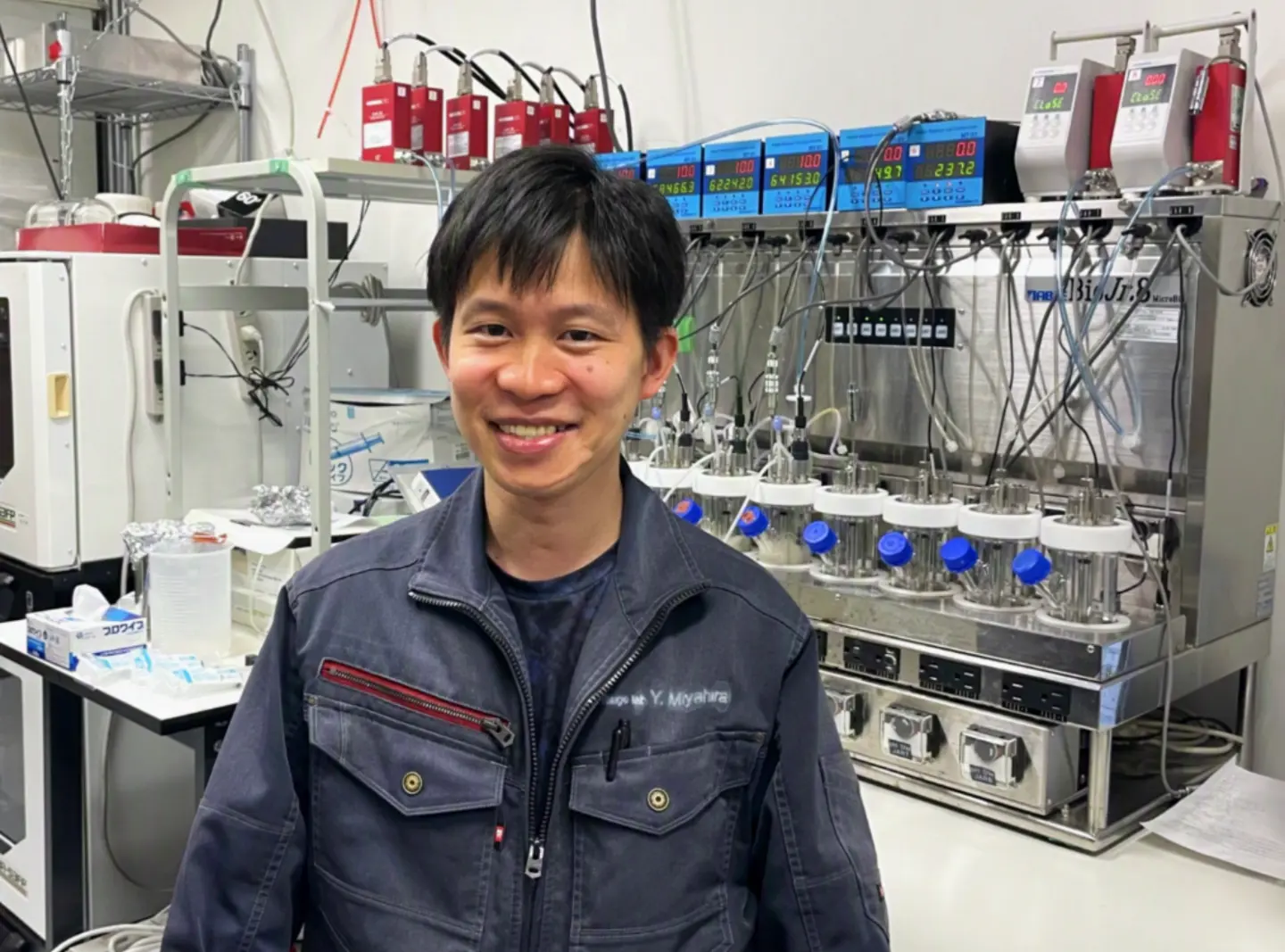 Specially Appointed Assistant Professor Yuki Miyahara. Image Credit: Institute of Science Tokyo.
A bacterium known for producing such biodegradable plastics is Ralstonia eutropha, a hydrogen-oxidizing bacterium. It acquires energy from hydrogen, absorbs CO2, and accumulates poly(3-hydroxybutyrate) or P(3HB) within its cells. For the bacterium, P(3HB) stores carbon and energy while also serving as a biodegradable plastic.
Using this bacterium could offer a way to manufacture plastics without relying on petroleum. Traditional cultivation techniques utilize elevated hydrogen concentrations, posing an explosion hazard. A research group led by Specially Appointed Assistant Professor Yuki Miyahara and Professor Takeharu Tsuge at the Institute of Science Tokyo (Science Tokyo) earlier devised a safer cultivation approach that keeps hydrogen levels below the flammable threshold.
It remained unclear how much CO2 to provide for efficient P(3HB) generation in these safer, reduced-hydrogen environments. Consequently, the investigators examined how varying CO2 levels affected bacterial growth and P(3HB) production.
They also concentrated on an enzyme named carbonic anhydrase. When the bacterium utilizes CO2, this enzyme assists in transforming CO2 into a state more easily assimilated within the cell. Prior research had presented contradictory findings on whether increasing this enzyme's quantity might enhance P(3HB) output, prompting the team to explore this question as well.
Why this Matters
Scientists cultivated the bacteria across three distinct CO2 levels – high, medium, and low – to assess both microbial proliferation and P(3HB) synthesis.
This finding was unanticipated. The microorganisms demonstrated enhanced growth and greater P(3HB) output in the low- CO2 environment compared to the high-CO2 environment. The P(3HB) quantity generated, in proportion to the CO2 provided, was roughly 11.8 times higher in the low- CO2 condition than in the high- CO2 condition.
Next, the researchers increased the quantity of carbonic anhydrase synthesized by the bacterium. Although this did not significantly alter bacterial cell dry weight post-cultivation, P(3HB) content rose from 77% to 81% of the cell's dry weight. In other words, the cells did not grow considerably more; instead, P(3HB) made up a larger percentage of their dry mass.
Significantly, this outcome was observed solely when CO2 concentrations were low. With abundant CO2, increasing enzyme quantity made little difference.
The bacteria themselves synthesized elevated levels of carbonic anhydrase in low- CO2 settings. This indicates that when CO2 is restricted, the bacterium enhances its inherent capability to optimize the utilization of available CO2. Increasing enzyme levels further may then improve P(3HB) production.
What’s Next
The current results imply that bacteria can effectively utilize carbon dioxide and generate biodegradable plastic, even under conditions of low CO2 concentration. Moving forward, exhaust gas with minimal CO2 content could potentially serve as a direct raw material, bypassing any initial CO2 concentration step. This offers a way to use CO2 that would otherwise be emitted.
The current investigation employed a small-scale cultivation setup. Before implementing this technique for large-scale manufacturing, researchers must assess its performance when substantial volumes of exhaust gas are supplied consistently and reliably.
Furthermore, the exact reason elevated CO2 concentrations reduce the effectiveness of P(3HB) synthesis remains unclear. The group intends to examine bacterial metabolic processes more thoroughly and to explore synthesis utilizing actual industrial exhaust streams.
Because CO2 is the raw material, we expected that supplying more of it would be better. Instead, we found the opposite: lower CO2 concentrations led to more efficient production of biodegradable plastic. It was also fascinating to see that the microorganisms themselves strengthened their ability to make efficient use of limited CO2.
Yuki Miyahara, Specially Appointed Assistant Professor, School of Materials and Chemical Technology, Institute of Science Tokyo
Yuki Miyahara adds, “Going forward, I would like to find ways to draw out even more of the microorganisms’ natural capabilities and use CO2 as a raw material to produce environmentally friendly plastics and other useful substances.”
 Research Identifies Microorganisms That Convert Precursors Into Testosterone