From DNA Sample to Sequencing Reads
How Are DNA Fragments Reassembled?
Checking and Refining a Reconstructed Genome
The Move Toward Complete Genomes
References and Further Reading
Genome reconstruction involves sequencing technologies, computational assembly algorithms, and scaffolding methods to reconstruct DNA sequences into increasingly complete genomes. Assembly quality assessment, haplotype phasing, and advances toward telomere-to-telomere assemblies are central to improving genome accuracy and completeness.
 Image credit: Lia Koltyrina/Shutterstock.com
Although an organism’s genome consists of long, continuous DNA molecules organized into chromosomes, sequencing technologies generally read DNA in smaller fragments rather than as complete chromosomes. Reconstructing the genome therefore requires computational methods to determine how these overlapping sequence reads fit together and establish their correct order. This process, known as genome reconstruction or genome assembly, provides a foundation for studying genetic variation, genome organization, evolution, and disease.1
Genome reconstruction can broadly follow two approaches: reference-guided and de novo assembly. Reference-guided assembly uses an existing genome to help guide the reconstruction of newly generated sequence data. In contrast, de novo assembly reconstructs a genome directly from sequencing reads without relying on an existing reference. This makes de novo assembly particularly valuable when a suitable reference genome is unavailable or when researchers want to capture genomic regions and structural variants that may be poorly represented in an existing reference.2
From DNA Sample to Sequencing Reads
Genome reconstruction begins with extracting DNA from a biological sample and sequencing it to generate reads representing different regions of the genome. How successfully these reads can be assembled depends on several interconnected factors. Longer, more accurate reads provide greater genomic context and reduce uncertainty in the reconstructed sequence, while sufficient sequencing depth increases the likelihood that genomic regions are adequately represented among the reads. Genome complexity also matters, as repetitive and structurally complex regions can make it more difficult to determine how individual reads fit together.3
These factors help explain the different strengths and limitations of short- and long-read sequencing. Short-read technologies generate large numbers of highly accurate reads at high sequencing depth, but their limited length can make repetitive and structurally complex regions difficult to reconstruct. When a read falls entirely within a long repeat, there may be insufficient sequence context to determine where it belongs in the genome. Long reads reduce some of this ambiguity by spanning repetitive regions and extending into surrounding sequences, providing additional context for assembly. Historically, however, long-read sequencing was limited by higher error rates, and achieving comparable sequencing depth required substantially more sequencing effort and cost.2,3
Recent advances in long-read sequencing are helping address some of the earlier limitations in read accuracy and performance. Two widely used approaches, PacBio HiFi and Oxford Nanopore Technologies (ONT), achieve long-read sequencing in different ways. PacBio HiFi improves accuracy by sequencing the same DNA template multiple times and combining the resulting subreads into a consensus sequence. This combination of read length and accuracy helps researchers reconstruct repetitive and other difficult-to-assemble genomic regions. ONT, meanwhile, can generate long and ultra-long reads that extend beyond 100 kb. Their exceptional length allows them to span large repeats and structural variants that can be difficult to reconstruct from shorter reads. Together, these advances are enabling increasingly contiguous and more complete genome assemblies.3
How Oxford Nanopore sequencing works
Video credit: OxfordNanoporeTechnologies/Youtube.com
How Are DNA Fragments Reassembled?
Once sequencing reads have been generated, researchers use genome assembly algorithms to determine how the reads fit together to reconstruct the original DNA sequence. The underlying principle is that reads originating from neighboring regions of the genome contain shared sequence information. By identifying these relationships, assembly algorithms can reconstruct longer continuous sequences known as contigs.4
To manage the millions of possible relationships between reads, assemblers represent them as assembly graphs, computational maps that show how different sequences may connect based on shared sequence information. Two major graph-based approaches are overlap graphs and de Bruijn graphs. In an overlap graph, reads are connected when the end of one overlaps with the beginning of another. Some assemblers represent these same read-overlap relationships using a string graph, an alternative formulation of the overlap graph. De Bruijn graphs work differently by breaking reads into shorter sequences called k-mers and connecting those that overlap. In both cases, the graph provides a framework for resolving sequence relationships and reconstructing longer continuous regions of the genome.4
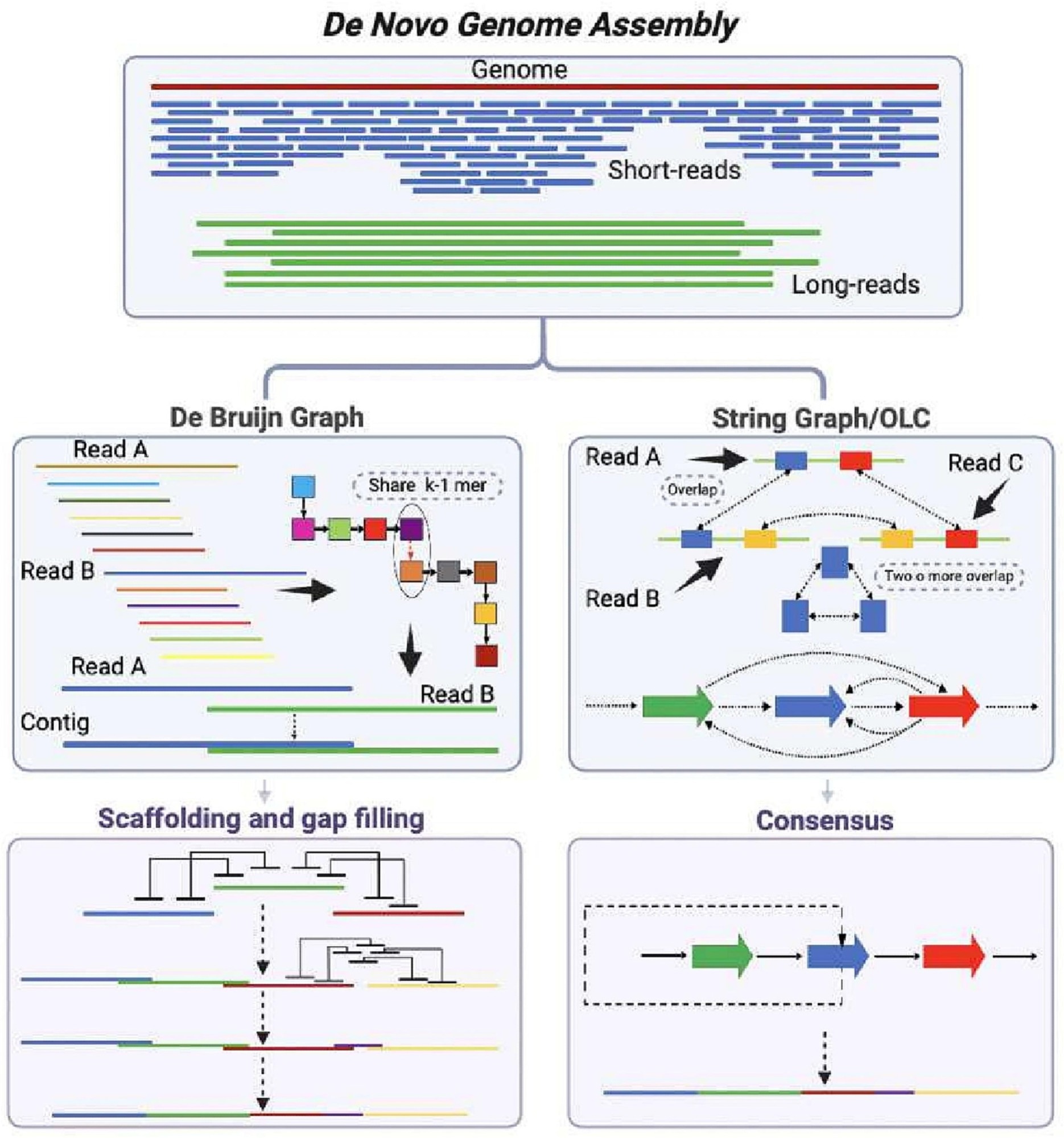 Overview of de novo genome assembly, illustrating how sequencing reads are processed using graph-based assembly approaches to reconstruct longer genomic sequences. Image credit: Espinosa et al. (2024).3
Even after assembly, individual contigs may represent only portions of a chromosome, leaving gaps between sequences whose relative positions are still unknown. Scaffolding is the process of linking these separate contigs into larger structures, known as scaffolds, by determining their relative order and orientation. Additional long-range information can help establish these relationships.
One source of the long-range information needed for this process is Hi-C, a sequencing-based technique that captures DNA regions that are physically close together within chromosomes. These contact patterns can help researchers determine which contigs belong together and how they should be arranged. This helps transform fragmented assemblies into increasingly complete, chromosome-scale sequences.5
Checking and Refining a Reconstructed Genome
Producing an initial assembly is not the end of genome reconstruction. The resulting sequence may still contain residual base-level errors, which can be corrected through polishing, a process that uses supporting sequencing data to improve the accuracy of the assembled sequence. Once refined, the assembly must still be rigorously evaluated for accuracy, completeness, continuity, and possible misassemblies.4
Assembly quality is assessed from several complementary perspectives. Continuity describes how fragmented an assembly remains, and is often measured using N50, the sequence length at which 50% of the total assembly length is contained in contigs of that length or longer. Completeness asks a different question: whether the reconstructed genome contains the sequences expected to be present. Tools such as BUSCO assess this by searching for conserved single-copy orthologous genes that should normally be found in the genome. Consensus accuracy, in turn, looks at whether the individual bases within the reconstructed sequence are correct. Read-based and k-mer-based analyses can help identify bases or sequences that are not adequately supported by the original sequencing data.4
For diploid organisms, which carry two copies of each chromosome, researchers must also consider whether the two inherited versions have been reconstructed correctly. This process, known as haplotype phasing, aims to separate genetic variants belonging to each parental chromosome into their respective sequences. Phasing accuracy can then be evaluated, for example, using parent-specific k-mers when parental sequencing data are available.4
Because each measure captures a different aspect of assembly quality, researchers typically use several complementary evaluation methods. Reference-based approaches compare the reconstructed genome with an existing high-quality assembly, while reference-free approaches can assess it against the underlying sequencing data. Together, these methods provide a more comprehensive assessment and can reveal errors that any single metric may miss.4
The Move Toward Complete Genomes
Genome reconstruction is increasingly moving toward chromosome-scale and telomere-to-telomere (T2T) assemblies, which aim to reconstruct chromosomes continuously from one end to the other. Unlike chromosome-scale scaffolds, which may still contain gaps, T2T assemblies seek to reconstruct an entire chromosome as a continuous sequence. Repetitive regions, including centromeres and segmental duplications, have historically been difficult to assemble, while distinguishing the two parental haplotypes in diploid genomes presents an additional challenge.4
Modern approaches combine accurate long and ultra-long reads with long-range information to resolve difficult repeats, phase haplotypes, and support chromosome-scale reconstruction. Together, these technologies are helping researchers access genomic regions that were previously difficult to reconstruct.4
As genome assemblies become more complete, they can improve the detection of structural variation and provide deeper insights into evolution, biodiversity, and disease-associated variation. High-quality assemblies from multiple individuals are also supporting the development of pangenomes, which represent genomic diversity more broadly than a single reference genome. These advances are moving genome reconstruction toward a more complete and representative view of genomic diversity.1,6
References and Further Reading
- Logsdon, G. A., Vollger, M. R. & Eichler, E. E. Long-read human genome sequencing and its applications. Nat. Rev. Genet. 21, 597–614 (2020). DOI:10.1038/s41576-020-0236-x, https://www.nature.com/articles/s41576-020-0236-x
- Mahmoud, M., Agustinho, D. P. & Sedlazeck, F. J. A Hitchhiker’s Guide to long-read genomic analysis. Genome Res. 35, 545–558 (2025). DOI:10.1101/gr.279723.124, https://genome.cshlp.org/content/35/4/545
- Espinosa, E., Bautista, R., Larrosa, R. & Plata, O. Advancements in long-read genome sequencing technologies and algorithms. Genomics 116, 110842 (2024). DOI:10.1016/j.ygeno.2024.110842, https://www.sciencedirect.com/science/article/pii/S0888754324000429
- Li, H. & Durbin, R. Genome assembly in the telomere-to-telomere era. Nat. Rev. Genet. 25, 658–670 (2024). DOI:10.1038/s41576-024-00718-w, https://www.nature.com/articles/s41576-024-00718-w
- Jiang, L. et al. The Bioinformatic Applications of Hi-C and Linked Reads. Genomics Proteomics Bioinformatics 22, qzae048 (2024). DOI:10.1093/gpbjnl/qzae048, https://academic.oup.com/gpb/article/22/4/qzae048
- Liao, W.-W. et al. A draft human pangenome reference. Nature 617, 312–324 (2023). DOI:10.1038/s41586-023-05896-x, https://www.nature.com/articles/s41586-023-05896-x
Last Updated: Oct 12, 2026