Carterra®, a leading provider of high-throughput surface plasmon resonance (HT-SPR™) platforms for antibody and small molecule drug discovery, today highlighted the role of its LSA-XT platform in new research from Google DeepMind published in Nature. The paper, “Function-preserving watermarking of AI-generated proteins” introduces SynthIDBio, a family of methods for embedding provenance signatures in AI-designed protein sequences and AI-predicted structures. Google DeepMind scientists collaborated with Adaptyv Bio, which used Carterra HT-SPR technology to measure whether the watermarked proteins still bind their targets as well as unmarked designs.
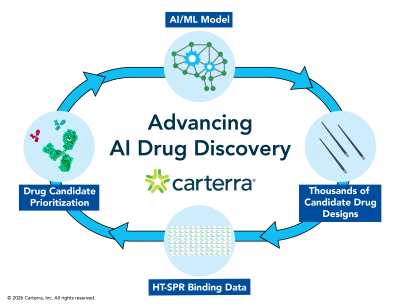 ‘Lab-in-the-loop’ workflow. Image Credit: Carterra, Inc.
Proving that Function Survives
For a watermark to be useful in biology, the protein must still bind its target. That can only be confirmed in the lab. Researchers measured the binding kinetics and affinities of hundreds of AI-designed proteins against three therapeutically relevant targets: the SARS-CoV-2 receptor binding domain, VEGF-A, and PD-L1. The study also describes SynthIDBio-structure, a finely tuned version of AlphaFold 3 that embeds an imperceptible watermark in predicted biomolecular structures with negligible loss of accuracy. This proof of concept has potentially meaningful applications in biosecurity and scientific integrity.
Another AI Leader Needs Binding Data
Google DeepMind joins a growing list of AI leaders, including Anthropic, whose work depends on experimental binding data to confirm designs and to train the next generation of models. In AI drug discovery, algorithms propose candidate proteins and antibodies in days, which moves the bottleneck from design to experimental validation. The emerging answer is “Lab-in-the-Loop” (LitL): AI models generate candidates, high-throughput experiments test them, and the resulting data feeds back to sharpen the next round of designs.
Carterra’s HT-SPR platforms sit at the center of that loop. Combining proprietary microfluidics with real-time HT-SPR, they deliver up to 100 times the throughput of traditional label-free platforms while using a fraction of the sample, producing the kinetics and affinity data that tell researchers whether a design works and teach models how to do better. Industry analysts have taken notice. A July 2026 Leerink Partners report named Carterra a core enabler of the roughly $7 billion Lab-in-the-Loop market, and William Blair analysts have identified Carterra as a winner in life science tools for AI drug discovery. Carterra’s technology also underpins collaborations such as Twist Bioscience’s work with AWS Biodiscovery and Anthropic’s autonomous protein design study.
“Adaptyv's role is to turn AI-designed proteins into real experimental data, quickly and at scale,” said Julian Englert, CEO and co-founder of Adaptyv Bio. “We use Carterra's HT-SPR for campaigns like this across hundreds of designs. It gives us real binding kinetics and affinity data, not just a yes/no answer – which is what lets the AI model learn and improve the next round of designs.”
Investing to Keep Pace with AI
Carterra continues to expand its platform to meet the demands of AI-driven discovery. The Carterra Vega™, launched in February 2026 as the industry’s first 48-channel HT-SPR system, enables primary screening of more than 20,000 small molecule interactions per day. Carterra also announced recently a collaboration with AstraZeneca “to develop hardware and software aimed at advancing lab-in-the-loop drug discovery.”
When Google DeepMind, Anthropic, and other leaders in AI all need the same thing – high-quality binding data at scale – it says a lot about where drug discovery is headed.The impact of our technology in this new era is driving explosive growth for Carterra, but just as important, we are helping advance the field of AI drug discovery by supplying the all-important data layer.”
Tim Germann, Chief Commercial Officer, Carterra
 Study Identifies Single Hydrophobic Hotspot Driving Tau Protein Misfolding Propagation