Bolting time is a critical agronomic trait in Brassica campestris. Once the plant shifts from producing edible leaves to flowering, leaf production ceases, leading to rapid deterioration of yield and quality. While factors such as photoperiod, temperature, and hormones are known to influence this process, the underlying genetic architecture remains incompletely understood. Domestication has produced substantial variation in bolting time across accessions, yet the key genes targeted by selection and their regulatory mechanisms have largely eluded identification. Due to these challenges, there is a pressing need for in-depth investigation into the molecular regulators that control bolting time and the genetic variations that underpin this domestication trait.
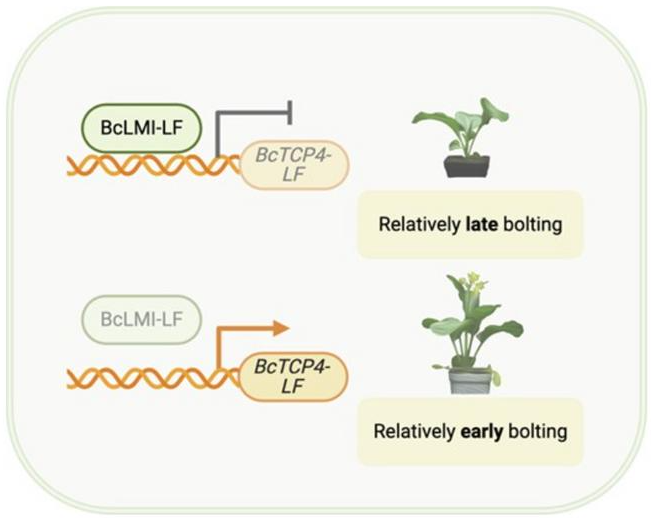 Schematic model of the BcLMI1–BcTCP4 regulatory pathway involved in bolting time in B. campestris. BcLMI1-LF represses BcTCP4-LF expression by directly binding to its promoter, thereby delaying bolting. When this repression is released, BcTCP4-LF is upregulated, leading to relatively early bolting. Image Credit: Horticulture Research
A team led by researchers at Zhejiang University’s College of Agriculture and Biotechnology reports (DOI: 10.1093/hr/uhag157) these findings on April 17, 2026, in Horticulture Research, a journal published by Oxford University Press on behalf of Nanjing Agricultural University. The study integrates selective-sweep analysis of 365 resequenced B. campestris accessions with genome-wide association studies (GWAS) to pinpoint BcLMI1 (LATE MERISTEM IDENTITY 1)-LF as a key candidate regulator of bolting time, and further validates its function through transgenic experiments and molecular assays.
The researchers categorized 365 accessions into early- and late-bolting groups and performed selective-sweep analysis using three complementary methods–FST, π, and XP-CLR–identifying over 1,500 overlapping candidate genes. GWAS further narrowed the focus to two core genes, with BcLMI1-LF emerging as a particularly compelling target. Haplotype analysis revealed that haplotype 3 (Hap3) of BcLMI1-LF is predominantly distributed north of the Yangtze River and is strongly associated with late bolting. Overexpression of BcLMI1-LF-Hap3 in B. campestris significantly delayed bolting and produced visible leaf lobe phenotypes. Strikingly, suppressing BcTCP4 (TEOSINTE BRANCHED 1/CYCLOIDEA/PCF 4)-LF–a conserved bolting regulator–recapitulated the same delayed-bolting and leaf-lobing effects. Yeast one-hybrid, dual-luciferase, and chromatin immunoprecipitation (ChIP)-qPCR assays confirmed that BcLMI1-LF-Hap3 directly binds to the BcTCP4-LF promoter and represses its transcription. This positions BcLMI1 as an upstream master regulator that acts through BcTCP4 to coordinate both developmental timing and leaf morphology.
“We were surprised to find that a class I HD-ZIP transcription factor–typically known for its roles in meristem identity–actually functions as a repressor of bolting by shutting down a TCP gene,” the authors said. “This flips the conventional view that TCPs are the primary drivers of flowering time. Instead, it suggests a hierarchical network where HD-ZIP genes sit at the top, potentially integrating environmental signals like photoperiod and hormones to fine-tune the transition from leaves to flowers.” They added that the strong selection signatures at the BcLMI1 locus provide compelling evidence that this regulatory axis was actively shaped by domestication.
The discovery offers immediate molecular targets for breeding late-bolting Brassica crops–a priority as climate change introduces greater temperature fluctuations that can trigger premature flowering. Because BcLMI1-LF-Hap3 overexpression delays bolting without compromising leaf development, the haplotype could be introduced into elite cultivars through marker-assisted selection or gene editing. Moreover, the finding that BcTCP4-LF suppression recapitulates the late-bolting phenotype suggests that modulating either gene in the pathway could achieve similar results. The study also provides a blueprint for dissecting complex domestication traits: using population-level selection signals to prioritize candidate regulators, then dissecting their downstream networks through functional genomics.
 Single-Molecule Optical Tweezers Visualize Real-Time Dynamic Protein and DNA Interactions