Researchers found that blocking USP15 disrupted ovarian cancer cell division, slowed metastatic tumor growth in mice, and made cancer cells more sensitive to chemotherapy, revealing a potential new way to tackle treatment resistance.
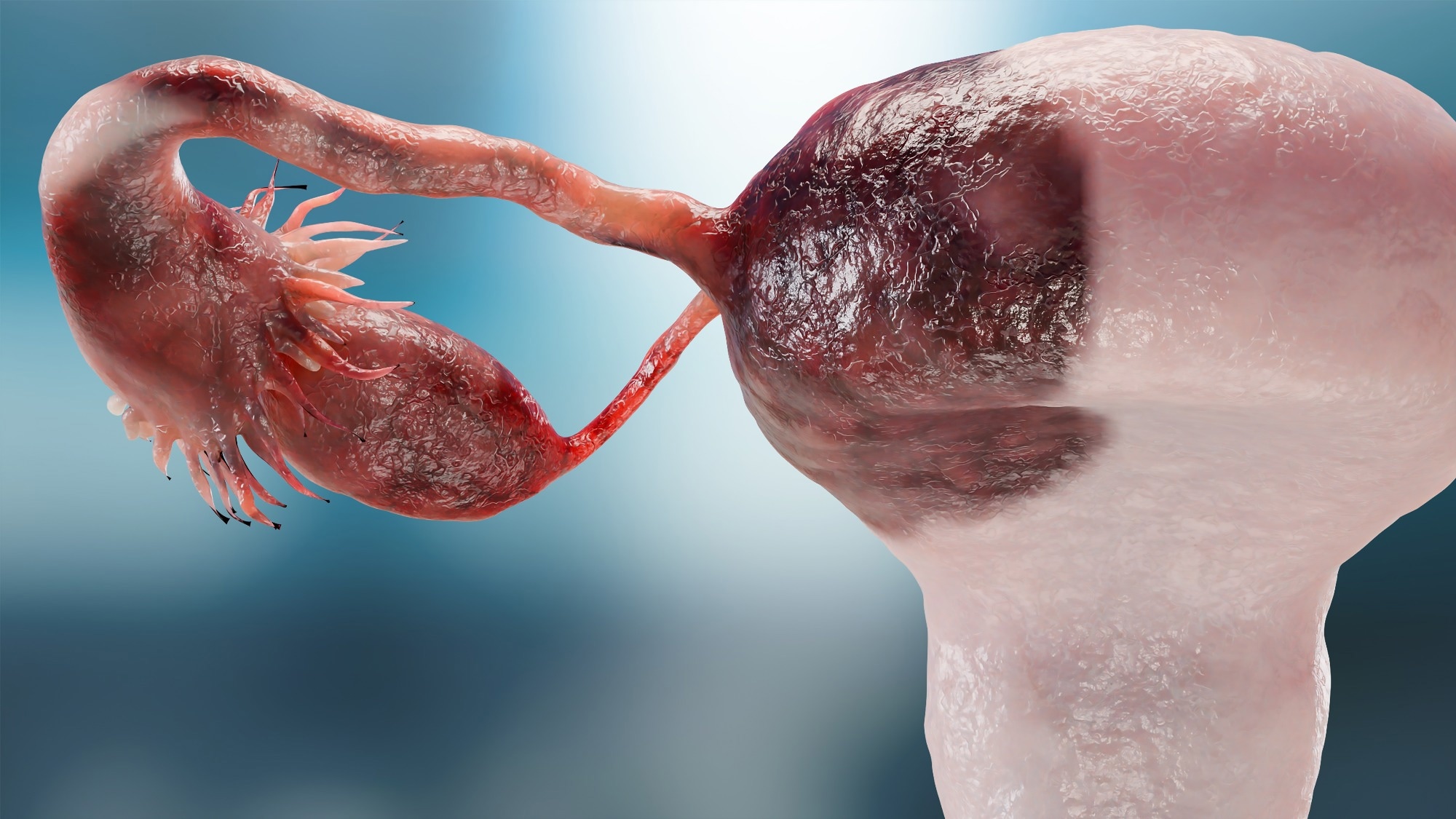 Study: USP15 regulates mitotic fidelity, metastatic potential, and chemotherapeutic response in ovarian cancer cells. Image credit: ALIOUI Mohammed Elamine7/Shutterstock.com
A majority of ovarian cancer cases are diagnosed after the disease has already spread, which leaves patients with fewer treatment options and a bleak prognosis. In a recent study published in Molecular Therapy Oncology, researchers identified an enzyme called ubiquitin-specific peptidase 15 that may help drive ovarian cancer progression and resistance to chemotherapy.
Late diagnosis leaves ovarian cancer harder to treat
More than 70% of ovarian cancer cases are diagnosed after the cancer has already spread, largely because reliable early biomarkers are lacking and symptoms are often not apparent in the early stages. Treatment options after detection consist of a combination of surgery and platinum and taxane drugs. Most patients respond initially, but over 85% relapse within six months, and the returning tumors develop chemoresistance. The survival at five years for metastatic disease is under 30%.
Identifying the molecular mechanisms that drive the aggressive metastasis observed in ovarian cancer cases, and determining the factors that contribute to chemoresistance is essential to improve the prognosis for ovarian cancer patients. One potential molecule being extensively studied is ubiquitin-specific peptidase 15 (USP15), a deubiquitinase enzyme that is elevated in several cancers and stabilizes proteins that support tumor growth, though its role in ovarian tumor progression and drug response remains largely unknown.
Gene silencing reveals USP15’s role in cancer cells
In the present study, the team first analyzed publicly available clinical datasets to compare USP15 gene activity in normal ovarian tissue, ovarian tumors, and metastatic tumors, and to relate USP15 levels to progression-free survival in patients. They then used short hairpin ribonucleic acids (shRNA), which are small genetic tools that dial down a gene, to reduce USP15 in six ovarian cancer cell lines and in immortalized fallopian tube secretory epithelial cells, modeling the cell type from which high-grade serous ovarian cancer is thought to originate.
The researchers measured cell viability and growth and, to confirm that the effects came from USP15 loss, restored an shRNA-resistant version of the gene in two cell lines. They also treated five cell lines with the inhibitor USP15-IN-1, while overexpressing USP15 in other ovarian cancer cells (OVCA420).
They examined cell-cycle behavior using Ki67 and phospho-histone H3 staining, propidium iodide flow cytometry, and immunofluorescence for Cyclin B1 protein levels. The researchers also conducted RNA sequencing and western blot analysis to detect proteins tied to deoxyribonucleic acid (DNA) damage, chromosome segregation, cell cycle arrests, and apoptosis. They also used various assays to study metastatic behavior.
Finally, the team assessed whether USP15 knockdown or inhibition altered sensitivity to paclitaxel, carboplatin, doxorubicin, and an experimental inhibitor of the DNA-damage-response kinase ATM. They also examined patient data on chemotherapy response in relation to USP15 levels.
Blocking USP15 disrupts cancer growth and cell division
The study implicated USP15 in ovarian cancer cell survival, proliferation, and metastatic potential, and reducing its activity also made the cancer cells more vulnerable to chemotherapy. USP15 levels were highest in metastatic tumors, and higher USP15 levels were also associated with shorter progression-free survival.
However, knocking down USP15 was found to sharply reduce viability and proliferation in all six ovarian cancer cell lines and in fallopian tube cells, while noncancerous HEK293T cells used as a control were unaffected. Furthermore, restoring an shRNA-resistant copy of the gene reversed the decline, and the inhibitor USP15-IN-1 produced a similar decrease in viability, highlighting the role of USP15 in cell proliferation.
Cells lacking USP15 stalled at the G2-M checkpoint, which controls whether cells with replicated DNA proceed into mitosis. The researchers found that in these cells, Cyclin B1 accumulated and stayed in the cytoplasm, while serine/threonine-protein kinase (PLK1) declined, a pattern consistent with DNA damage checkpoint activation. Additionally, the levels of other proteins that support accurate chromosome separation, such as KIF15 and TOP2A, also decreased. Cells developed anaphase bridges, chromatin strands that can break and damage DNA. The cells also showed signs of apoptosis, including increased Annexin V staining and cleaved caspase-3 and reduced levels of the anti-apoptotic protein BCL2.
Cells with less USP15 produced more E-cadherin, an epithelial marker, and less MMP2 and MMP9, which are enzymes that remodel surrounding tissue. These cells also exhibited reduced migration and invasion. In mice, tumor burden was lower and median survival reached 300 days with USP15 knockdown cells, compared with 87 days for controls.
Furthermore, the paclitaxel dose needed to halve viability also decreased to less than 1 nanomolar with USP15 knockdown, compared to more than 14 nanomolar in controls. Sensitivity to carboplatin, doxorubicin, and the ATM inhibitor also increased, and among patients treated with taxane- and platinum-based chemotherapy, higher tumor USP15 expression was associated with poorer progression-free survival.
However, the authors noted that the evidence remains preclinical, based on cell lines and mice, and researchers still need to determine whether USP15 can be inhibited selectively and safely enough to provide a useful therapeutic window.
Preclinical findings point to USP15 as treatment target
In summary, the study identified USP15 as a protein that promotes ovarian cancer cell growth, metastatic potential, and drug resistance in laboratory and animal models. Reducing USP15 levels or attenuating its activity disrupted chromosome separation, caused DNA damage, activated programmed cell death, and improved responses to standard drugs. The authors concluded that USP15 could serve as a therapeutic target for ovarian cancer, though selective inhibitors and safety in healthy tissue still required further investigation before clinical use could be considered.
Reference
Ogunsanya, A., Alfaran, F., Amadu, O. N., & Padmanabhan, A. (2026). USP15 regulates mitotic fidelity, metastatic potential, and chemotherapeutic response in ovarian cancer cells. Molecular Therapy Oncology, 34(3). DOI:10.1016/j.omton.2026.201329 https://www.cell.com/molecular-therapy-family/oncology/fulltext/S2950-3299(26)00205-5
 Post-Translational Modification Crosstalk Regulates Oncogenic Protein Stability and Activity