Scientists at LSU’s Pennington Biomedical Research Center have pinpointed a neural mechanism that may explain how pregnancy influences the desire to pursue certain highly appealing foods. Dr. Yanlin He led this joint research effort, along with Dr. Pingwen Xu of the University of Illinois Chicago and Dr. Chunmei Wang of Baylor College of Medicine.
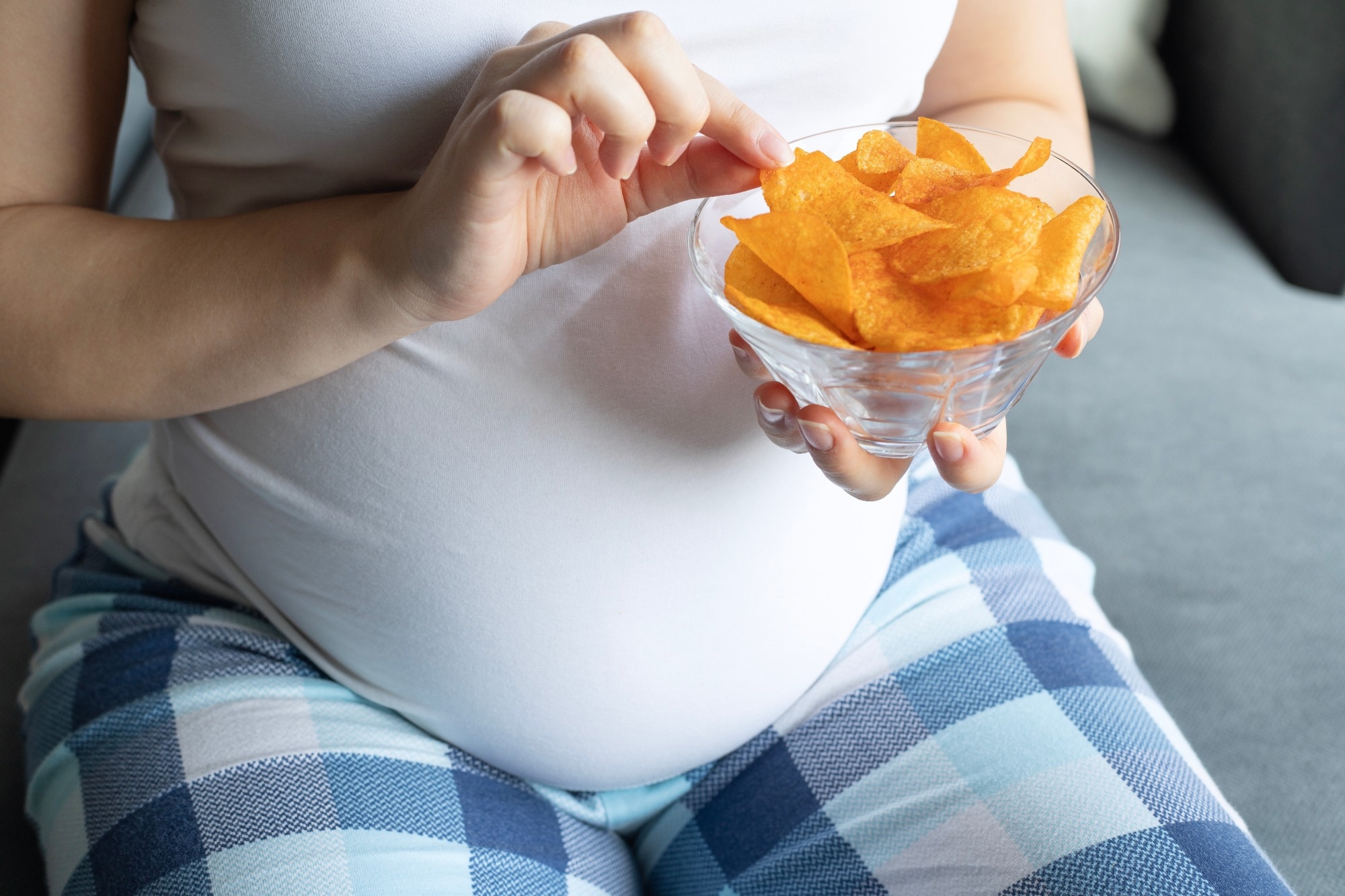 Image Credit: Hazal Ak/Shutterstock.com
Researchers investigated how pregnancy affects neurons that produce serotonin in a brain area called the dorsal raphe nucleus. They found that during pregnancy, these neurons show decreased activity, leading to increased food craving behaviors in animal studies.
The researchers observed that SK3 potassium ion channel function in serotonin-producing neurons increases during pregnancy. SK3 plays a crucial role in determining whether these neurons become active, and its heightened activity was associated with a decline in serotonin neuron activity in the dorsal raphe nucleus. Subsequent tests assessed whether SK3 caused this change.
Removing SK3 from these serotonin-producing neurons halted the pregnancy-linked decline in neuronal activity and significantly reduced behaviors resembling cravings for food. In contrast, increasing SK3 activity in non-pregnant females altered neuronal activity and food-seeking behaviors in ways similar to those seen during pregnancy.
The research team also identified a neural pathway linking serotonin neurons in the dorsal raphe nucleus to the ventral tegmental area, a brain region associated with reward and motivation. Stimulating this pathway reduced food-craving-like behaviors in pregnant animals, whereas blocking it increased such behaviors in non-pregnant animals.
The findings suggest that during pregnancy, SK3 activity increases, leading to decreased serotonin neuron activity and altered signaling within a brain circuit related to rewards. This study builds on earlier research indicating that changes in the brain's reward system are involved in cravings for food during pregnancy.
The discovery could ultimately improve understanding of why some women experience strong food cravings and excessive weight gain during pregnancy. However, the findings are currently based in animal model studies, so we caution that directly manipulating serotonin during pregnancy could carry risks.
Dr. Yanlin He, Director, Brain Glycemic and Metabolism Control Laboratory, Pennington Biomedical Research Center
Dr. He added, “Further research is needed to determine how pregnancy-related hormonal and other physiological changes influence SK3 activity and serotonin signaling. More importantly, we hope to gather additional evidence from human clinical studies at PBRC to determine whether these findings can be translated to the prevention of maternal obesity.”
Source:
Journal reference:
Zhao, Q., et al. (2026) Serotonin neurons in the dorsal raphe control food-craving-like behavior during pregnancy in mice. Nature Neuroscience. DOI:10.1038/s41593-026-02445-3. https://www.nature.com/articles/s41593-026-02445-3.
 Researchers Propose Roadmap for Brain-Wide Lifetime Electrophysiology in Mammalian Models