A respiratory condition that leaves the lungs irreversibly scarred is claiming almost 4,000 Australian lives every year, with an alarming number of cases caused by workplace exposures in industries such as mining, farming and construction.
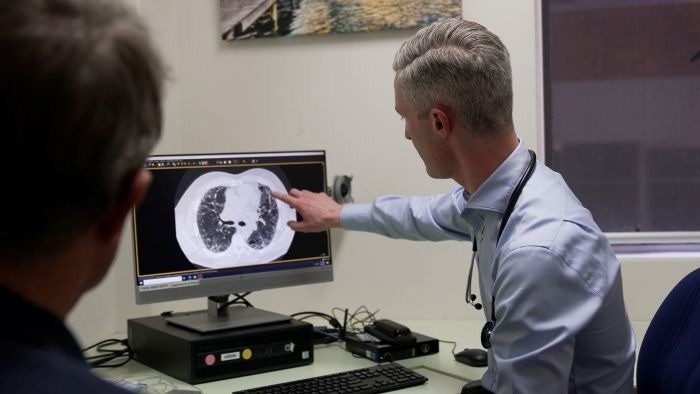 Doctor revealing the impact of lug scarring to a pulmonary fibrosis patient. Image Credit: Boehringer Ingelheim
Launched in Canberra today, the Burden of Pulmonary Fibrosis: Hard Truths of Lung Scarring in Australia report found that nearly 22,000 Australians are now living with irreversible and progressive lung scarring, significantly more than previous estimates.
Known medically as pulmonary fibrosis, lung scarring is an incurable condition where the lungs gradually stiffen, leading to worsening breathlessness, breathing difficulty, declining lung function and disability. Nearly half of all cases prove fatal within five years of diagnosis.
While the causes of lung scarring are diverse and often hard to determine, the new report reveals 21 percent of cases are due to workplace exposure to hazardous dusts, vapors and chemicals in industries such as mining, farming, construction, and even hairdressing.
The report found that last year alone, almost 1,600 Australians were diagnosed with irreversible lung scarring linked to occupational exposures. It projects that by 2030, almost 1,000 Australians will die annually from lung scarring related to workplace exposure.
In Australia, one-in-five stonemasons and 10 percent of tunnel construction workers are expected to develop silicosis, a form of lung scarring. Airborne particles that can cause lung scarring when inhaled are often used in employment sectors as diverse as hairdressing and farming.
“While the banning of silica in engineered stone and a national registry for dust diseases is a strong start, more action is needed to reduce the risk of exposure-related lung scarring,” said report contributor and respiratory physician from the University of Queensland, Professor Dan Chambers.
“This is a terrible disease, where a person’s lungs feel heavy and rigid, like they’ve been set in concrete, and the breathlessness feels like suffocating from the inside,” he said.
Despite claiming the lives of thousands of Australians, lung scarring is under recognized and under resourced with significant gaps in prevention, detection and treatment. The lack of awareness and understanding of lung scarring as a public health issue is concerning, especially given the report’s projection that the number of Australians living with the condition will exceed 25,000 by 2030 – a 55 percent rise since 2016. Clearly, more needs to be done to limit exposure to hazardous dusts, improve early and accurate diagnosis and end a ten-year new treatment drought for the growing number of Australians with irreversibly scarred lungs.”
Dan Chambers, Professor and Respiratory Physician, University of Queensland
Mark Brooke, Lung Foundation Australia CEO, said that “until now, the overall picture of lung scarring and its impact on individuals, society and the health system had been unclear.”
Mr Brooke explained that for most cases of lung scarring, there is no known cause. “For others, doctors point to hazardous vapors, air pollution and smoking, medical conditions such as scleroderma and rheumatoid arthritis where the immune system mistakenly attacks itself, as well as lung injury caused by certain medications,” he said.
“Once scarring occurs, the lung can’t be repaired. Medication can slow the disease but can’t stop its progression, and while lung transplantation is the only way to prevent an early death only a fraction of patients with lung scarring are eligible for a transplant.”
“This report must act as a wake-up call to improve prevention, as well as bolster detection and treatment of this terminal illness.”
Mr Brooke reiterated Lung Foundation of Australia calls to transition the Federal Government’s National Lung Cancer Screening Program into an integrated, multi-disease lung screening initiative.
Research shows that approximately 8-10 percent of lung cancer screenings reveal lung abnormalities that indicate early lung scarring.
Dr Rolf Gomes, Founder of Heart of Australia, the mobile health organization undertaking lung screening in rural communities in Queensland and New South Wales, said that “one-in-five cases of lung scarring occurs in rural and remote areas, where those affected face significant barriers to accessing specialist care”.
“The more lungs we examine, the more people we find with signs of lung scarring, especially in farming and mining communities where exposure to hazardous dusts, vapors and chemicals can be high,” he said.
“We know that many Australians with lung scarring wait years for a diagnosis and face delays in accessing specialist care, particularly in regional areas. Heart of Australia is helping to bridge the gap in access to diagnostic testing, which must be a central element of a coordinated national response.”
The report calculates the cost of irreversible lung scarring to the Australian economy and healthcare system at $4.2 billion annually.
Key recommendations presented in the report include:
- Prioritizing research funding for pulmonary fibrosis.
- Expanded access to comprehensive, multidisciplinary care.
- Faster access through the PBS to next-generation medicines that slow disease progression with few side effects.
Commissioned by Boehringer Ingelheim Australia, the report was developed by HTAnalysts with the support of Lung Foundation Australia, the Centre of Research Excellence in Pulmonary Fibrosis and Heart of Australia.
 Novel Molecular Pathway Identified to Combat T-Cell Exhaustion in Cancer