Stentor coeruleus, a single-celled organism approximately one millimeter long, seems to have a startling, unique ability. Because of its trumpet-like form, this little organism, sometimes called the "platypus" of microbes, appears to have a clear preference for corners.
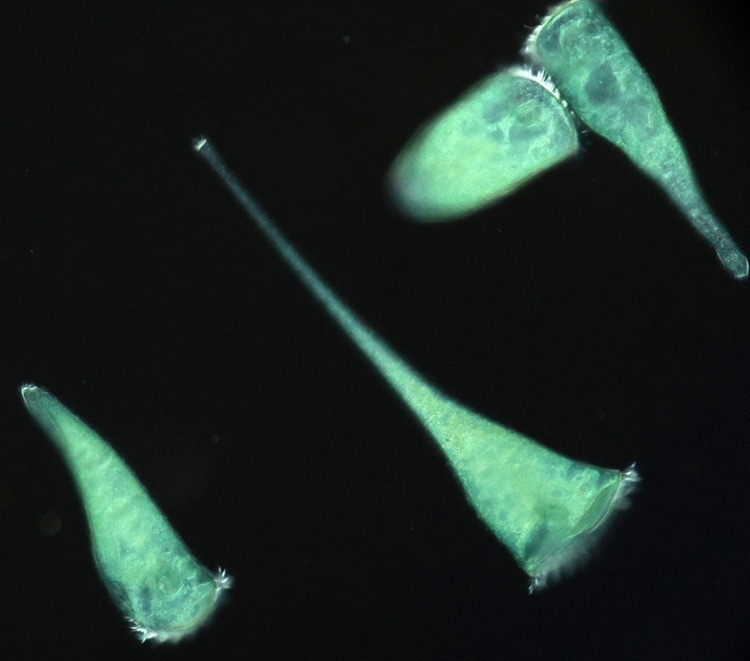 Stentor coeruleus. Image Credit: Laboratory of Physical Ethology, Hokkaido University
Maintaining protists is challenging because it requires a very careful balance of culture medium and nutrient conditions.
Syun Echigoya, Assistant Professor, Hokkaido University
He put some oat grains in the culture dish one day after learning that they may be an excellent food source.
The following day, the organisms appeared to have completely disappeared. However, when he lifted an oat grain under the microscope, he found Stentor coeruleus clustered tightly in a narrow gap between a grain and the surface beneath. The microorganisms had assembled in this confined space, anchoring themselves in position.
“That moment led us to suspect that they might be sensitive to surrounding geometry,” says Echigoya. “We then set out to test this idea". The results were published in the Proceedings of the National Academy of Sciences.
To replicate the structures that microbes encounter in natural aquatic environments, the scientists created microscopic chambers with carefully controlled geometries. While some chambers featured edges, angles, and cramped areas that resembled corners, others had smooth, level surfaces.
We systematically changed geometric features, such as corner angle and depth, to create distinct anchoring-site options. We then did a quantitative behavioral analysis using video recordings of the microbes, complemented by numerical simulations.
Syun Echigoya, Assistant Professor, Hokkaido University
What they witnessed was far from random movement. At first, the cells swam freely, exploring their surroundings. However, their behavior altered when they got closer to a surface.
They used the coordinated beating of cilia, hair-like structures, to glide over the walls while their bodies gradually changed into an asymmetrical form. They gradually guided themselves into more confined, corner-like areas. Once there, they securely affixed themselves to the surface.
S. coeruleus is able to strategically roam its surroundings despite being a single cell without eyes, a brain, or a nervous system. It accomplishes this by transforming its shape, allowing it to sense and respond to its surroundings.
We were surprised by how effective this minimal strategy is. S. coeruleus does not need to recognize structures in a cognitive sense. With a simple shift in body shape, it can physically interact with surfaces to find suitable corner spaces to attach.
Syun Echigoya, Assistant Professor, Hokkaido University
“These findings suggest that even subtle physical features in natural environments can have a big impact on where microorganisms live and how they spread. At the microscopic scale, landscapes are filled with small crevices and sheltered spaces. The ability to locate and settle into these protected niches may help explain how microorganisms survive, move, and form communities,” noted Associate Professor Yukinori Nishigami, co-author and head of the Laboratory of Physical Ethology at Hokkaido University.
Source:
Journal reference:
Echigoya, S., et al. (2026) Geometrical preference of anchoring sites in the unicellular organism Stentor coeruleus. Proceedings of the National Academy of Sciences. DOI: 10.1073/pnas.2518816123. https://www.pnas.org/doi/10.1073/pnas.2518816123.
 Experts Extend Lives of Animals By Activating ‘Energy Saver’ Mode