From edible insects and microbial proteins to green extraction and functional foods, a new review explores how emerging food technologies could reshape what we eat, reduce waste, and support a more resilient global food system.

Exploring recent trends and innovations in food systems with implications for social, economic, and environmental aspects of food sustainability (review). Image Credit: Nalidsa / Shutterstock
Every year, nearly one-third of the food produced worldwide never reaches consumers and gets wasted, while billions struggle to afford healthy diets. Researchers are now investigating new technologies and unconventional food sources that could help reshape food production, providing more nutritious, environmentally sustainable options.
A recent review published in the journal Discover Food examined how new technologies and food innovations can reshape modern food systems to become healthier and more environmentally responsible.
Sustainable Food Systems Background
Food production systems are central to public health and environmental stability, and often drive economic development. The rapidly growing world population, climate pressures, and ever-changing dietary habits are increasing the demand for food production.
There is growing interest in novel ways to design food systems that protect ecosystems while ensuring safe and nutritious diets. However, much of the research focuses on individual aspects, such as plant-based foods, waste reduction, and innovative processing technologies, and there is a dearth of studies that examine these developments together through environmental, social, and economic lenses.
At the same time, global food waste continues to rise, contributing to resource depletion and greenhouse gas emissions. It has become imperative to evaluate emerging technologies and food innovations and understand how they may strengthen sustainable food systems and improve long-term food security.
Food Innovation Review Study Design
In the present study, the authors conducted a structured narrative review to examine recent scientific developments in the field of sustainable food systems. They gathered and analyzed published research addressing technological innovations, alternative food sources, food sustainability, and waste management strategies. The review discussed the social, economic, and environmental implications and implementation challenges of these innovations within current food production and consumption systems.
The researchers explored several major themes, including minimally processed foods and emerging food processing technologies designed to preserve nutritional quality while reducing environmental impact. Another theme evaluated plant-based alternatives and functional foods, including ingredients that provide additional health benefits beyond basic nutrition. The review also examined the development of products enriched with bioactive compounds and nutraceutical ingredients derived from plant, microbial, and animal-derived food sources.
The review also considered unconventional protein sources such as edible insects, algae, fungi, and single-cell proteins from microorganisms. These alternatives were assessed for nutritional potential and their ability to reduce resource use compared with conventional livestock production. The review also considered studies comparing land, water, energy use, and other environmental indicators.
To understand strategies for managing food loss and waste across the supply chain, the authors reviewed studies on waste valorization, where discarded agricultural and food processing materials are converted into valuable products.
The review also highlighted technological approaches for recovering valuable compounds, such as antioxidants, pigments, dietary fibers, oils, and phenolic compounds, from food waste. These included microwave-assisted extraction, ultrasound-assisted extraction, enzyme-assisted extraction, supercritical carbon dioxide extraction, and pressurized-liquid extraction, among other green extraction techniques.
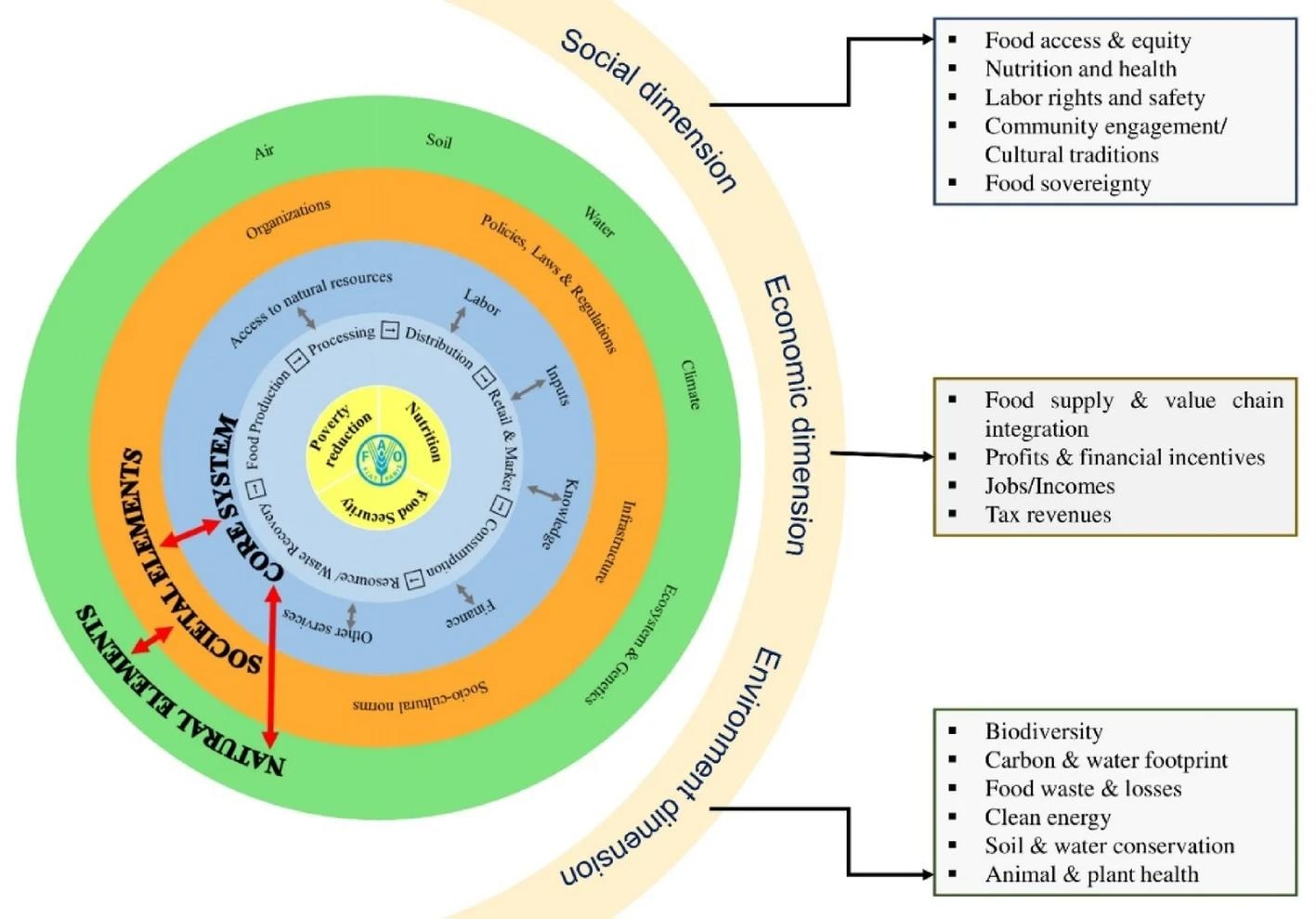
Schematic representation of the food system wheel, illustrating the key components of a sustainable food system across the social, economic, and environmental dimensions
Alternative Proteins and Waste Recovery Findings
The study found that a wide range of technological and dietary innovations can strengthen sustainable food systems by improving resource efficiency and nutritional quality, while reducing the environmental impact of food production. Emerging food technologies and alternative protein sources, along with waste-recovery strategies, could help address the economic and environmental challenges of modern food production.
Alternative protein sources, such as insects, microbial proteins, algae, and fungal products, show promise as potentially viable alternatives, as they require substantially fewer natural resources than traditional livestock. Insect farming has been reported to produce far lower greenhouse gas emissions than common meat sources and uses considerably less land and water. Similarly, mealworm production requires only a small area of land and minimal water compared with poultry or meat production.
The review also identified single-cell proteins as a promising option for sustainable food production. Microbial protein can be produced from inexpensive substrates such as agricultural residues and food waste, thereby lowering manufacturing costs while reducing the environmental burdens associated with conventional protein sources.
Moreover, food waste contains valuable nutrients and bioactive compounds, and the review emphasized the importance of food waste management methods, such as green extraction technologies that recover antioxidants, pigments, oils, and dietary fibers from food waste and by-products. The findings also showed that functional foods enriched with bioactive compounds may support both public health and environmental sustainability when developed through responsible production methods.
However, the researchers noted major challenges, including social acceptance of novel protein sources, safety concerns, and high production costs, which may limit large-scale adoption of alternative nutrient sources and food waste processing technologies. They also noted that some emerging technologies may involve trade-offs, including higher capital costs, energy or water demands, and the need for stronger regulatory and labeling frameworks.
Sustainable Food Policy Implications
In summary, the review showed that a combination of innovative food sources and technologies, along with improved waste management strategies, could contribute to more sustainable food systems. These approaches have the potential to support global nutrition needs while reducing environmental pressures and improving resource efficiency.
However, economic barriers, regulatory challenges, and social and cultural reluctance to accept alternative food sources remain important considerations that must be addressed through public education programs, transparent labeling, safety assessment, and policy changes.
Download your PDF copy by clicking here.
Journal reference:
- Nonglait, D. L., & Gadkari, P. V. (2026). Exploring recent trends and innovations in food systems with implications for social, economic, and environmental aspects of food sustainability (review). Discover Food. DOI:10.1007/s44187-026-00896-y, https://link.springer.com/article/10.1007/s44187-026-00896-y
 Study Maps Precise Anatomical Circuits Within the Brainstem Locus Coeruleus