The Australian National University (ANU) has created a new nanoscopy technology that has revealed secret networks utilized for cell-to-cell communication, providing fresh insights into human disorders.
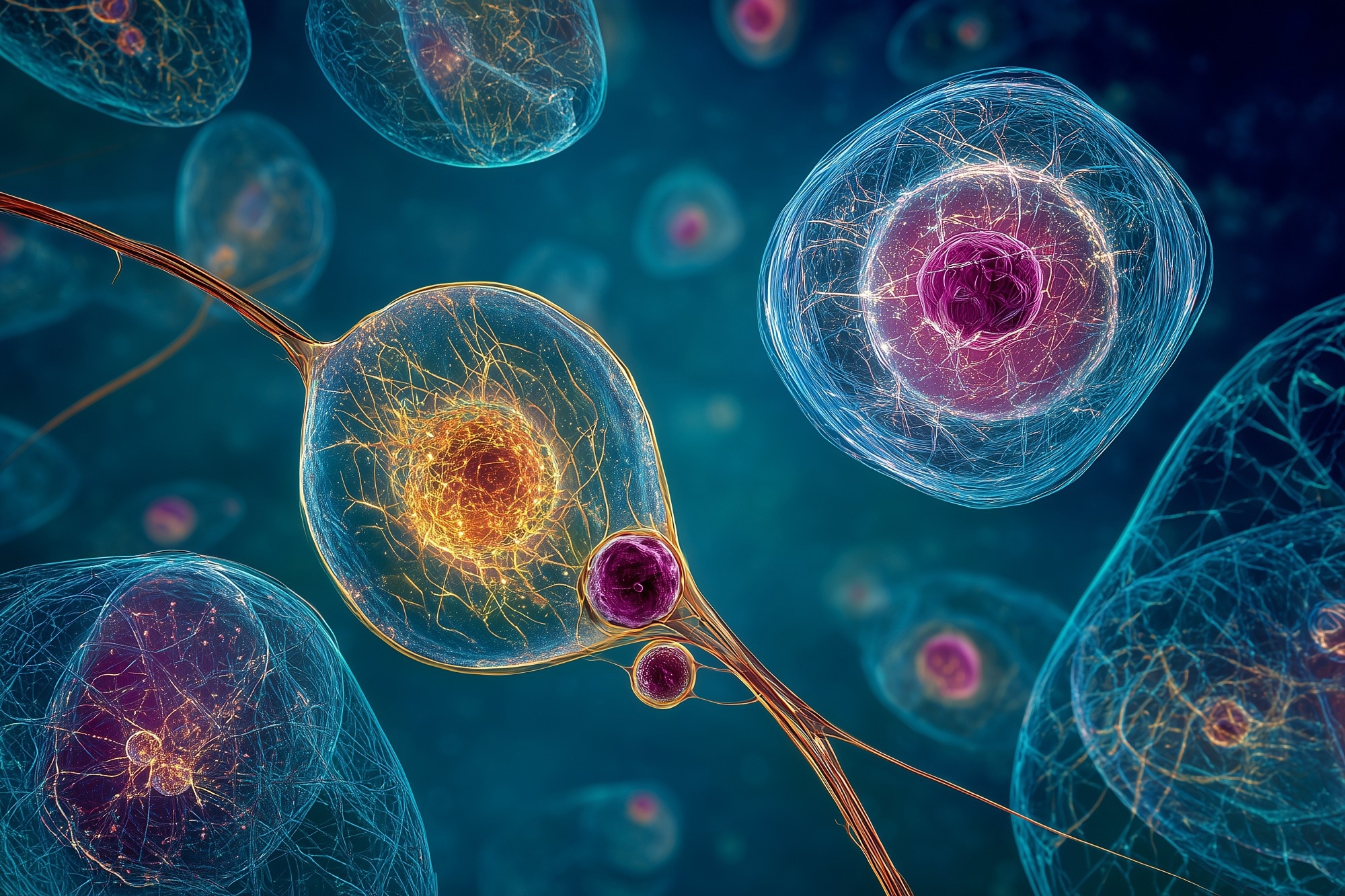 Image credit: Indah HR/Shutterstock.com
The discovery, published in Nature Communications, enables scientists to observe how living cells interact with their surroundings over the course of many days, exposing three-dimensional behaviors that were previously impossible to detect using standard microscopes.
“Using gentle, label-free imaging means we can finally witness the secret, dynamic life of cells in real time and 3D,” says the senior investigator, Dr. Steve Lee from The John Curtin School of Medical Research (JCSMR).
The technique allows for faster and more accurate breakthroughs in how we understand and treat human disease at the nanoscale.
Dr. Steve Lee, The John Curtin School of Medical Research, The Australian National University
The scientists observed tiny, thread-like nanoscale extensions from cells using a novel technique called RO-iSCAT. By using nanoscopy to create exceptionally high-resolution images, the team was able to visualize cellular structures that cannot normally be seen with conventional microscopy tools.
These structures were shown to extend, retract, and reconnect over days of continuous imaging, forming highly organized communication networks capable of carrying biochemical messages between neighboring cells.
Junyu Liu, the lead author and PhD researcher, contributed to the development of the novel method by rotating the illumination angle and merging images captured at different heights.
Under rotational illumination, the background noise is stripped away, revealing various nanoscale cellular structures in three dimensions. I still remember showing the first video to everyone. My supervisor Steve immediately recognized that this was something new.
Junyu Liu, The Australian National University
The group started experimenting with measuring the frequently elusive, thread-like cellular extensions, which are essential for nearly all cellular signaling, communication, and movement, using this three-dimensional tracking method.
Our technique boosts a nearly undetectable amount of light signal bouncing off living cells by 10-fold in real time. It’s incredible that this technique doesn’t require the use of chemical dyes, or ‘labels’, that are ubiquitous in nanoscopes but can be toxic to the very cells they are studying due to phototoxicity.
Dr. Steve Lee, The John Curtin School of Medical Research, The Australian National University
Dr. Daniel Lim, a senior imaging scientist, considered it a milestone to be able to observe these slender, thread-like tubes emerge from cells and establish connections with one another in real time.
“It was like watching the most fascinating short film for me,” says Dr. Lim. “Every time you watch it, you see something new or interesting that raises more questions.”
According to their footage, these linkages are not as static as originally believed. Before creating a sturdy bridge, the structures twist around one another in rapid and highly dynamic movements.
“Seeing interactions between cells happening at the nanoscale so spontaneously and frequently right under our noses was truly exciting,” says Dr Lee. “They looked nothing like the static images in textbooks. We’ve been hooked ever since.”
The group promptly investigated several cell kinds using their new capability. Researchers are studying how human blood vessel cells and pancreatic cancer cells create several "tight" connections with the surrounding connective tissue cells. By influencing their local environment or aiding in the formation of new blood vessels, these interactions are thought to help tumors grow and resist treatment.
Since some viruses are believed to propagate across these cellular bridges, the same method may potentially aid researchers in understanding how viruses move between cells.
“Now we have the tool to better understand these nanoscale interactions within larger cell populations,” says Dr. Lim. “This could help us learn how to block specific pathways to treat diseases or deliver drug therapies more precisely.”
Through this work, the researchers uncovered a previously unseen dimension of cellular behavior that may have existed all along but remained beyond the reach of earlier imaging technologies.
Source:
Journal reference:
Liu, J., et al. (2026) Using rotational integration of oblique interferometric scattering to track axial spatiotemporal responses of tubular membrane protrusions. Nature Communications. DOI: 10.1038/s41467-026-72302-1. https://www.nature.com/articles/s41467-026-72302-1.
 Research Exposes Molecular Mechanisms Dampening CD8+ T Cell Functional Efficacy