A new review charts how mass spectrometry is enabling scientists to measure thousands of protein groups in single cells, providing a clearer view of how cells function and respond in real time.
Review: Single-Cell Proteomic Technologies: Tools in the Quest for Principles
In a recent review published in the journal Annual Review of Biophysics, Nikolai Slavov of Northeastern University and Parallel Squared Technology Institute, Massachusetts, USA, traced the field’s development across more than 120 cited studies, charting the evolution of single-cell proteomics via mass spectrometry (MS) from its inception into a high-performance technology supporting the accurate quantification of thousands of protein groups per cell, with recent studies reaching over 5,000 protein groups in single HeLa cells.
The review examines the technological drivers of this progress, focusing on the synergies between miniaturized sample preparation methodologies (e.g., nanodroplet processing) and advanced instrumentation (e.g., the Orbitrap Astral analyzer). It highlights how these advancements have the potential to support the development of mechanistic biophysical models by capturing protein-level responses that traditional ribonucleic acid (RNA) sequencing technologies alone cannot directly detect.
Single-Cell Proteomics Background and Rationale
For decades, the scientific characterization of cellular heterogeneity primarily relied on nucleic acid-based profiling, especially transcriptomic and genomic approaches. However, more recent research indicates that messenger ribonucleic acid (mRNA) levels are frequently inaccurate proxies for protein activity. These studies have shown that protein degradation is the dominant factor determining their observable abundances (particularly at slow growth rates), and post-translational modifications (PTMs) remain invisible to genomic assays.
Furthermore, emergent high-throughput proteomic investigations reveal that proteins exhibit a significant dynamic range in abundance, spanning from ~1 to 10^7 copies per cell. While traditional single-cell protein assays (e.g., flow or mass cytometry) are often limited by antibody specificity and throughput, advances in MS technologies now offer a label-free or multiplexed alternative that significantly improves data resolution by capturing the “true” molecular effectors of the cell.
The present review highlights how recent innovations in Single-Cell Proteomics by Mass Spectrometry (SCoPE-MS) methodologies have experimentally established the feasibility of using isobaric carriers to increase fragment ion counts, thereby supporting sequence identification in trace samples.
Single-Cell Proteomics Review Scope and Methods
This review aimed to elucidate the technological advancements that have enabled proteomic analysis to transition from traditional bulk-sample evaluations to high-resolution single-cell proteomic characterization. It classified sample preparation technologies by their underlying biophysical mechanisms into:
Multiwell plate-based methods: Systems like minimal proteomic sample preparation (mPOP) utilize 96- or 384-well plates with one-pot freeze-heat lysis in 1 to 10 µL of water. This mechanism has been shown to eliminate the traditional need for detergents and reduce adsorptive data losses.
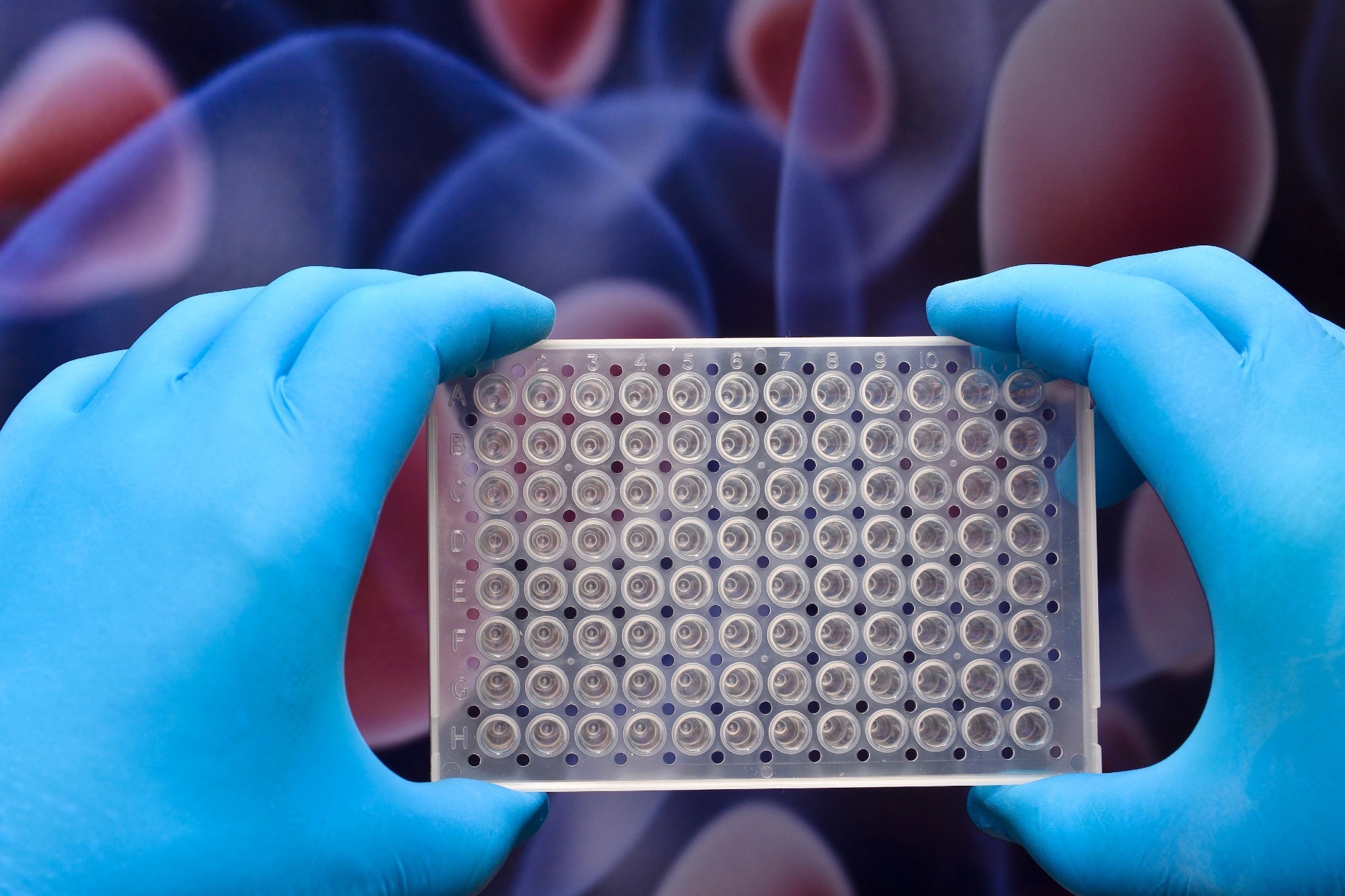
Multiwell plate. Image Credit: Sergei Drozd
Microchip-based methods: Nanodroplet processing in one pot for trace samples (nanoPOTS) is a technology that uses nanowells of ~200 nL (N2 sample volume = <30 nL) to improve protein recovery.
Glass slide-based droplet arrays: The relatively novel nanodroplet processing on open platforms (nPOP) method utilizes automated dispensers to arrange thousands of 5-20 nL droplets on unpatterned slides. This mechanism has been validated to allow for the parallel preparation of over 3,700 single cells in a single preparation.
Microfluidic integrated systems: The development of closed polydimethylsiloxane (PDMS) devices (e.g., SciProChip) has allowed for a single platform to demonstrate the combined capacity to automate cell isolation, lysis, and on-chip solid-phase extraction.
Furthermore, recent investigations indicate that reducing single-cell proteomic flow rates from 300 nL/min to 20 nL/min during peptide separation results in a 5- to 10-fold increase in per-molecule signal intensity, predominantly due to improved electrospray ionization efficiency.
Mass Spectrometry Throughput and Sensitivity Findings
The review highlights the substantial recent improvements (both sensitivity and throughput) that modern technologies demonstrate over their traditional precursors. For example, the “dual analyzer” design of the Orbitrap Astral mass spectrometer platform (Thermo Scientific) has been shown to stably achieve 200 Hz MS/MS throughput while maintaining high sensitivity, enabling deep proteome coverage from very small inputs.
Laboratory-based studies reveal that this design allows the platform to accurately identify ~5,000 protein groups from a single HeLa (cervical cancer cell line) cell in label-free analyses. Similarly, Bruker’s timsTOF Ultra 2 model leverages trapped ion mobility spectrometry (TIMS) combined with quadrupole time-of-flight (QTOF) technologies to identify 4,000-5,000 protein groups per cell by concentrating ions via parallel accumulation-serial fragmentation (PASEF) methodologies.
Single-Cell Multiplexing and Sample Scaling
Emergent research seeks to further augment these platforms’ throughput by using multiplexing (combining multiple, individually labeled samples into a single analytical run). For example, plexDIA utilizes nonisobaric tags to encode samples with mass/charge shifts, thereby enabling 3-plex to 9-plex analysis per run. In contrast, timePlex staggers and overlaps the separation periods of individual samples within the “time domain”, demonstrating combinatorial proteomics scaling.
Finally, scientists are currently investigating hybrid multiplexing approaches wherein 3-timePlex assays are combined with 9-plexDIA, thereby enabling the analysis of 27 samples per run. In demonstrated workflows, this has enabled over 500 samples per day, with a clear path to exceed 1,000 cells per day as multiplexing scales further.
“Causal inference from observational data in the presence of unobserved confounders is fundamentally limited regardless of the algorithms used or the scale of the dataset.” Nikolai Slavov.
Single-Cell Proteomics Challenges and Future Directions
The present review explores the transition of modern proteomics technologies from pilot feasibility validation to scalable, high-depth quantification. Current development trajectories suggest that single-cell proteomics will soon exceed 1,000 cells per day with minimal compromise in coverage.
However, it underscores persistent challenges in standardizing post-translational modification (PTM) analysis and in improving software tools for joint modeling of overlapping mass spectra, as well as the broader challenge of drawing causal or mechanistic inferences from complex biological data, which need to be overcome before these techniques can spearhead the next phase of functional biological understanding.
 Single-Cell RNA Sequencing Reveals Cellular Heterogeneity Across Distinct Anatomical Prostate Zones