To celebrate World Ocean Day this 8 June, Adelaide University marine biologists Professor Sean Connell and Dr Dominic McAfee have shared four of their favourite facts about South Australia’s coastline.
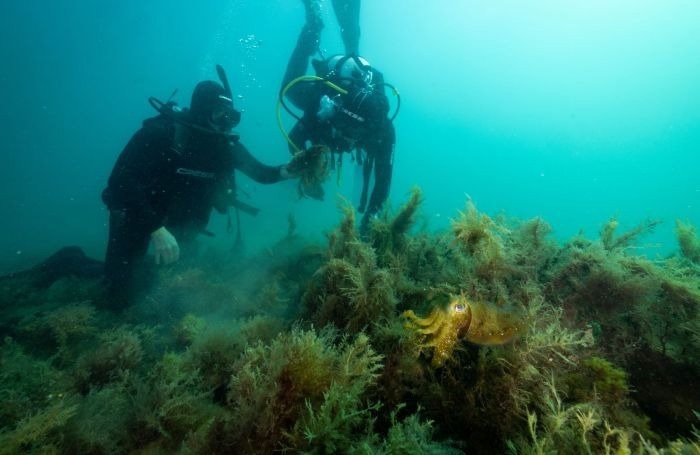 Dr Dominic McAfee and Professor Sean Connell diving at a reef. Image Credit: Stefan Andrews
Use these to spark conversation and curiosity with ocean conservation in mind.
Seventy Percent of the Australian Population (Including Many South Australians) Live Alongside the Great Southern Reef
“The Great Southern Reef is incredibly long – 8000 kilometres – and connects the coastline from the Indian Ocean in Western Australia through the Southern Ocean of South Australia to the East Australian Current that flows down from Queensland to Tasmania,” said Professor Connell, from Adelaide University’s School of Biological Sciences.
Many of South Australia’s Marine Animals are Found Almost Exclusively in Southern Australia
“The diversity of plant and animal life is astonishing,” said Dr McAfee, from Adelaide University’s Environment Institute.
“South Australia is home to more species of algae than corals on the Great Barrier Reef. These algae form habitat and food for tiny creatures, including fish, abalone and leafy sea dragons. Yet, it is the kelp forests that span this region that gives the Great Southern Reef its productivity and identity.”
The Indian Ocean is the Warmest Ocean in the World
“The Indian Ocean, which South Australia’s coast opens out into, influences the western Great Southern reef by way of the strong Leeuwin Current,” Professor Connell said.
During an extreme La Niña event, it can affect roughly 2000 kilometers of WA's coastline and trigger significant changes to seagrass, algae, coral habitats, fish populations, and the southward extension of tropical species.”
Professor Connell, School of Biological Sciences, Adelaide University
Our Oysters Respond to Underwater Music (And That’s Helping to Bring Some Species Back)
“Sean and I have been restoring lost oyster reefs by playing the sounds of healthy reefs to attract oyster larvae, enticing them to settle and grow more quickly at these restoration sites,” Dr McAfee said.
“Sean was so worried about how to deliver and attract oyster larvae to the newly built reefs that he thought they could enhance the navigational cues oysters might use to find reefs.
“When he suggested the idea, most people though he was being a bit silly. Yet, a non-governmental organization called AusOcean thought the idea was mad and brilliant. And, it turns out, it works!”
Find out more about Adelaide University’s research into conservation, management and restoration of ecosystems and natural resources on the Environment Institute website.
 Collision-Sensing Enables Efficient Bacterial Navigation Through Complex Micro-Scale Mazes