Introduction
The Scientific Challenge in Rejuvenation Biology
Partial Reprogramming and Preservation of Cellular Identity
Case Study: Altos Labs
From Lab to Clinic: What Still Stands in The Way
References and Further Reading
Cellular rejuvenation research seeks to reverse age-associated molecular and epigenetic changes while preserving the cellular identity required for normal tissue function. Partial reprogramming has emerged as a promising strategy, demonstrating rejuvenation effects in experimental models while highlighting significant biological, safety, and regulatory challenges that must be overcome before clinical application.
 Image credit: Anusorn Nakdee/Shutterstock.com
The effort to reverse cellular aging without erasing cellular identity has become one of the defining scientific challenges of this decade, as researchers attempt to restore youthful cellular states while preserving stable function and preventing loss of cell fate.
Aging is increasingly being reframed as a modifiable biological process driven by measurable molecular changes rather than an unavoidable, linear decline. Advances in epigenetics, cellular biology, and in vivo reprogramming studies have provided evidence that aspects of biological aging can be altered, positioning rejuvenation as a legitimate area of experimental investigation.
Contemporary aging research increasingly focuses on biological hallmarks such as epigenetic alterations, mitochondrial dysfunction, cellular senescence, stem-cell exhaustion, and altered intercellular communication, many of which appear at least partially reversible in experimental systems.1,3
This shift has moved the field beyond theoretical speculation, although it remains scientifically and clinically contested due to unresolved safety and efficacy constraints.
Download the Free PDF to Explore How Scientists Are Reversing Cellular Ageing Without Erasing Cellular Identity
The Scientific Challenge in Rejuvenation Biology
One of the most important contributors to cellular aging is epigenetic drift, defined as the progressive disruption of chemical markers that regulate gene activity without altering the underlying DNA sequence.
As these regulatory patterns deteriorate over time, cells lose the tightly controlled gene expression programs required for normal function. In addition, mitochondrial efficiency declines, stress-response pathways weaken, and tissue-level repair capacity gradually deteriorates, collectively driving systemic functional aging across multiple organs.
Epigenetic reprogramming has emerged as a potential strategy to reverse aspects of this decline by resetting age-related cellular changes. The approach is based on the Yamanaka factors, a set of transcription factors that can return mature cells to a more youthful biological state. However, full reprogramming converts cells into pluripotent stem cells, erasing their specialized identity and introducing significant risks, including loss of tissue function and tumor formation.
Experimental evidence from cellular reprogramming studies suggests that biological age and cellular identity are not inseparably linked. During full reprogramming, age-associated epigenetic signatures can be reset toward a developmental “ground zero” state, but this process is normally accompanied by loss of differentiated identity.3
Cellular identity is essential for maintaining tissue-specific function, as it ensures correct gene network activity while suppressing inappropriate programs that would disrupt physiological stability. Loss of this identity leads to functional disorganization at the tissue level, where coordinated signaling, metabolic control, and structural integrity are progressively compromised.
Rejuvenation is therefore not simply turning back the biological clock. The aim is to reverse age-associated molecular changes while preserving the gene regulatory networks that define cellular identity and function. Achieving this balance requires precise control over the timing, magnitude, and specificity of reprogramming, since excessive activation can lead to dedifferentiation and tumor formation, whereas insufficient activation may be ineffective.
The challenge is not only to make cells younger, but to do so without disrupting the biological instructions that maintain tissue function.1,2
Partial Reprogramming and Preservation of Cellular Identity
To overcome these limitations, researchers developed partial reprogramming as a controlled alternative to full cellular reprogramming.
The strategy involves transient or cyclic exposure to reprogramming factors, sufficient to reset age-associated epigenetic marks and improve cellular function, but not long enough to cross the threshold into pluripotency. In this intermediate state, cells undergo molecular rejuvenation while retaining their differentiated identity and tissue-specific gene expression programs.
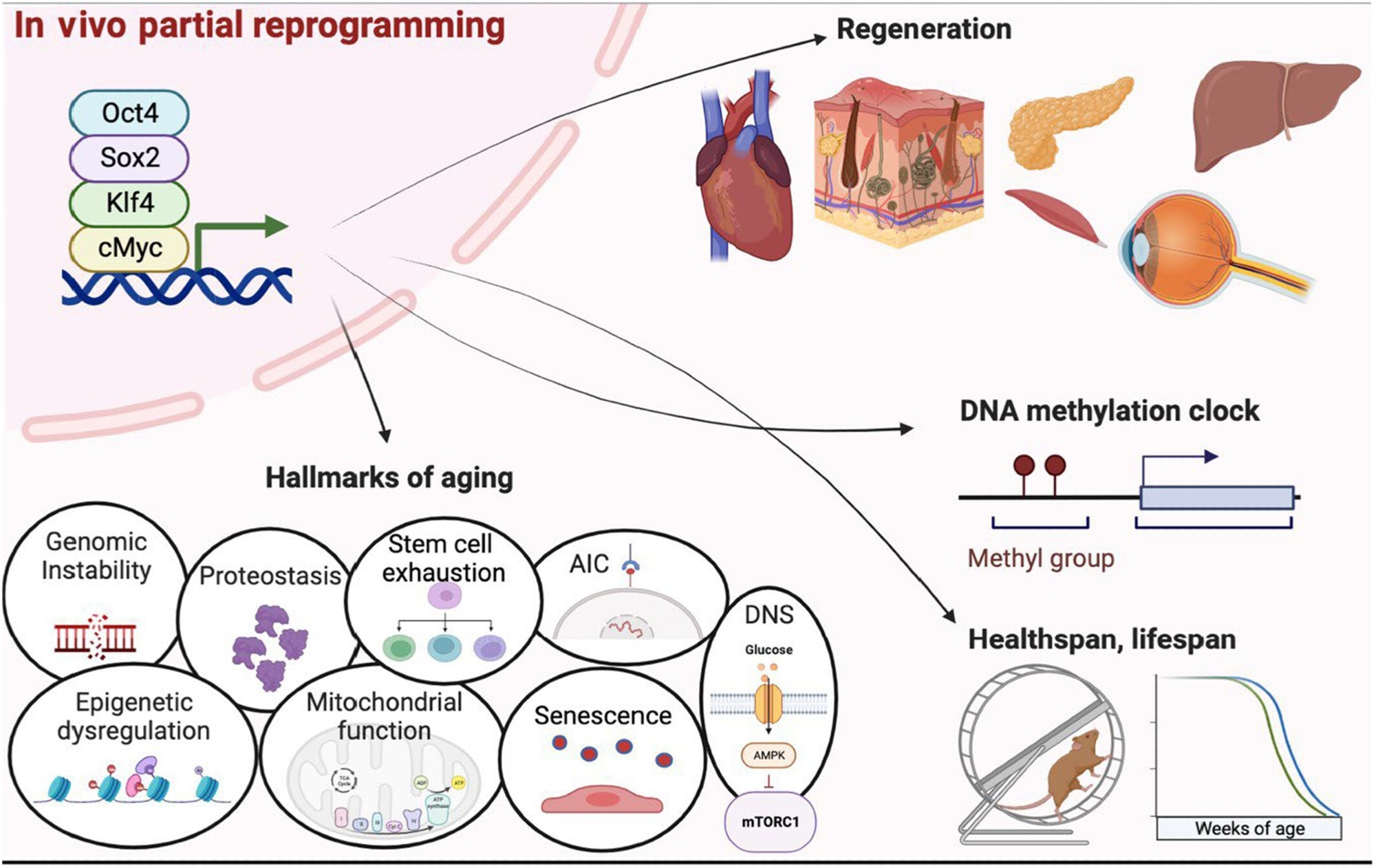 Proposed effects of in vivo partial reprogramming. Transient activation of the Yamanaka factors (Oct4, Sox2, Klf4, and c-Myc) has been shown in experimental models to improve tissue regeneration, ameliorate multiple hallmarks of aging, reduce epigenetic age measured by DNA methylation clocks, and enhance healthspan and lifespan while preserving cellular identity. Image credit: Paine et al (2023).
Early studies in senescent fibroblasts demonstrated reduced epigenetic age alongside preserved cell fate, indicating that aspects of aging can be reversed without complete loss of identity.
Subsequent animal studies showed that cyclic in vivo partial reprogramming could improve multiple hallmarks of aging and, in certain progeroid mouse models, extend lifespan while avoiding the widespread teratoma formation associated with full reprogramming.3
These findings suggest that rejuvenation and dedifferentiation are separable processes, governed by exposure duration and the degree of reprogramming induction.3
Case Study: Altos Labs
No organization better illustrates the scale of ambition in modern aging research than Altos Labs. The company, founded in 2022 with approximately $3 billion in funding, is widely regarded as one of the largest private biotech launches in longevity research.
The organization was established on the foundation of advances in cellular reprogramming, particularly the discovery of the Yamanaka factors by Shinya Yamanaka, which demonstrated that differentiated cells can be reset toward a pluripotent state.
Subsequent work by its founding scientist, Juan Carlos Izpisua Belmonte, showed that partial epigenetic reprogramming in mice improved multiple age-associated phenotypes and increased lifespan in a progeroid model, findings that helped establish partial reprogramming as a major avenue of rejuvenation research.5
Altos Labs is structured as a distributed research institute rather than a conventional biotech company, with major sites in Redwood City and San Diego and a strong emphasis on investigator-led fundamental biology. Its research ecosystem includes leading scientists in epigenetics, stem cell biology, and regenerative medicine, reflecting a deliberate focus on the mechanisms of cellular aging prior to therapeutic translation.
Within its San Diego laboratories, researchers, including Izpisua Belmonte, study epigenetic regulation of cellular identity, building on evidence that transient activation of reprogramming factors can enhance tissue function in organs such as the heart, liver, and brain. The institute also employs advanced platforms such as organoid systems and artificial intelligence–based “virtual cell” models to accelerate biological discovery.
Altos Labs represents a long-horizon, industrial-scale investment in fundamental aging biology, positioning itself not as a finished therapeutic platform but as an effort to resolve the core mechanisms required for future regenerative medicine.4,5,6
From Lab to Clinic: What Still Stands in The Way
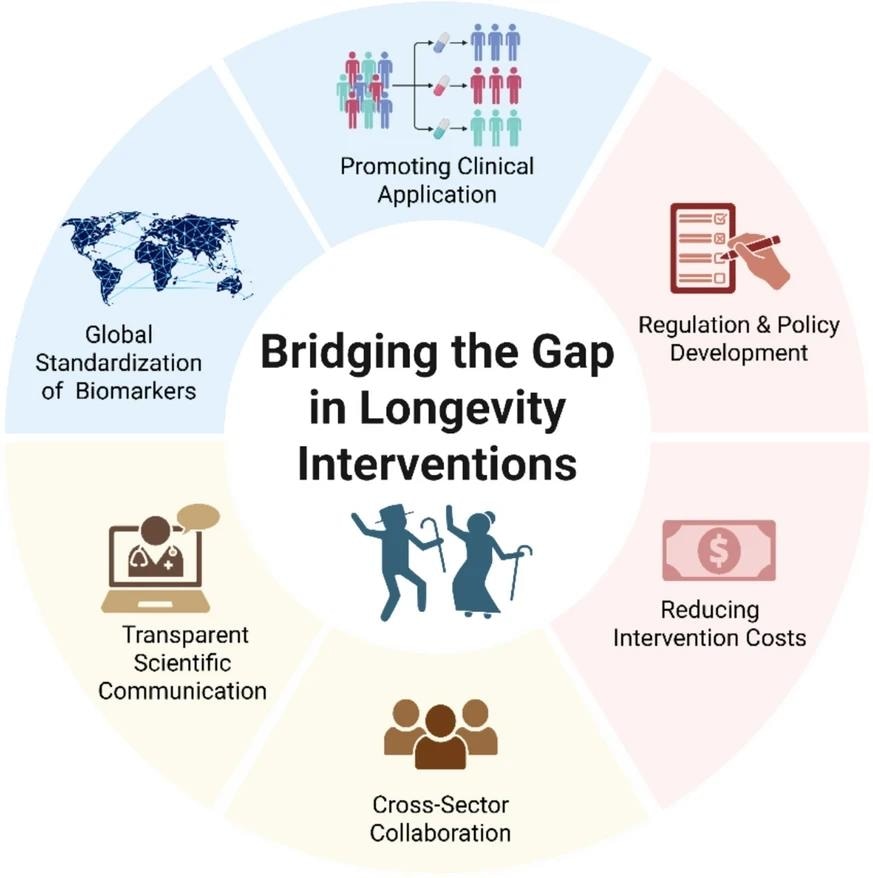 Key priorities for translating longevity interventions from experimental research to clinical practice include biomarker standardization, regulatory development, cost reduction, scientific transparency, cross-sector collaboration, and clinical implementation. Image credit: Yu et al (2025).
Translating rejuvenation biology into human therapies remains constrained by the intrinsic complexity of aging as a systemic, multi-layered process rather than a single disease target.
Although cellular reprogramming strategies, including Yamanaka factor-based approaches, have demonstrated reversal of aging markers and lifespan extension in mice, their translation to human application is limited by the risk of loss of cellular identity and tumorigenesis, as well as the difficulty of achieving precise temporal and spatial control in living tissues.
Additional barriers include delivery challenges, potential off-target effects, long-term safety uncertainties, and the lack of validated biomarkers that can reliably demonstrate clinically meaningful rejuvenation in humans.7
Species differences amplify these challenges, the context-dependent roles of aging mechanisms such as senescence, and the absence of robust, standardized measures of biological age that can reliably validate intervention outcomes. In addition, regulatory authorities do not classify aging as a disease, which limits the approval pathway for interventions that target aging as a whole rather than specific age-related conditions.
Recent reviews of regulatory environments have found no dedicated geroscience-specific approval framework and identified the absence of clear regulatory pathways as a major obstacle to the development of gerotherapeutics. As a result, the field remains at a stage where strong mechanistic advances in model systems have not yet converged into clinically deployable therapies for human aging.7,8
References and Further Reading
- Yu, D., Zeng, X., Barzilai, D., Thor, D., & Lyu, Y. X. (2025). Bridging expectations and science: a roadmap for the future of longevity interventions. Biogerontology, 26(4), 138.
- Jasper, H. (2024). Aging Reprogrammed. Innovation in Aging, 8(Supplement_1), 268.
- Paine, P. T., Nguyen, A., & Ocampo, A. (2024). Partial cellular reprogramming: A deep dive into an emerging rejuvenation technology. Aging Cell, 23(2), e14039.
- Altos Labs. (2026). Unraveling The Deep Biology of Cell Rejuvenation to Reverse Disease.
- Dominus, S. (2026). Longevity Science Is Overhyped. But This Research Really Could Change Humanity.
- Blagosklonny, M. V. (2022). Altos Labs and the quest for immortality: But can we live longer right now?
- Saliev, T., & Singh, P. B. (2024). From Bench to Bedside: Translating Cellular Rejuvenation Therapies into Clinical Applications.
- Muscedere, J., et al. (2025). Advancing Geroscience Research – A Scoping Review of Regulatory Environments for Gerotherapeutics.
Last Updated: Jun 5, 2026