Formulation Science: Applications and Benefits
Why Safety Assessment Is Becoming More Complex
Navigating Regulatory Pressures for Novel Formulations Across Global Markets
Emerging Solutions to Balance Product Innovations and Regulatory Hurdles
References and Further Reading
Formulation science is driving innovation across pharmaceuticals, cosmetics, food, and agriculture through advanced ingredients and delivery technologies, but increasingly complex formulations create new safety assessment challenges. Balancing innovation with robust safety evaluation, evolving global regulations, NAMs, AI-driven screening, and cross-sector collaboration is essential for accelerating the safe development and approval of next-generation products.
 Image credit: ARTFULLY PHOTOGRAPHER/Shutterstock.com
New ingredients, delivery systems, and formulation technologies are expanding what is possible across many industries. However, innovation must be supported by careful safety assessment to ensure products perform as intended and meet regulatory expectations. As formulations become more complex, understanding ingredient interactions and potential risks is increasingly important. Maintaining this balance between innovation and safety is a key consideration for researchers and product developers.
Formulation science, also known as formulation technology or engineering, is dedicated to designing and optimizing multi-component systems that meet specific performance, stability, and functionality goals. By precisely selecting and combining diverse ingredients, formulation science drives the creation of advanced products across a broad range of industries.1
Central to this discipline is the use of novel ingredients with specialized functions, including antioxidants, depigmenting agents, vitamins, sunscreens, hydroxy acids, peptides, biotic substances, and marine-derived biopolymers. Progress in delivery technologies, such as transdermal patches, implants, microneedles, hydrogels, nanoparticles, and inhalable forms, has further broadened the versatility of formulations. Advanced nanocarrier systems, including mesoporous silica nanoparticles, have also emerged as promising platforms for improving ingredient stability, controlled release, bioavailability, and targeted delivery.1,2
Innovative formulations are widely applied in the pharmaceutical industry, where they improve drug delivery, enable controlled release, and increase patient compliance. In cosmetics, these formulations enable restorative skincare, advanced UV protection, and tailored beauty solutions. In food, they allow for efficient incorporation of functional additives and improved product stability. Specialized formulations have enabled targeted delivery of agrochemicals in the agriculture sector. Advances in formulation science lead to greater efficacy, fewer side effects, more customized solutions, improved safety, and greater adherence to regulatory standards. Increasingly, formulation strategies are also being used to enhance the performance of multifunctional ingredients while reducing the total number of ingredients required in finished products.1-3
Why Safety Assessment Is Becoming More Complex
Safety assessment in formulation science is becoming increasingly complex due to the use of multifunctional ingredients. Examples include green tea extract, which provides antioxidant, anti-inflammatory, and UV-protective effects, and hyaluronic acid, known for its hydration and wound-healing functions. These ingredients may appear as natural extracts, purified molecules, or molecular conjugates, each offering distinct biological or physicochemical benefits within a single formulation.3
Despite their appeal, multifunctional and natural ingredients present major challenges. Biological sources such as plants, algae, and microorganisms inherently vary in chemical composition depending on origin, seasonality, or extraction technique, leading to inconsistency in active content and safety profiles. For example, the antioxidant content in green tea extract can fluctuate with harvest time and extraction method, affecting both efficacy and potential toxicity.4
Ingredient interactions add another layer of complexity: synergistic or antagonistic effects may create emergent properties not predictable from individual components. For example, mixing specific surfactants and biopolymers in shampoos can cause the formula to separate into two liquid phases, significantly affecting product safety and stability. Such interactions may alter physical stability, ingredient bioavailability, texture, foaming properties, and overall product performance in ways that cannot be predicted solely from the properties of individual ingredients.3,5
A thorough safety evaluation requires analyzing both individual ingredient toxicity and their interactions, which can change with storage and use. For instance, preservatives might break down or react with active ingredients at higher temperatures, reducing shelf life or generating irritants. Additional risks arise from extractables and leachables originating from manufacturing equipment, packaging systems, and delivery devices. These substances may alter product stability, reduce efficacy, or pose toxicological risks, including mutagenicity, carcinogenicity, immunogenicity, or endocrine-disrupting effects, necessitating comprehensive toxicological risk assessments throughout product development.6
Explore the Future of Formulation Science. Download Free PDF Here.
Global regulatory bodies play distinct roles in overseeing the development and approval of novel pharmaceutical formulations. Major agencies include the United States Food and Drug Administration (FDA), the European Medicines Agency (EMA), the United Kingdom’s Medicines and Healthcare products Regulatory Agency (MHRA), and Japan’s Pharmaceuticals and Medical Devices Agency (PMDA). Each body is tasked with safeguarding public health by overseeing clinical trial protocols, evaluating market authorization dossiers, and conducting post-marketing safety surveillance.7
Recent years have seen regulatory pressures intensify, especially for novel formulations, due to evolving ingredient-safety frameworks and new legislative initiatives, most notably in the European Union (EU). The EU’s accelerated revisions to safety assessment protocols, transparency obligations, and environmental risk evaluations have heightened expectations for ingredient disclosure and data robustness.8
In contrast, the U.S. FDA continues to operate under a distinct pathway structure that often emphasizes expedited review for breakthrough therapies and adaptive approval processes. The UK’s MHRA, meanwhile, is forging a unique regulatory path in the post-Brexit environment, while Asian agencies display a spectrum of approaches, from accelerating harmonization with International Council for Harmonization (ICH) standards to maintaining country-specific requirements. Although international harmonization efforts have expanded, significant differences remain in evidentiary requirements, review procedures, lifecycle management expectations, and post-market surveillance obligations.7,9
Such regulatory divergences significantly increase the complexity of global product launches. Companies must contend with non-uniform data requirements, variable approval timelines, and differing post-authorization monitoring responsibilities. This regulatory fragmentation can result in duplicated studies, launch delays, and greater resource expenditure, and these challenges are especially acute for advanced and innovative formulations.
Therefore, understanding the interplay among the EU, the U.S., the UK, Asia, and other international frameworks, as well as the pressures exerted by evolving regulations, is essential for successful, timely market entry. Growing integration between pharmaceutical, chemical, and environmental regulatory policies further increases the need for comprehensive safety documentation and cross-disciplinary compliance strategies.8
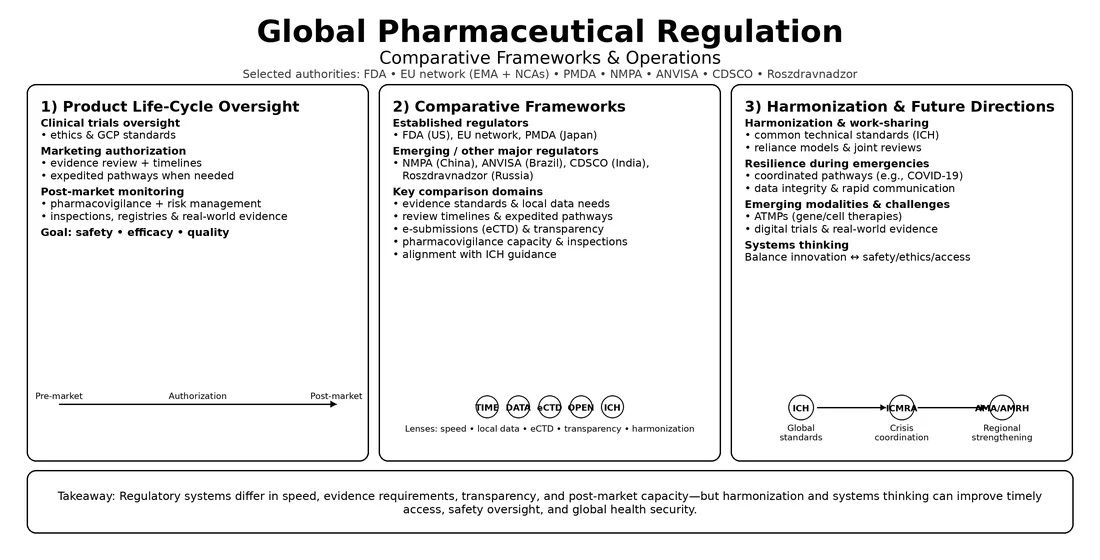 Global pharmaceutical regulation varies across regions in evidence requirements, review pathways, and post-market surveillance, but ongoing harmonization initiatives aim to improve safety oversight, regulatory efficiency, and patient access to innovative therapies. Image credit: Umaru, (2026).
Emerging Solutions to Balance Product Innovations and Regulatory Hurdles
Innovative strategies are rapidly transforming how companies and researchers address the challenges of bringing novel formulations to market while satisfying demanding regulatory standards. A key driver of these advances is the adoption of New Approach Methodologies (NAMs), which provide advanced, human-relevant alternatives to animal testing through in vitro models, computational toxicology, and predictive assessments. These innovative tools generate more meaningful safety data, reduce reliance on animal studies, and accelerate research and development. However, broader implementation of NAMs still requires overcoming challenges related to regulatory acceptance, validation standards, data integration, and stakeholder confidence.10
To mitigate scientific, technical, and legislative challenges, organizations are increasingly embedding safety assessments at the earliest stages of formulation development. This proactive integration enables real-time risk evaluation, minimizes costly setbacks, and ensures that new ingredients are aligned with evolving safety and compliance benchmarks. Harnessing systems biology and artificial intelligence (AI)-driven safety screening, research teams can decode complex biological interactions, anticipate hazards, and address potential risks much earlier in the innovation pipeline. AI is increasingly being applied not only to hazard prediction but also to candidate prioritization, toxicity forecasting, formulation optimization, and early-stage decision-making, enabling more efficient and data-driven product development.11
Cross-sector collaboration among industry, academia, and regulatory bodies has also given rise to shared data platforms and risk-based compliance frameworks that streamline regulatory navigation. By adopting these novel strategies, companies can effectively balance pioneering product innovation with regulatory requirements, reduce research and development costs, shorten development timelines, and accelerate the safe introduction of new products to market. Continued progress will depend on combining scientific innovation, harmonized regulatory approaches, advanced toxicological assessment methods, and transparent safety evaluation practices across the product lifecycle.6,7,10
References and Further Reading
- Obeid L. Formulation Science Advances: Innovations, Applications and Discoveries. J Formul Sci Bioavailab. 2024;7:149.
- Budiman A, et al. Innovative Approaches to Enhancing Formulations and Skin Care Efficacy Through Mesoporous Silica Advancements. Int J Nanomedicine. 2025;20:13543-13561.
- Rischard F, et al. The challenges faced by multifunctional ingredients: A critical review from sourcing to cosmetic applications. Adv Colloid Interface Sci. 2025;340:103463.
- Ayub A, et al. Green nanoscience for healthcare: Advancing biomedical innovation through eco-synthesized nanoparticle. Biotechnol Rep (Amst). 2025;47:e00913.
- Bernatonyte U, Kopustinskiene DM. The Influence of Thickeners on Shampoo Properties. Cosmetics. 2026;13(3):104.
- Kuzmič S, et al. Extractables and Leachables in Pharmaceutical Products: Potential Adverse Effects and Toxicological Risk Assessment. Toxics. 2026;14(1):92.
- Umaru OT, et al. Global Pharmaceutical Regulation: Comparative Frameworks and Operations. Pharmacy (Basel). 2026;14(2):50.
- Miettinen M. Crossing silos: how changes in EU chemicals policy and legislation are reflected in its pharmaceutical policy and legislation. J Pharm Policy Pract. 2025;18(1):2587439.
- Liberti L, et al. FDA Facilitated Regulatory Pathways: Visualizing Their Characteristics, Development, and Authorization Timelines. Front Pharmacol. 2017;8:161.
- Sewell F, et al. New approach methodologies (NAMs): identifying and overcoming hurdles to accelerated adoption. Toxicol Res (Camb). 2024;13(2):tfae044.
- Ocana A, et al. Integrating artificial intelligence in drug discovery and early drug development: a transformative approach. Biomark Res. 2025;13(1):45.
Last Updated: Jun 12, 2026