A squishy worm originating as a floating, head-like form within the Pacific Ocean is reshaping scientific understanding regarding metamorphosis at the cellular scale.
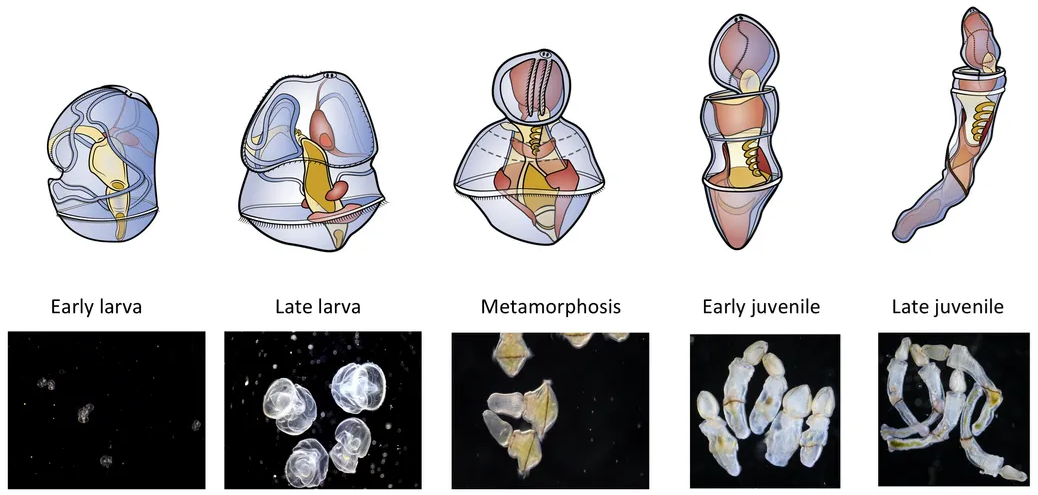 As the acorn worm Schizocardium californicum grows, it undergoes a radical physical transformation that completely changes its body shape. Image Credit: Illustrations by Sami Chang. Photos by Paul Bump
In contrast to humans, roughly 80% of animal species undergo metamorphosis, a structured growth progression from egg to larva to full adult, but the underlying cellular mechanisms remain poorly defined. Previous hypotheses and studies suggested that initial larval cells perish and are replaced by newly formed adult counterparts. Other findings suggest that cells retain their dedicated roles during growth, such as larval skin cells maturing into adult cells.
However, research led by Stanford shows evidence in the acorn worm Schizocardium californicum that most larval cells undergo reprogramming, with neuronal cells even acquiring distinct functions in the mature organism.
Reprogramming is a bit of an exotic fruit in developmental biology. Generally, we used to think that as cells develop, they become increasingly restricted in their function. But when we start looking at more animals that go through metamorphosis, they may reveal that reprogramming is a much more common feature of development.
Christopher Lowe, Study Senior Author and Biology Professor, Stanford School of Humanities and Sciences
Cellular reprogramming typically occurs after physical injury or in organisms that can regenerate specific organs or whole limbs, rather than as a standard developmental mechanism. Published in Nature Communications, this investigation provides evidence indicating widespread cellular reprogramming during normal development within a bilaterally symmetrical animal – a body plan with matching halves, similar to humans.
Earlier studies identified developmental reprogramming in sponges and jellyfish, two lineages distantly related to humans on the evolutionary tree. Conversely, acorn worms belong to the phylum Hemichordata, which serves as an evolutionary bridge to vertebrate animals, including mammals.
Following the Cells
For this investigation, the research group, led by Paul Bump, a former doctoral candidate in Christopher Lowe’s laboratory at Stanford’s Hopkins Marine Station, carried out genetic profiling across more than 87,000 individual acorn worm cells. Investigators applied single-cell RNA sequencing to specimens collected across five distinct developmental phases: early larval, late larval, metamorphosis, early juvenile, and late juvenile. Using this information, they classified the cells into 12 major classes, including cartilage, immune, and skin cells.
This evaluation revealed that many larval cells shared greater similarity with one another than with adult units performing identical functions. Specifically, larval neurons aligned more closely with larval gut tissue than with adult neurons. This pattern applied to over half of the analyzed cells, pointing toward widespread reprogramming. Exceptions occurred. Specifically, functional roles of muscle and mesoderm cells, which form certain organs, remained the same between larval and juvenile stages.
Bump also successfully applied a persistent dye to select larval cells prior to metamorphosis, tracking them through the transformation to confirm their persistence within the adult organism.
This suggested that cells were not large-scale dying; they were actually being carried over. Based on their RNA sequence data, we saw that they had become very different in cell type, which was supportive of the idea that larval cells were being reprogrammed into new fates during metamorphosis, which goes against what most of the field would have predicted.
Christopher Lowe, Study Senior Author and Biology Professor, Stanford School of Humanities and Sciences
An Unusual Animal for an Unusual Discovery
Conducting research using Schizocardium californicum presented difficulties. This organism is rarely utilized in research, forcing investigators to modify techniques and tools normally reserved for other animals.
However, the fact that this worm lacks frequent study is the precise reason for the interest of Lowe's team. His laboratory focuses on “non-model” marine organisms because they can offer deeper insights regarding both their own growth and the broader evolutionary history of diverse animal species.
The majority of standard model organisms, animals routinely selected for scientific research, such as mice and zebrafish, exhibit direct development. They transition directly from an embryo or egg into an adult. These species are studied frequently partly due to their closer genetic proximity to humans and partly because direct development remains simpler to handle within laboratory environments.
Focusing primarily on direct development creates a major gap in understanding the broader animal world, Lowe noted, because numerous species are indirect developers possessing larval phases that undergo metamorphosis before maturing into adults.
The Schizocardium californicum worm also has a well-studied direct-developing relative: Saccoglossus kowalevskii, occasionally called the Virginia acorn worm.
Major differences regarding developmental pathways between these two acorn worms become obvious through direct observation. Upon hatching from an egg, the Virginia acorn worm possesses the wormlike shape retained throughout its lifecycle, whereas young Schizocardium californicum larvae bear no physical resemblance to adult forms. This investigation further indicates that the dramatic transition of the California worm occurs internally and externally.
“You can watch this process of metamorphosis and see physically how things radically change, but this morphological transformation is also mirrored by a massive change in cellular components,” Lowe said.
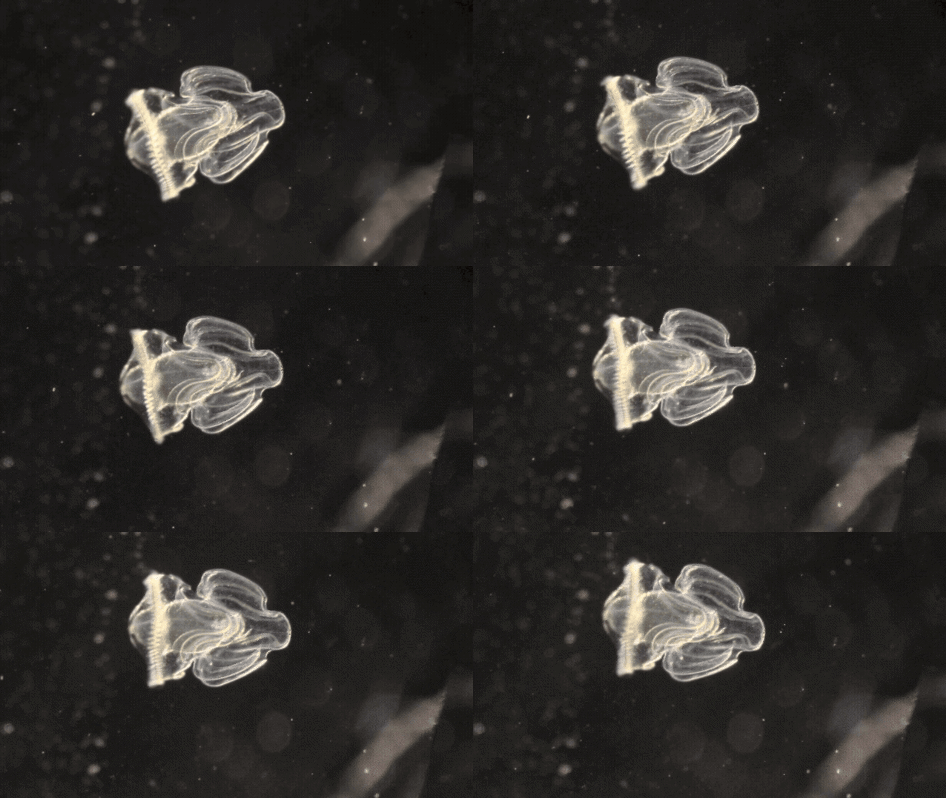
A Schizocardium californicum larva moves in the water by using the hair-like cilia on its body. Video Credit: Paul Bump
Source:
Journal reference:
Bump, P., et al. (2026) Distinct cell states define larval and adult body plans in a hemichordate. Nature Communications. DOI:10.1038/s41467-026-77191-y. https://www.nature.com/articles/s41467-026-77191-y.
 Scientists Find Cancer Gene Forcing Zombie Cells to Cause Aging