In the pharmaceutical and medical device industries, monitoring for contaminants is a vital production step.
Endotoxin is a contaminant regularly found in the cell wall of gram-negative bacteria, potentially causing headache, nausea, fever, inflammation, and even death. It is, therefore, imperative that medical devices and injectable pharmaceuticals be carefully tested to ensure that any endotoxin concentration is less than the endotoxin limit of the product.
The limulus amebocyte lysate (LAL) assay is specific and sensitive and is often the go-to test for detecting bacterial endotoxin.
Molecular Devices supports these requirements by offering a validated, ready-to-use kinetic endotoxin testing workflow that integrates optimized reader settings, software designed for use in regulated environments, and automated data analysis.
This article demonstrates the performance of the PYROSTAR™ ES-F/Plate Test from FUJIFILM Biosciences in combination with the SpectraMax® i3x Multi-Mode Microplate Reader from Molecular Devices.
This assay sees LAL coagulation monitored as an increase in turbidity over time, with an absorbance microplate reader used to measure this kinetically.
The more endotoxin is found in a test sample, the shorter the resulting onset time, or time needed for the absorbance of a sample to increase above its initial value by a specified amount. The amount for this assay is 0.015 OD.
A standard curve of onset time versus concentration of a control standard endotoxin (CSE) is implemented to interpolate the amount of endotoxin present in a test sample. Using the PYROSTAR ES-F/Plate assay, it is possible to quantitatively detect levels of endotoxin from 0.01 to 10 endotoxin units (EU/mL).
The PYROSTAR ES-F/Plate or other kinetic turbidimetric endotoxin assay can be run using a preconfigured protocol thanks to Molecular Devices’ SoftMax® Pro software. This protocol includes all the required instrument settings, automatic reporting of results, and complementary data analysis.
These capabilities are available through the Spectranet Customer Care Portal or in the software’s own Protocol Library (version 7.4 or higher).
The SoftMax Pro GxP software is ideally suited to use in regulated environments. This latest, most secure software has been designed to offer streamlined workflows to ensure data integrity while maintaining full FDA 21 CFR Part 11 and EudraLex Annex 11 compliance.
Materials
- PYROSTAR ES-F/Plate Reagent (FUJIFILM Biosciences, Catalog #543-10331)
- Control Standard Endotoxin (CSE, included with PYROSTAR ES-F/Plate assay)
- LAL Reagent Water (LRW, FUJIFILM Biosciences, Catalog #LRW-00125)
- Endotoxin-free microplates (BioClean Plate Wako, Catalog #293-35221)
- Endotoxin-free pipettes
- Endotoxin-free dilution tubes
- SpectraMax i3x Multi-Mode Microplate Reader (Molecular Devices)
- Other SpectraMax readers with absorbance detection mode and kinetic reading are also suitable for use with the PYROSTAR ES-F/Plate assay. These include the following:
- SpectraMax M-Series Multi-Mode Microplate Readers
- SpectraMax ABS Plus Microplate Reader
- FlexStation® 3 Multi-Mode Microplate Reader
Methods
The SpectraMax i3x reader was turned on, and its temperature was set to 37 °C via the reader’s touchscreen or the SoftMax Pro software.
PYROSTAR ES-F/Plate Reagent was reconstituted by adding the volume of LAL Reagent Water (LRW) specified in the product insert. The vial was then swirled gently to avoid bubbles and dissolve the lyophilized reagent.
Control standard endotoxin (CSE) was reconstituted to 1000 EU/mL. This was done by adding the required LRW volume, based on the information provided in the Certificate of Analysis for the LAL and CSE-matched kit.
The vial was vortexed for two minutes to thoroughly reconstitute its contents. It was possible to store unused reconstituted CSE at 4 °C for up to one month and vortex this for one minute just before each additional use.
A 1:10 dilution series of CSE was prepared in LRW for the standard curve. Standards ranged from 0.01 to 10 EU/mL.
Table 1. Instrument settings used to acquire data for the PYROSTAR ES-F/Plate endotoxin assay. The 96 Well Standard Slow Motion_i3x* plate type must be imported into the Plate Type Settings in SoftMax Pro Software. It is used to slow the speed of microplate movement in the SpectraMax i3x reader during the kinetic reading; this ensures the clot is not disrupted and prevents aberrant absorbance measurements. Source: Molecular Devices UK Ltd
| Parameter |
Setting |
| Read mode |
Absorbance (ABS) |
| Read type |
Kinetic |
| Wavelength(s) |
Lm1: 405 nm |
| Plate type |
For i3x: 96 Well Standard Slow Motion_i3x*
Other readers: 96 Well Standard |
| Timing |
Total run time: two minutes
Interval: forty seconds |
| Shake |
Before first read: 10 seconds |
| More settings |
Carriage speed: Slow (SpectraMax ABS Plus, M-Series, or FlexStation 3 readers) |
*Available for download on Spectranet, Molecular Devices’ customer care portal
Fifty μL of LRW was added to wells designated as negative controls to set up the assay plate. Next, 50 μL of CSE standard dilutions were added to wells in triplicate, and 50 μL of sample dilution and corresponding positive product controls were also added to designated wells.
A total of 50 μL PYROSTAR ES-F/Plate Reagent was added to all assay wells after each solution was added to the plate using a multi-channel pipette.
The plate was then placed in the pre-heated reader, and the reaction reading was initiated.
Data generation and analysis were performed using the SoftMax Pro software’s ready-to-use, assay-specific protocol. The protocol is configured to accurately run each assay using the parameters outlined in the PYROSTAR ES-F/Plate package insert (Table 1).
Complete data analysis features are also available, meaning that results are immediately viewable upon completion of the plate read. It was also possible to monitor progress by observing kinetic traces in the plate section of the protocol.
Every SpectraMax reader listed in the Materials section produced similar data with the PYROSTAR ES-F/Plate assay to that obtained with the SpectraMax i3x reader.
Specialized plate movement optimization or reducing plate movement speed helps to minimize clot disruption and improve the SpectraMax i3x reader’s kinetic assay consistency. This plate definition is available via Molecular Devices’ customer care portal, Spectranet.
Users of other SpectraMax readers will find Slow Carriage Speed as an option in the SoftMax Pro software settings.
Results
Figure 1 includes kinetic traces that highlight the onset times of the standards in the PYROSTAR ES-F/Plate assay.
Performance of the kinetic turbidimetric endotoxin assay on the SpectraMax i3x reader requires the use of the 96 Well Standard Slow Motion_i3x plate type in SoftMax Pro software.
This plate definition essentially prevents clot disruption and ensures smoother kinetic data by slowing the instrument’s plate carriage during the kinetic plate read.
Onset times were calculated from the kinetic data, and the mean onset time for each standard was plotted against CSE concentration using SoftMax Pro (Figure 2). For the two test runs shown, standard curve R2 was determined to be >0.98, meeting the assay’s specified criteria.
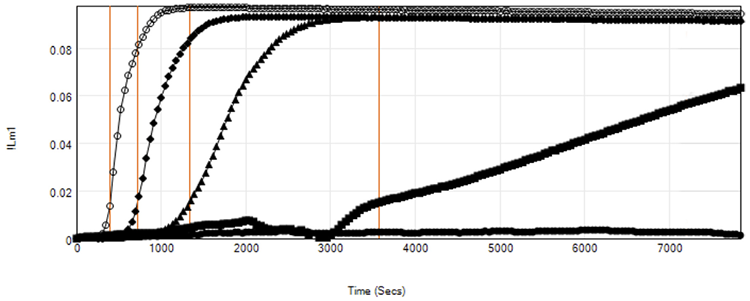
Figure 1. Kinetic traces of representative standards for the PYROSTAR ES-F/Plate assay. Vertical red lines indicate onset times (onset OD = 0.015). Data were generated using a ‘slow’ plate definition that ensures smooth kinetic data. Image Credit: Molecular Devices UK Ltd
This setup is designed to support regulatory compliance through a combination of:
- Data integrity, with confident decision-making and regulatory readiness supported by consistently comprehensive, accurate, and protected results throughout the whole assay workflow
- Audit trails, simplifying inspections and strengthening quality assurance processes via a complete, traceable history of data and user actions
- Electronic signatures, with secure sign-off and user authentication underpinning laboratories’ approaches to meeting regulatory requirements such as 21 CFR Part 11
- Regulated workflows, reducing variability while helping maintain compliance with global regulatory standards by supporting standardized processes from data acquisition to reporting
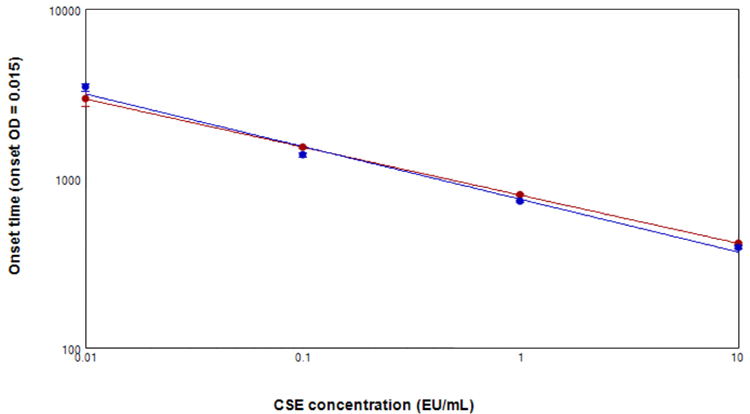
Figure 2. Endotoxin standard curves for two separate test runs of the PYROSTAR ES-F/Plate assay. Mean onset time in seconds, calculated from the kinetic data, vs. endotoxin standard concentration was plotted using the log-log curve fit in SoftMax Pro software. Test 1 (red) R2 = 1.000; test 2 (blue) R2 = 0.990. Image Credit: Molecular Devices UK Ltd
Conclusion
The limulus amebocyte lysate (LAL) test is a mainstay of drug and device testing for bacterial endotoxins, recognized by the U.S. Pharmacopeia (USP), the Japanese Pharmacopeia (JP), and the European Pharmacopeia (Ph. Eur.).
The PYROSTAR ES-F/Plate assay is both quantitative and kinetic, detecting concentrations as low as 0.01 EU/mL and offering labs a reliable method for ensuring safe endotoxin levels.
SpectraMax readers such as the SpectraMax i3x reader can be used in conjunction with the SoftMax Pro software to implement a streamlined workflow featuring automatic result calculation. This is achieved using a specifically configured protocol suitable for use in both non-regulated and regulated labs.
The SoftMax Pro GxP software offers a comprehensive system audit trail complete with e-signature statement capabilities and an audited document workflow stored within a SQL database.
When used together, the PYROSTAR ES-F/Plate assay, SoftMax Pro software, and SpectraMax microplate readers deliver a scalable solution for kinetic endotoxin testing, allowing laboratories to support regulatory compliance, generate reliable quantitative results, and improve workflow efficiency.
Acknowledgments
Produced from materials originally authored by Cathy Olsen, PhD, and Timothy Bolus from Molecular Devices, and Delaney Novak and Timothy Francis from FUJIFILM Biosciences.
About Molecular Devices UK Ltd
Molecular Devices is one of the world’s leading providers of high-performance life science technology. We make advanced scientific discovery possible for academia, pharma, and biotech customers with platforms for high-throughput screening, genomic and cellular analysis, colony selection and microplate detection. From cancer to COVID-19, we've contributed to scientific breakthroughs described in over 230,000 peer-reviewed publications.
Over 160,000 of our innovative solutions are incorporated into laboratories worldwide, enabling scientists to improve productivity and effectiveness – ultimately accelerating research and the development of new therapeutics. Molecular Devices is headquartered in Silicon Valley, Calif., with best-in-class teams around the globe. Over 1,000 associates are guided by our diverse leadership team and female president who prioritize a culture of collaboration, engagement, diversity, and inclusion.
To learn more about how Molecular Devices helps fast-track scientific discovery, visit www.moleculardevices.com.
Sponsored Content Policy: AZoLifeSciences publishes articles and related content that may be derived from sources where we have existing commercial relationships, provided such content adds value to the core editorial ethos of AZoLifeSciences, which is to educate and inform site visitors interested in life science news and information.