This article examines the use of Molecular Devices’ SpectraMax® iD5e Multi-Mode Microplate Reader alongside Poly-Dtech's Multi-Dtech™ technology to detect two targets in the same well via a robust, no-wash immunoassay.
Time-resolved Förster resonance energy transfer (TR-FRET) is a pioneering immunoassay technique widely employed to detect and quantify biomolecules.
This homogeneous method is rapid, wash-free, cost-effective, and able to help minimize background fluorescence. Bright-Dtech™ technology incorporates high-brightness fluorophores and nanoparticles, offering improved sensitivity and limits of detection when compared with traditional TR-FRET methods.
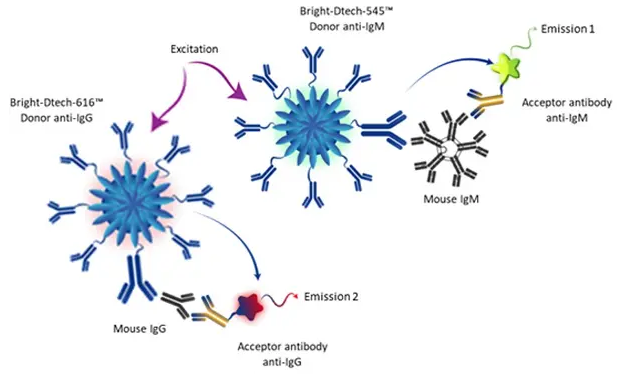
Figure 1. Multiplex TR-FRET technology using Bright-Dtech nanoparticles. Image Credit: Molecular Devices UK Ltd
In the Multi-Dtech TR-FRET method, two pairs of antibodies are used to specifically detect mouse IgG and IgM.
Donor antibodies are conjugated to lanthanide-based fluorescent nanoparticles, while acceptor antibodies are labeled with fluorophores emitting in different spectral regions, either green (520 nm) or red (665 nm).
Two distinct signals are generated when the targets are recognized by the antibody pairs. These signals correspond to each analyte (Figure 1) and are generated as energy is transferred from the donor to the acceptor.
These signals are measured simultaneously via time-resolved fluorescence, providing highly specific quantitative results due to an improved signal-to-noise ratio and reduced background fluorescence versus conventional fluorescence detection (Figure 2).
The Mouse IgG/IgM Assay Kit facilitates the simultaneous quantitative detection of mouse IgM and IgG in serum using TR-FRET. This kit incorporates Bright-Dtech technology, enhancing detection via its outstanding sensitivity and specificity. The dynamic range of the assay spans from 1 to 1000 ng/mL.
Materials
- Multi-Dtech Multiplex TR-FRET Assay Kit Mouse IgM/IgG (Poly-Dtech P/N FRETmlgG/IgM)
- Nunc™ 384-Well ShallowWell Standard Height Black (Thermo Scientific P/N 264705) included with the Multi-Dtech Multiplex TR-FRET Assay Kit
- SpectraMax iD5e Multi-Mode Microplate Reader*, with:
- Enhanced TRF Module (Molecular Devices P/N 0200-7030)
- Time Resolved Filter 340 nm BW 70 nm (Molecular Devices P/N 6590-0080)
- Time Resolved Filter 520 nm BW 15 nm (Molecular Devices P/N 6590-0098)
- Fluorescence, Luminescence, and TRF Filter 535 nm BW 25 nm (P/N 6590-0099)
- Time Resolved Filter 616 nm BW 10 nm (Molecular Devices P/N 6590-0118)
- Time Resolved Filter 665 nm BW 10 nm (Molecular Devices P/N 6590-0121)
- SoftMax Pro data acquisition and analysis software (Molecular Devices)
*Equivalent results can be generated using the SpectraMax iD5 reader.
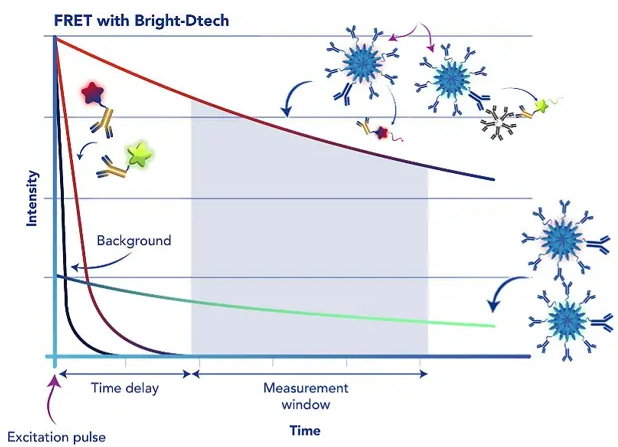
Figure 2. Principle of time-resolved signal measurement using Bright-Dtech nanoparticles. Time-resolved fluorescence (TRF) reduces background by using a lanthanide fluorophore, such as europium or terbium, which emits long-lived fluorescence. This fluorescence lasts for milliseconds; therefore, excitation by a pulsed light source (e.g., flash lamp), followed by a delay and then a signal measurement (‘counting window’), allows short-lived background fluorescence (lasting only nanoseconds) to decay before the signal is recorded. Image Credit: Molecular Devices UK Ltd
Methods
The Multiplex TR-FRET mouse IgM/IgG assay was conducted by Poly-Dtech in accordance with the manufacturer's kit data sheet protocol.
Standards for IgM and IgG were prepared at final concentrations from 0 to 1000 ng/mL, with the Poly-Dtech TRF assay buffer used to generate two-fold serial dilutions. Standards were dispensed in duplicate at their final concentrations at 10 µL per well, followed by 5 μL of the Donor/Acceptor mix solution.
The plate was covered with adhesive foil before being incubated at room temperature for one and a half hours. The SpectraMax iD5e reader was used to measure time-resolved fluorescence, using the instrument settings shown in Table 1.
Both microplate optimization and read height adjustment were conducted using the SpectraMax iD5e reader to ensure optimal assay sensitivity and dynamic range.
Data Analysis
Each well’s TR-FRET ratio was calculated using the following formula:
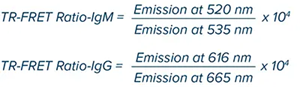
This ratiometric measurement lowers well-to-well variability while minimizing the risk of signal interference. The resulting signal’s intensity is directly proportional to the sample’s antigen concentration.
Standard curves for IgG and IgM were generated by using a four-parameter logistic (4PL) curve fit to plot the TR-FRET ratio on the Y-axis and the log10 of Ig concentration on the X-axis.
It was possible to determine the limit of detection (LOD) by adding three (IgG) or four (IgM) standard deviations to the blank (zero) replicates’ mean value and then calculating the corresponding concentration.
The limit of quantification (LOQ) was established by adding 10 standard deviations to the mean of the blank (zero) replicates and then calculating the corresponding concentration.
The SoftMax Pro software was used to generate and analyze all data.
Results
The data was analyzed as described and plotted in SoftMax Pro software. This was achieved using a 4PL curve fit for IgG and IgM (Figure 3).
Both calibration curves exhibited excellent linearity, with %CV ≤5% and R2 = 0.999. LOD and EC50 values are shown in Table 2. It was noted that the assay window for IgM was bigger; however, both targets were detected with outstanding sensitivity and low signal variability.
Table 1. Optimized instrument settings for the Poly-Dtech Multiplex TR-FRET assay on the SpectraMax iD5e reader. Source: Molecular Devices UK Ltd
| Parameter |
|
| Read mode |
TR-FRET with Enhanced TRF Module |
| Read type |
Endpoint |
| Wavelengths |
Select ‘Use Filter’ for both Ex and Em.
IgM detection:
Excitation: 340 nm
Emission 1: 535 nm
Emission 2: 520 nm
IgG detection:
Excitation: 340 nm
Emission 1: 616 nm
Emission 2: 665 nm
|
| PMT and optics |
Number of pulses: 110
Excitation time: 0.05 ms
Measurement delay: 0.03 ms
Integration time: 0.4 ms
Read height [optimize] |
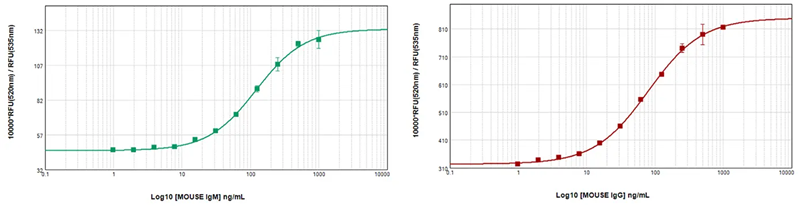
Figure 3. Mouse IgM (green) and IgG (red) calibration curves in a multiplex assay. The curves were generated and measured in the same wells. The Y-axis reflects the TR-FRET ratio as calculated in the Methods section. Both curves showed R2 = 0.999 and CV% ≤5% for all replicates. Both curves showed parameter independence of at least 0.9, demonstrating a good fit. Image Credit: Molecular Devices UK Ltd
Table 2. Assay parameters for IgM and IgG Poly-Dtech multiplex assay on SpectraMax iD5e. The assay parameters validated by Poly-Dtech are as follows: EC50: 110 ng/mL for IgM and 79 ng/mL for IgG; LOD: 2 ng/mL (IgM) and 1.7 ng/mL (IgG). Source: Molecular Devices UK Ltd
| Parameter |
IgM |
IgG |
| Standard curve R2 |
0.999 |
0.999 |
| EC50 |
120.7 ng/mL |
78.8 ng/mL |
| LOD |
2.043 ng/mL |
1.693 ng/mL |
| LOQ |
11.8 ng/mL |
8.4 ng/mL |
Conclusion
Bright-Dtech™ nanoparticles’ enhanced sensitivity enables the highly accurate detection of low analyte concentrations.
By combining green (terbium) and red (europium) detection, Poly-Dtech’s Multiplex TR-FRET assay saves precious samples and time while continuing to maintain high assay quality and sensitivity.
These advantages are highlighted by the low LOD and excellent curve fit obtained via the SpectraMax iD5e reader.
Automated data analysis workflows and optimized data acquisition can be saved as protocols for repeated use in the SoftMax Pro software, ensuring consistent and efficient results.
References and Further Reading
- Poly-Dtech (2025). Multi-Dtech™ Multiplex TR-FRET Assay Kit Mouse IgM/IgG. Poly-Dtech. Available at: https://poly-dtech.com/product/multi-dtech-mouse-igg-igm/.
- Goetz, J., et al. (2016). Ultrabright Lanthanide Nanoparticles. ChemPlusChem, 81(6), p.497. DOI:10.1002/cplu.201600117. https://chemistry-europe.onlinelibrary.wiley.com/doi/10.1002/cplu.201600117.
- Charpentier, C., et al. (2020). Ultrabright Terbium Nanoparticles for FRET Biosensing and in Situ Imaging of Epidermal Growth Factor Receptors**. Chemistry – A European Journal, 26(64), pp.14602–14611. DOI:10.1002/chem.202002007. https://chemistry-europe.onlinelibrary.wiley.com/doi/10.1002/chem.202002007.
Acknowledgments
Produced from materials originally authored by Stanimira Valeva and Caroline Cardonnel from Molecular Devices, and Susana Brun, Mohamadou Sy, and Joan Goetz from Poly-Dtech.
About Molecular Devices UK Ltd
Molecular Devices is one of the world’s leading providers of high-performance life science technology. We make advanced scientific discovery possible for academia, pharma, and biotech customers with platforms for high-throughput screening, genomic and cellular analysis, colony selection and microplate detection. From cancer to COVID-19, we've contributed to scientific breakthroughs described in over 230,000 peer-reviewed publications.
Over 160,000 of our innovative solutions are incorporated into laboratories worldwide, enabling scientists to improve productivity and effectiveness – ultimately accelerating research and the development of new therapeutics. Molecular Devices is headquartered in Silicon Valley, Calif., with best-in-class teams around the globe. Over 1,000 associates are guided by our diverse leadership team and female president who prioritize a culture of collaboration, engagement, diversity, and inclusion.
To learn more about how Molecular Devices helps fast-track scientific discovery, visit www.moleculardevices.com.
Sponsored Content Policy: AZoLifeSciences publishes articles and related content that may be derived from sources where we have existing commercial relationships, provided such content adds value to the core editorial ethos of AZoLifeSciences, which is to educate and inform site visitors interested in life science news and information.