The MM 500 control is a high-energy laboratory ball mill designed for dry, wet, and cryogenic grinding, operating at frequencies of up to 30 Hz. It is the first mixer mill on the market to enable monitoring and control of temperature during the grinding process.
The temperature range spans from -100 to 100 °C. To provide maximum versatility, the mill can be used with various thermal fluids, allowing integration of different tempering devices for either cooling or heating.
When using liquid nitrogen for cooling, the mill must be fitted with the optional cryoPad extension device. This innovative cryoPad technology facilitates the selection and regulation of a specific cooling temperature within the range of -100 to 0 °C during the grinding process.
Mixer Mill MM 500 control - Introduction #RETSCH #mixermill #laboratoryinstruments
MM 500 Control - Introduction. Video Credit: Retsch GmbH
The Only Mixer Mill with Temperature Control
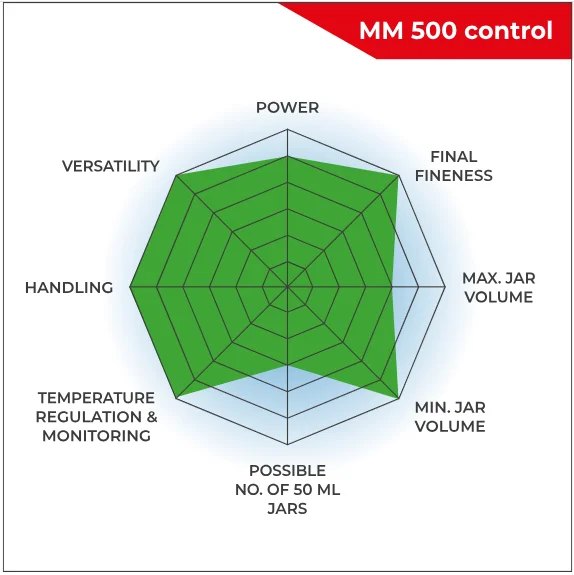
Image Credit: Retsch GmbH
- Maximum speed of 30 Hz
- Horizontal oscillation generates significant impact effects, facilitating effective sample processing.
- Accommodates feed sizes up to 10 mm and achieves a final fineness of 0.1 µm
- Equipped with two grinding stations for jars ranging from 2 mL to 125 mL, including an adapter for 18 × 2 mL single-use vials
- Offers various options for heating or cooling using thermal fluid or liquid nitrogen for cryogenic grinding, with temperature regulation capabilities between -100 °C and 100 °C, along with temperature monitoring
- Features GrindControl for measuring temperature and pressure within the jar
- Includes aeration lids to manage the atmosphere inside the jar
- Designed as a benchtop model with a touch screen, facilitating easy jar clamping; jars can remain clamped for subsampling. It supports storable Standard Operating Procedures (SOPs) and cycle programs, and provides four different jar materials suitable for both dry and wet grinding.
Advantages Through Design
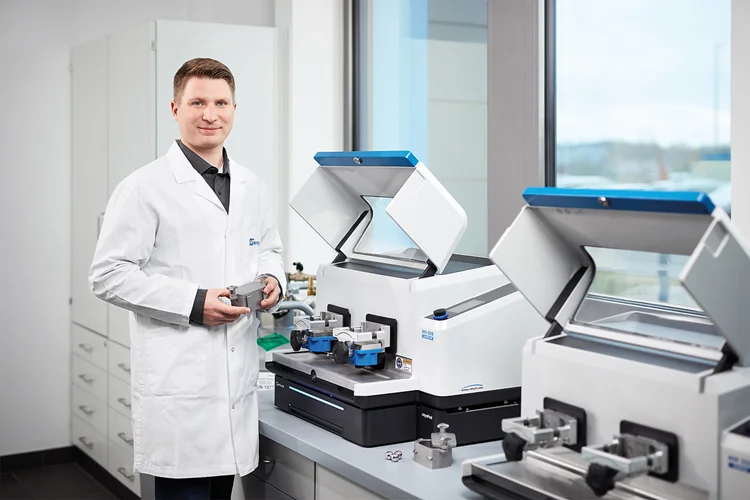
Mixer Mill MM 500 control. Image Credit: Retsch GmbH
- Dry, wet, and cryogenic grinding capabilities are available with frequencies reaching up to 30 Hz for high-energy grinding
- Sample processing is efficient and convenient with two screw-lock jars, each accommodating up to 125 mL.
- The patented hermetically sealed fluid system guarantees the safe use of thermal fluids during operation.
- A diverse selection of accessories is offered, including ventilation lids and grinding jars that are free from heavy metals, suitable for cryogenic grinding as well.
- The ergonomic design of the jar clamping system, combined with a low noise level, enhances user experience, while parameter settings can be easily adjusted via a touch display.
Temperature Monitoring and Control
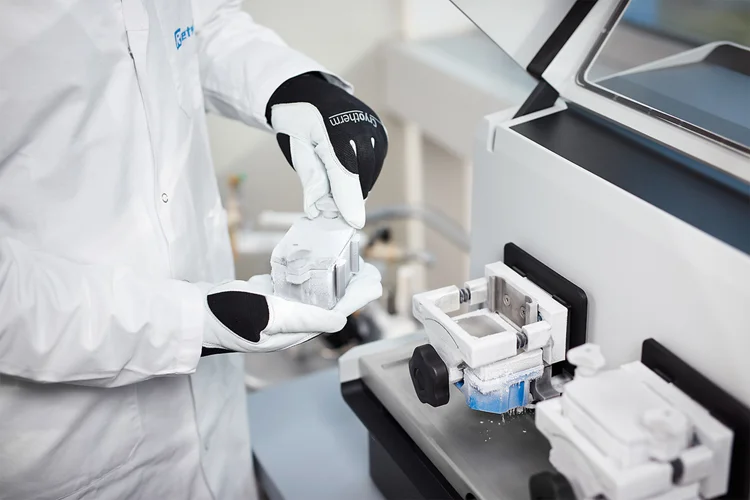
Temperature monitoring and control. Image Credit: Retsch GmbH
- Temperature is continuously surveyed during the grinding procedure
- Temperature control is achievable within a spectrum of -100 to 100 °C
- The system can operate using liquid nitrogen or alternative thermal fluids
- There is significant adaptability in choosing a tempering apparatus for temperature management (LN2 supply, cryostat, chiller, etc.)
- Grinding at low temperatures can be conducted without the use of LN2
cryoPad
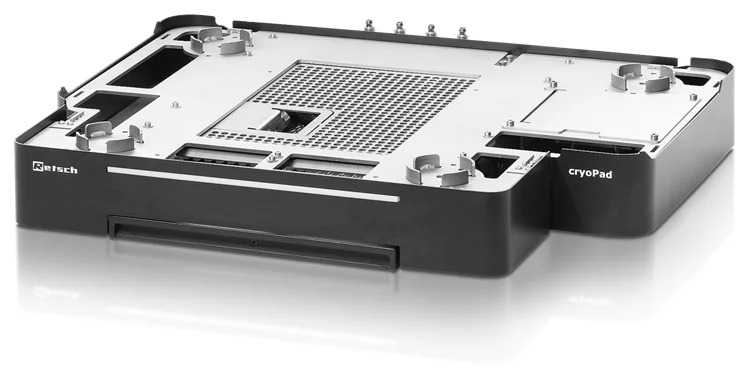
cryoPad. Image Credit: Retsch GmbH
- The cryoPad extension device is essential for functioning with LN2
- This cryoPad controls the LN2 flow through the thermal plate
- The technology of the cryoPad enables the selection and maintenance of a precise cooling temperature within the range of -100 to 0 °C when using LN2.
Mixer Mill MM 500 Control Application Examples
The temperature control system of the MM 500 is specifically engineered for handling temperature-sensitive sample materials. The purposes of cooling or heating may vary.
Mixer Mill MM 500 control - Application Video #RETSCH #mixermill #laboratoryinstruments
MM 500 control - Applications. Video Credit: Retsch GmbH
Cooling can be used, for example:
- To maintain the integrity of temperature-sensitive analytes, such as volatile compounds or components in pharmaceuticals and food products
- To conduct wet grinding at temperatures lower than room temperature
- Mechanochemistry
- Embrittlement
Certain applications benefit from heating the sample material during the process. Examples of heating include:
- Preparation of paste (in the food industry)
- Enhancing mechanochemical reactions
The necessary temperatures and the operational configuration vary based on the specific application.
Preserving Temperature-Sensitive Analytes

Grinding of coffee beans at low temperatures for natural substance analysis. Image Credit: Retsch GmbH
Certain analytes may be altered, destroyed, or vaporized when the sample material becomes excessively warm. If particular temperature thresholds are surpassed, the composition of substances such as proteins, pharmaceuticals, or food components can be significantly altered.
Maintaining a moderate temperature during the grinding process ensures that temperature-sensitive natural substances are physically retained in their original form for subsequent analysis.
Cryogenic Grinding
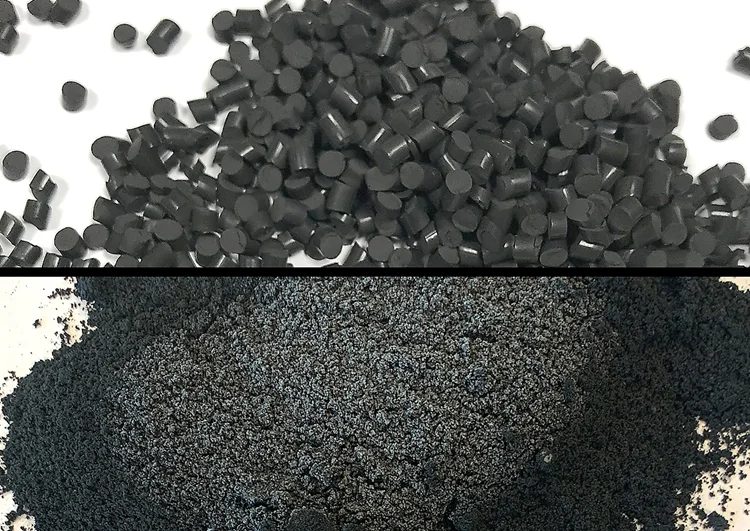
Fast milling of black fluorocarbon rubber (FKM) by embrittling the sample in two 125 mL jars at approximately 100 °C. Insert Image: Image Credit: Retsch GmbH
Temperatures that fall below 0 °C are conducive to the embrittlement and homogenization of materials such as ductile or sticky food. In cases where heavy-metal-free grinding is necessary, jars made of zirconium oxide or tungsten carbide are used.
When cooled to -100 °C, it is also feasible to effectively embrittle certain polymers.
Wet Grinding < 30 °C
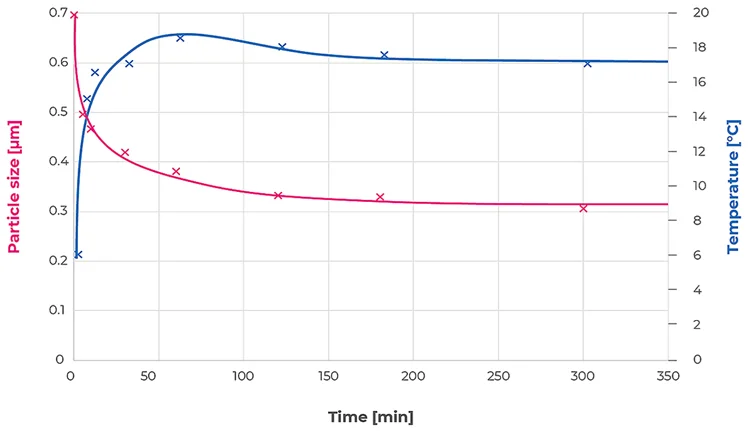
Particle size and temperature development for TiO2 in a wet grinding process with 30 Hz and two 125 mL jars. Insert Image: Image Credit: Retsch GmbH
When a chiller is used, effective wet grinding can be conducted at 30 Hz and below ambient temperature without the need for any cooling intervals.
Mechanochemistry
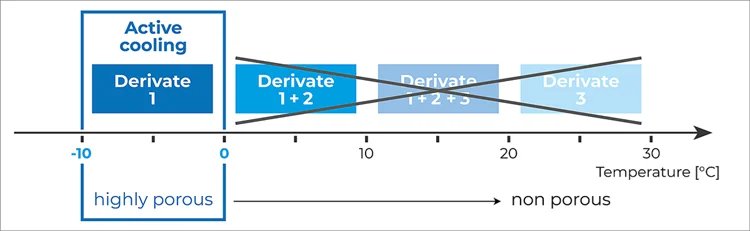
By keeping the temperature below 0 °C, the formation of non-porous zeolitic metal organic compound is inhibited. Image Credit: Retsch GmbH
Maintaining a low temperature during the mechanochemical process helps to prevent the creation of unwanted derivatives. Additionally, controlled heating can be used to trigger chemical reactions and enhance product yields.
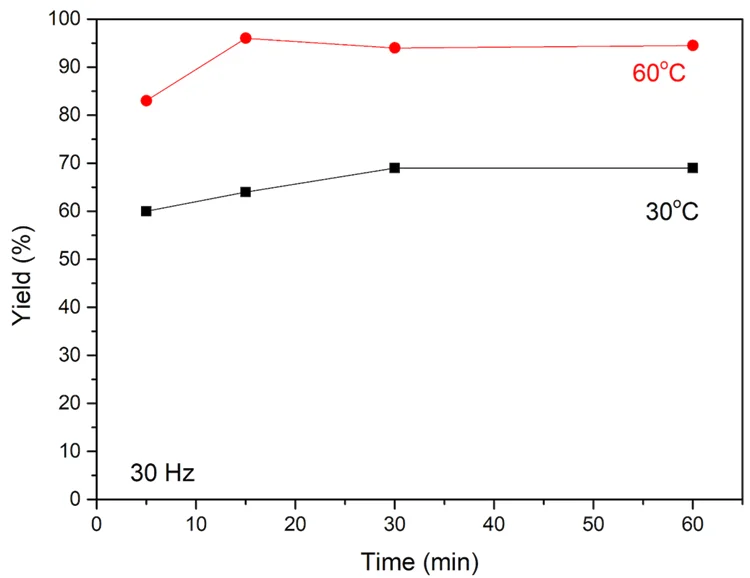
By increasing the temperature during synthesis, the yield of a metal-organic compound can be increased. Image Credit: ©Stuart James, Queen's University Belfast