The Mixer Mill MM 400 is an exceptional multipurpose mill engineered for dry, wet, and cryogenic grinding of small sample volumes up to 2 × 20 mL. It efficiently mixes and homogenizes powders and suspensions at 30 Hz in seconds, making it remarkably fast and user-friendly.
This compact benchtop unit is ideal for traditional homogenization processes and is also effective for biological cell disruption, facilitating DNA/RNA and protein extraction. With processing durations extending up to 99 hours, the MM 400 is particularly well-suited for research applications, such as those in mechanochemistry.
In terms of performance and versatility, this mill stands unmatched by any other technology currently available in the market.
Users might also be interested in the mixer mill models MM 500 nano and MM 500 vario, which operate on the same principle at a frequency of 35 Hz but offer significantly enhanced performance. For applications necessitating sample cooling or heating, the Mixer Mill MM 500 control is the ideal option. Each RETSCH mixer mill is tailored for specific application needs.
Mixer Mill MM 400 Introduction - Retsch
MM 400 Mixer Mill - Introduction video. Video Credit: Retsch GmbH
The Most Versatile All-Rounder of Ball Mills
- Maximum speed of 30 Hz
- Horizontal oscillation generates significant impact effects for efficient sample processing.
- Accommodates feed sizes up to 8 mm and achieves a final fineness of 5 µm
- Features two grinding stations for jars ranging from 2 mL to 50 mL, with an adapter for 10 × 2 mL single-use vials and four 50 mL conical centrifuge tubes
- Steel jars can be manually precooled using liquid nitrogen.
- Offers calibrated speed and time settings, compact benchtop design, storable standard operating procedures (SOPs) and cycle programs, and seven different jar materials
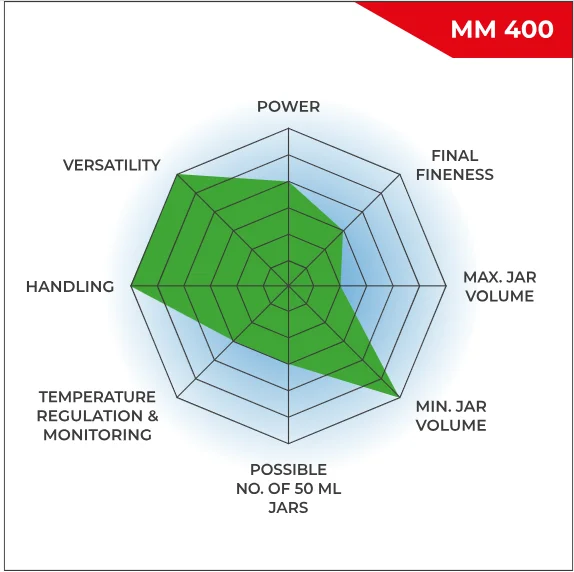
Image Credit: Retsch GmbH
Performance and Design
- Effective size reduction and homogenization achieved through impact and friction at frequencies of up to 30 Hz
- Fitted with two grinding stations, allowing for the processing of up to 20 samples in a single run
- Storage capacity for 12 Standard Operating Procedures (SOP) and six programmable cycles
- User-friendly touch display with notable noise reduction features
Unmatched Versatility
- Performs dry, wet, and cryogenic grinding to adapt to any sample material
- Thoroughly mixes powdered samples with binders directly in plastic vessels prior to pelletizing, e. g., for XRF analysis
- Ideal for mechanochemistry synthesis and rapid biological cell disruption via bead beating
- Highly effective for extraction of pesticides (QuEChERS) and herbal ingredients
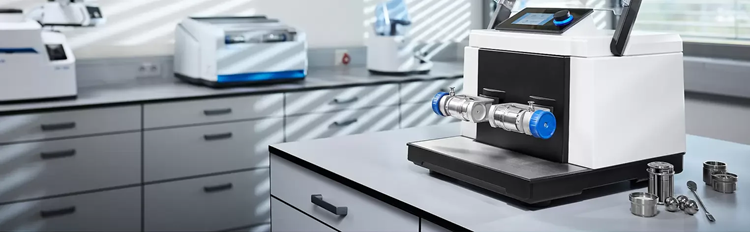
Image Credit: Retsch GmbH
Calibration Ensures Reproducible Results
Reproducibility remains critical throughout the operational sequence from sampling through analysis. Laboratory instruments capable of calibration assure consistent outcomes with minimal standard deviation during every run. This feature proves especially advantageous when contrasting findings generated across distinct sites.
The Retsch MM 400 is the first laboratory mill designed for full calibration. RETSCH performs initial calibration of operational frequency and duration, complemented by a regular servicing program to maintain unwavering milling reproducibility.
This functionality is particularly suitable for:
- Testing laboratories operating across multiple sites
- Built to support ISO/IEC 17025 and ISO 9000ff compliance
- Pharmaceutical preparations
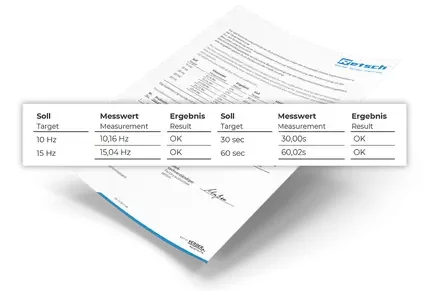
Image Credit: Retsch GmbH
Reproducibility of Mechanochemical Reactions in the Mixer Mill MM 400
Reproducibility serves as a cornerstone of scientific investigation and remains vital for maintaining the trust and dependability of scientific discoveries. The Mixer Mill MM 400 underwent testing to evaluate its reproducibility within a mechanochemical reaction, demonstrating that it delivers outstanding consistency across multiple trials, across both clamping stations, and between separate units.
Slight fluctuations in frequency from 30 Hz down to 29 or 28 Hz impact the yield of the reaction. Maintaining a target value, such as 30 Hz, without deviation represents a fundamental requirement for the mixer mill. This prerequisite is met by the MM 400, which includes a calibration certificate.
The mechanochemical synthesis of γ-Al2O3 + ZnO --> ZnAl2O4 was carried out for 30 minutes in 25 mL grinding jars, with 2 x 15 mm grinding balls and 1 g of educts, at 28 Hz, 29 Hz, and 30 Hz across five consecutive runs.
Comparative evaluation between the left and right clamping positions demonstrated exceptional consistency, as did the assessment across the five individual trials.
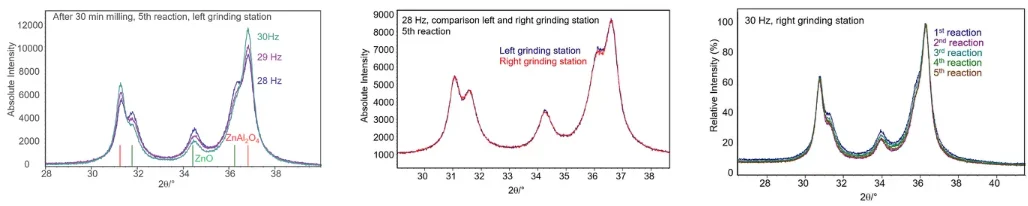
XRD patterns after the mechanochemical reaction γ-Al2O3 + ZnO -> ZnAl2O4: Left: Grinding at 28 Hz, 29 Hz, and 30 Hz, results after the fifth reaction. Middle: Comparison of the left and right grinding stations at 28 Hz, fifth reaction each. Right: Reaction one to five ata 30 Hz, right grinding station. Results presented by the group of Claudia Weidenthaler. Image Credit: Claudia Weidenthaler
Testing repeated on a second MM 400 unit confirmed matching high-level reproducibility across five consecutive runs at 30 Hz, with identical performance recorded at both the left and right clamping stations.
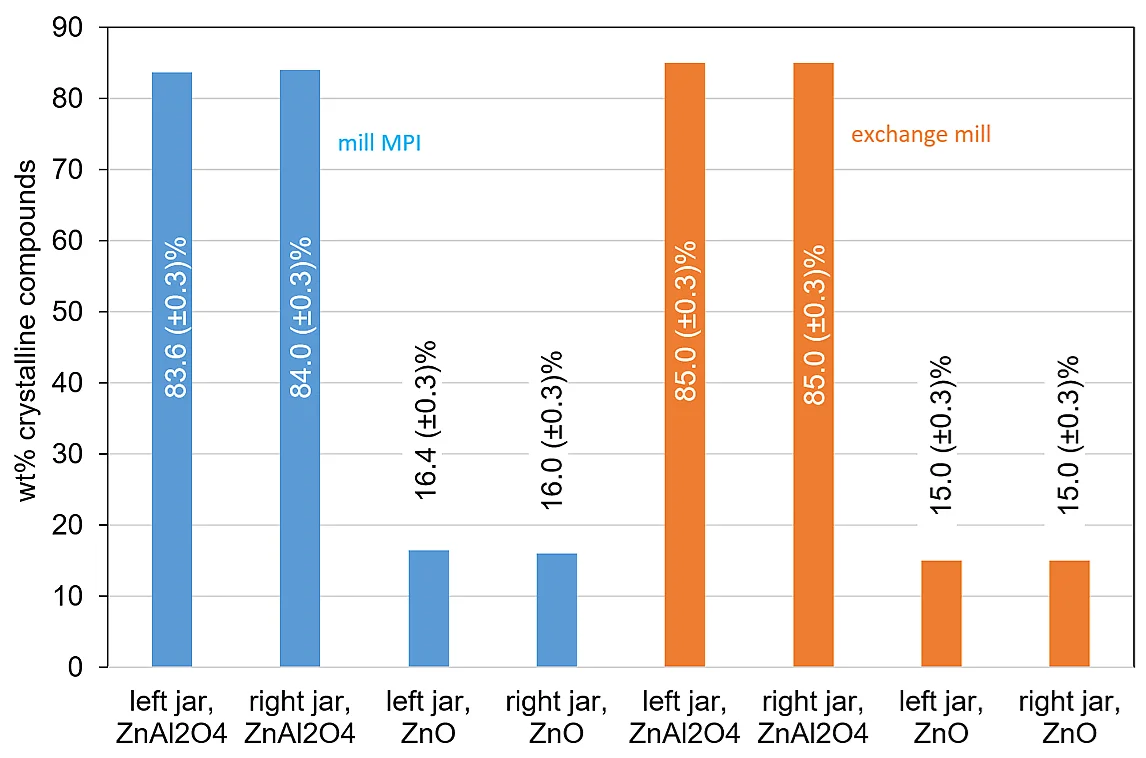
Almost identical results (weight % of educts and product) and reproducibility are obtained with a different MM 400 device. Results presented by the group of Claudia Weidenthaler. Image Credit: Claudia Weidenthaler