Life has a remarkable ability to recover, even in the aftermath of natural disasters such as forest fires or volcanic eruptions, but there remains a limited understanding regarding how organisms first colonize entirely new environments. A recent study by a group of ecologists and planetary scientists from the University of Arizona sheds light on these poorly understood events.
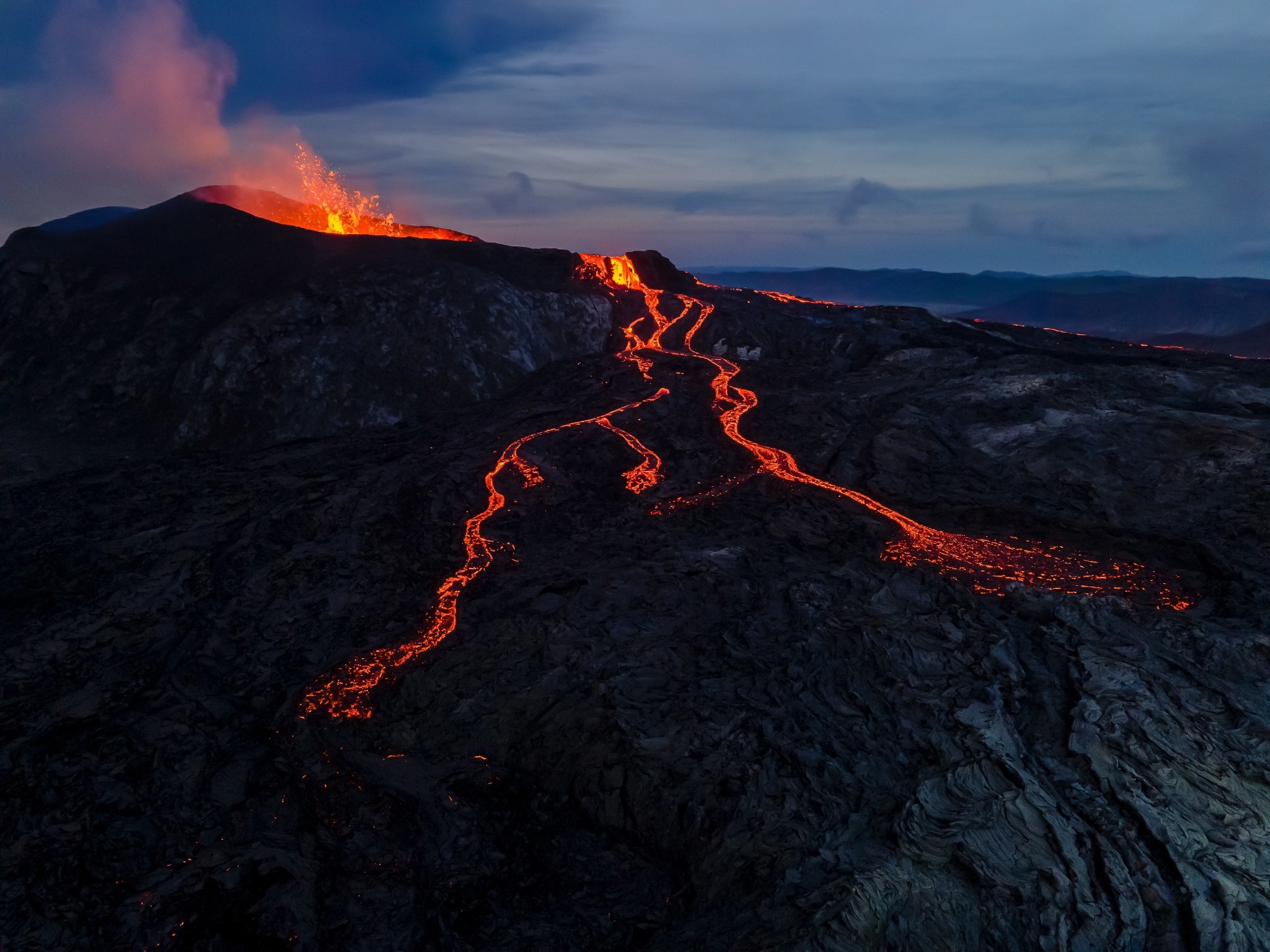 Image credit: Gianfranco Vivi/Shutterstock.com
The research team carried out field studies in Iceland after a sequence of eruptions from the Fagradalsfjall volcano, situated at the southwestern edge of the island. The volcano experienced three eruptions during the study period, spanning from 2021 to 2023. With each eruption, lava flows enveloped the tundra surrounding the volcano, at times even obscuring lava deposits from the preceding year.
The lava coming out of the ground is over 2,000 degrees Fahrenheit, so obviously it is completely sterile. It's a clean slate that essentially provides a natural laboratory to understand how microbes are colonizing it.
Nathan Hadland, University of Arizona
The study was published in Nature Communications Biology.
Hadland and team sought to uncover the origins of the microbes that inhabit fresh lava. The team gathered samples from a diverse range of potential sources, such as lava that had solidified just hours earlier, rainwater, and aerosols (airborne particles). They also collected soil and rocks from the surrounding regions.
The researchers extracted DNA from these samples and employed advanced statistical and machine learning methods to determine the organisms present on newly formed lava flows, the makeup of these micro-habitats, and their points of origin.
Hadland noted that although Iceland experiences significant precipitation, freshly laid lava rocks retain minimal water and possess few, if any, organic nutrients. To survive in such a resource-scarce environment, organisms must adapt to extremely low levels of water and nutrients.
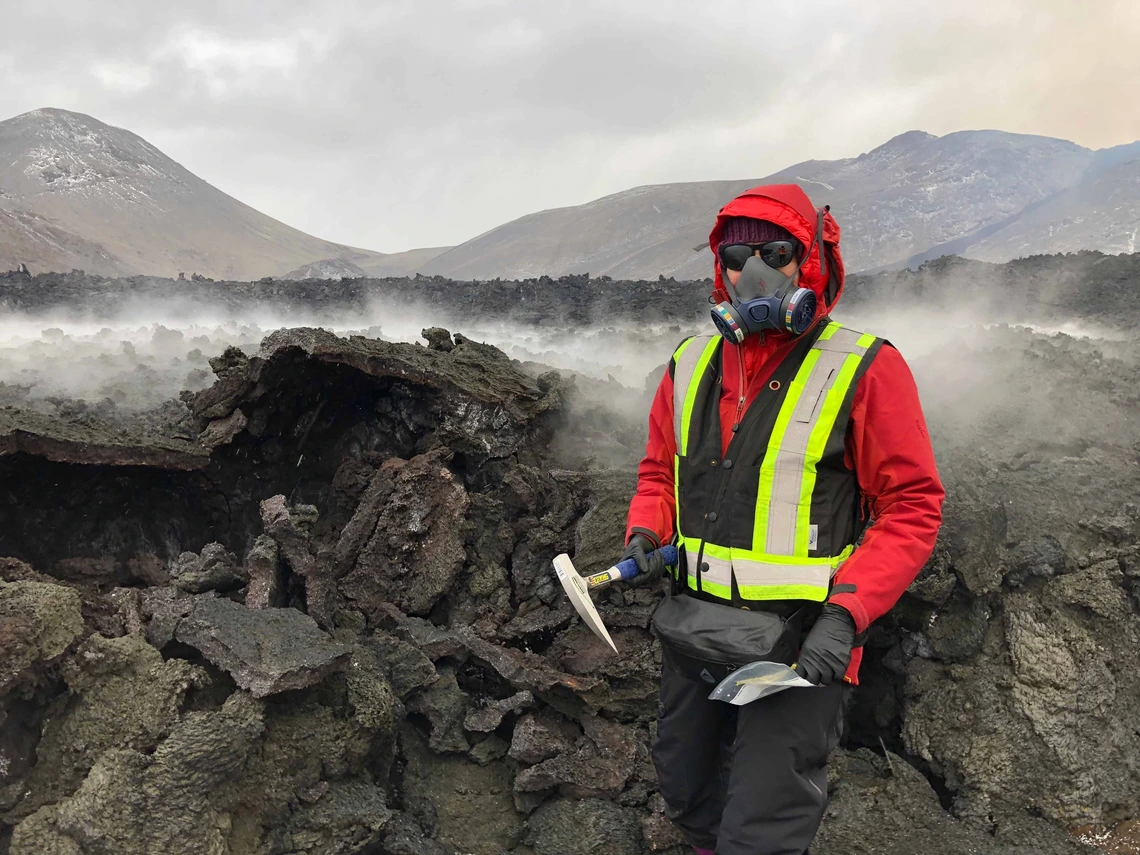
Wearing protective gear against toxic gases, Solange Duhamel stands next to a lava flow during an outing to collect samples of freshly deposited lava rock. Image Credit: Christopher Hamilton
These lava flows are among the lowest biomass environments on Earth. They are comparable to Antarctica or the Atacama Desert in Chile, which is not that surprising considering they start out as a blank slate. But our samples revealed that single-celled organisms are colonizing them pretty quickly.
Solange Duhamel, College of Science
As microorganisms established themselves in the new environment, biodiversity rose during the initial year after the eruption. However, following the first winter, diversity significantly declined, likely due to seasonal changes in environmental conditions favoring a particular subset capable of enduring those circumstances.
Subsequent winters indicated a decrease in turnover, demonstrating that diversity became more stable over time. With the accumulation of this data, a clearer understanding started to take shape.
Tougher Than the Rest
“It appears that the first colonizers are these 'badass' microbes, for lack of a better term, the ones that can survive these initial conditions, because there's not a lot of water and there's very little nutrients. Even when it rains, these rocks dry out really fast,” said Hadland.
In the following months and with the changes in seasons, the research indicated that the microbial community starts to stabilize, as additional microbes are introduced through rainwater and are "relocated" from neighboring regions.
One conclusion drawn from the study highlighted the essential function of rainwater in influencing microbial communities on newly formed lava.
“Early on, it appears colonizers are mostly coming from soil that is blown onto the lava surface, as well as aerosols being deposited. But later, after that winter shift in diversity we observed, we see most of the microbes are coming from rainwater, and that's a pretty interesting result,” said Hadland.
Researchers have been aware for a considerable time that rainwater contains microorganisms; atmospheric microbes, whether they are freely suspended or bound to dust particles, can serve as cloud condensation nuclei.
These are minuscule particles that provide a surface for water vapor to adhere to, facilitating the formation of small droplets. In essence, these minute, unseen organisms may have significant impacts on weather and climate events.
Seeing this huge shift after the winter was pretty amazing, and the fact that it was so replicable and consistent over the three different eruptions – we were not expecting that.
Solange Duhamel, College of Science
While earlier research has examined how organisms establish themselves in habitats, the majority of these studies concentrate on secondary ecological succession, the scientific term for organisms reoccupying disturbed environments, and macroecology, which pertains to plants and animals.
The investigation presented in this study represents the first comprehensive analysis of primary succession by microbes, organisms that colonize new habitats as they are being created.
Furthermore, in contrast to prior studies that relied on samples taken months after a volcanic eruption, Hadland's team collected samples from lava flows immediately after they had cooled. Ultimately, due to the eruptions occurring over a span of three years, the team was able to construct an ecological narrative with an unparalleled level of detail.
“The fact that we were able to do this three times – following each eruption in the same area – is what sets our project apart. In science, we want to measure things three times – what we call a 'triplicate,' if possible, and that is very rare in a natural environment. For this study, nature essentially is giving us a triplicate,” said Hadland.
From Arizona to Iceland to Mars
“For the first time, we are beginning to gain a mechanistic understanding of how a biological community established over time, from the very beginning,” said Duhamel, adding that one of the study's implications is to potentially inform the habitability of other worlds such as Mars.
The majority of the Martian surface consists of basalt and has undergone alterations due to volcanic activity, similar to that on Earth, although volcanic activity on Mars has significantly diminished.
“Volcanic activity injects a lot of heat into the system, and it releases volatile gases, it can melt frozen water beneath the surface. We can observe these widespread, large volcanic terrains on Mars with remote sensing, and so the idea is that past volcanic eruptions could have created transient periods of habitability,” said Duhamel.
The potential for microbes to colonize new environments and the exploration of their spatial distribution patterns represent a crucial initial step in investigating the possibility of life on other planets.
Source:
Journal reference:
Hadland, N., et al. (2025) Three eruptions at the Fagradalsfjall Volcano in Iceland show rapid and predictable microbial community establishment. Communications Biology. DOI:10.1038/s42003-025-09044-1. https://www.nature.com/articles/s42003-025-09044-1
 Merging Advanced Machine Learning With Biological Research Accelerates Global Health Solutions