Researchers have successfully reconstructed the ancient genomes of Human betaherpesvirus 6A and 6B (HHV-6A/B) from human remains that are over two thousand years old. This study, conducted by the University of Vienna and the University of Tartu (Estonia) and published in Science Advances, verifies that these viruses have been co-evolving with humans since at least the Iron Age. The results outline the extensive history of HHV-6 integration into human chromosomes and indicate that HHV-6A lost this capability at an early stage.
 Image credit: sokolova_sv/Shutterstock.com
HHV-6B infects approximately 90 % of children by the age of two and is primarily recognized as the cause of roseola infantum, also known as "sixth disease", which is the leading cause of febrile seizures in young children. Along with its close relative HHV-6A, it is part of a group of common human herpesviruses that generally establish lifelong, latent infections following an initial mild illness during early childhood.
The remarkable characteristic is their ability to integrate into human chromosomes, a trait that enables the virus to remain inactive and, in rare instances, to be passed down as part of the host's own genetic material. Such inherited viral sequences are found in about 1 % of the population today. While previous research had suggested that these integrations were ancient, the new findings from this study offer the first direct genomic evidence.
Recovering Viral DNA from the Distant Past
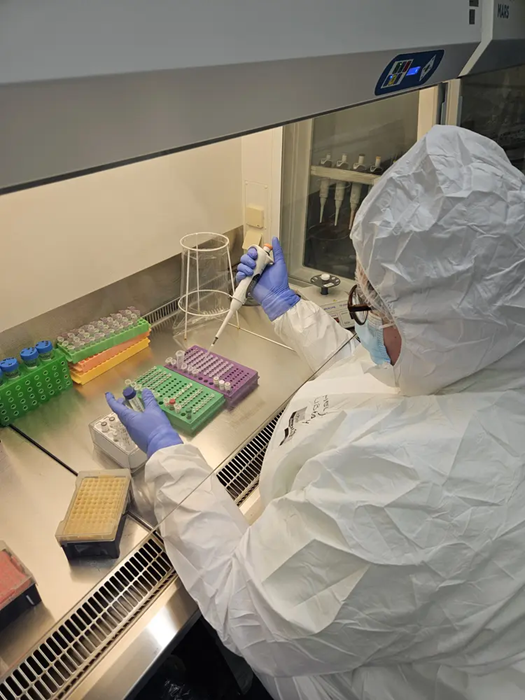
Image Credit: University of Tartu, Institute of Genomics, Ancient DNA Laboratory
An international research team has successfully mapped the deep history of the Human herpesvirus (HHV-6) by examining nearly 4,000 ancient skeletons across Europe.
The study uncovered 11 ancient viral genomes, including a remarkably well-preserved sample from a young girl in Iron Age Italy, dating back to as early as 1100 BCE.
From the medieval remains of England and Russia to a unique "hotspot" in Sint-Truiden, Belgium, where both HHV-6A and 6B coexisted, the findings reveal that these viruses have been constant companions for over two millennia.
While HHV-6 infects almost 90 % of the human population at some point in their life, only around 1 % carry the virus, which was inherited from your parents, in all cells of their body. These 1 % of cases are what we are most likely to identify using ancient DNA, making the search for viral sequences quite difficult. Based on our data, the viruses' evolution can now be traced over more than 2,500 years across Europe, using genomes from the 8th-6th century BCE until today.
Meriam Guellil, Study Lead Researcher, Department of Evolutionary Anthropology, University of Vienna
Ancient Integrations, Lasting Consequences
The recovered genomes allowed the researchers to pinpoint the specific locations on the chromosomes where the viruses integrated. By comparing these findings with contemporary data, it was revealed that some integrations took place a significant time ago and have been passed down through generations for thousands of years.
One of the two viral species, HHV-6A, appears to have progressively diminished its ability to integrate into human DNA, suggesting that these viruses have followed distinct evolutionary trajectories while coexisting with their human hosts.
Carrying a copy of HHV6B in your genome has been linked to angina–heart-disease, we know that these inherited forms of HHV6A and B are more common in the UK today compared to the rest of Europe, and this is the first evidence of ancient carriers from Britain.
Charlotte Houldcroft, Department of Genetics, University of Cambridge
A New Chapter in Virus–Host Evolution
The discovery of these ancient HHV-6 genomes represents the initial occurrence of time-stamped evidence concerning the extended co-evolution of this virus with humans at the genomic level.
It demonstrates how ancient DNA can reveal the significant evolution of infectious diseases, from temporary childhood infections to viral sequences that have become part of the human genome. Initially identified in the 1980s, HHV-6A and HHV-6B can now be traced back to the Iron Age, offering direct genomic proof of an ancient, shared history between viruses and humans.
Modern genetic data suggested that HHV-6 may have been evolving with humans since our migration out of Africa. These ancient genomes now provide first concrete proof of their presence in the deep human past.
Meriam Guellil, Study Lead Researcher, Department of Evolutionary Anthropology, University of Vienna
Source:
Journal reference:
Meriam Guellil, M., et al. (2026) Tracing 2500 years of human betaherpesvirus 6A and 6B diversity through ancient DNA. Science Advances. DOI: 10.1126/sciadv.adx5460. https://www.science.org/doi/10.1126/sciadv.adx5460
 Study Uncovers Two-Protein Repair Mechanism Preserving Circular ecDNA Stability