New research suggests that bacteria can survive antibiotic treatment thanks to an enzyme released by dying cells, according to researchers from Wageningen University & Research and the University of Cologne.
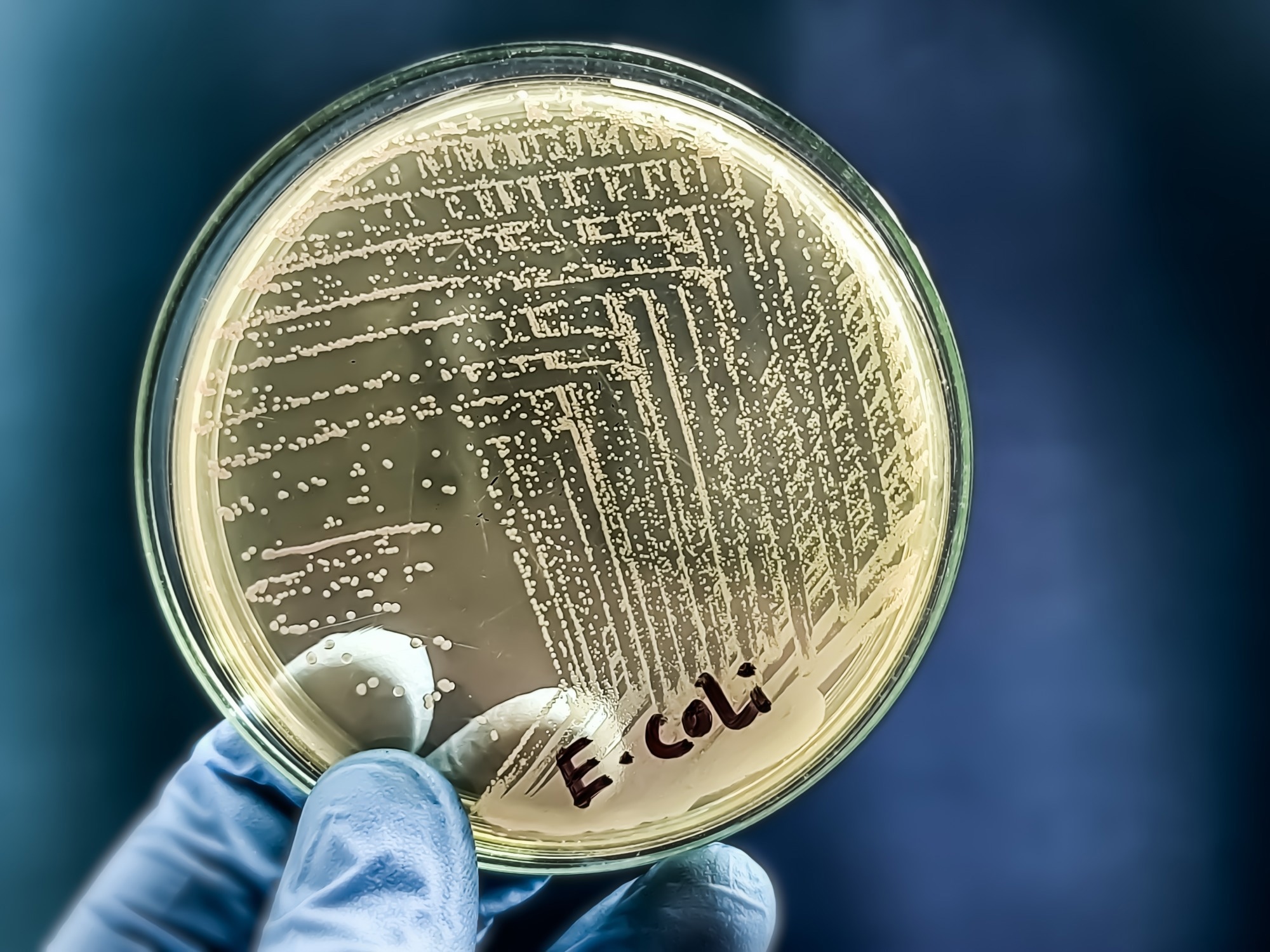 Image credit: Saiful52/Shutterstock.com
This finding, published in the journal Proceedings of the National Academy of Sciences (PNAS), aids in understanding bacterial survival processes and, consequently, antibiotic efficacy. The group showed that the bacteria Escherichia coli (E. coli) can produce an enzyme that chemically degrades the antibiotic, making it ineffective.
The researchers refer to this as 'altruistic cell death' since the enzyme is produced in particular by dying bacteria, ensuring the survival of the population as a whole. This helps explan bacterial collective survival strategies, which in turn enhances the efficacy of current and new antibiotics.
The project was inspired by a finding made by the study's first author, Dr. Rotem Gross (University of Cologne), who demonstrated that, while bacterial colonies first die when exposed to antibiotics, they gradually rebound and continue to proliferate uncontrolled. The team examined two distinct strains of E. coli bacteria, which are pathogens that cause hospital-acquired infections, septicemia, and urinary tract infections, among other ailments.
They also looked into how these strains responded to beta-lactams, the most commonly used class of antibiotics in the world. The antibiotic is chemically broken down by the enzyme beta-lactamase, which is produced by the bacteria. When its concentration fell below a threshold level due to enzymatic activity, the bacterial cultures began to recover.
Therefore, the death of some of the bacteria contributes significantly to the long-term survival of the population as a whole, which can be interpreted as an example of altruistic collective behavior.”
Dr. Joachim Krug, University of Cologne
Along with the dying bacteria, the remaining bacteria also help in fighting off the antibiotic. They also make the enzyme, but it stays inside the cell and breaks down the antibiotic that has been absorbed. The enzyme is released by the dying bacterium. This happens in both E. Coli strains that were studied.
Nonetheless, the researchers observed that there are significant differences between the two E. coli strains under investigation in the degree to which cell death influences the decrease in the antibiotic.
Since beta-lactamase inhibitors are only effective in culture media and cannot enter intact cells, this implies that the strains will also respond differentially to their administration. Beta-lactamase inhibitors are substances intended to get around bacterial resistance mechanisms. The population is consequently more vulnerable to these substances, which are already often used to treat infections, when there is a larger degree of altruistic cell death.
We were amazed by the variety of defense mechanisms that the bacteria are able to mobilize even under simple laboratory conditions.”
Dr. Joachim Krug, University of Cologne
As a result, predicting the effectiveness of specific antibiotics under realistic physiological conditions is a significant challenge, which the team hopes to address in the future.
Source:
Journal reference:
Gross, R., et al. (2026). Contributions of intra- and extracellular antibiotic degradation to collective β-lactam survival. Proceedings of the National Academy of Sciences. DOI: 10.1073/pnas.2526410123. https://www.pnas.org/doi/full/10.1073/pnas.2526410123
 Living Organisms Depend on Bacterial Production of Critical Vitamin B12