A novel bio-based nanofibre dressing exploits a difference of just two carbon atoms between closely related polymers to direct antibiotic release towards wounds, offering a sustainable strategy to combat early bacterial colonization before biofilms take hold.
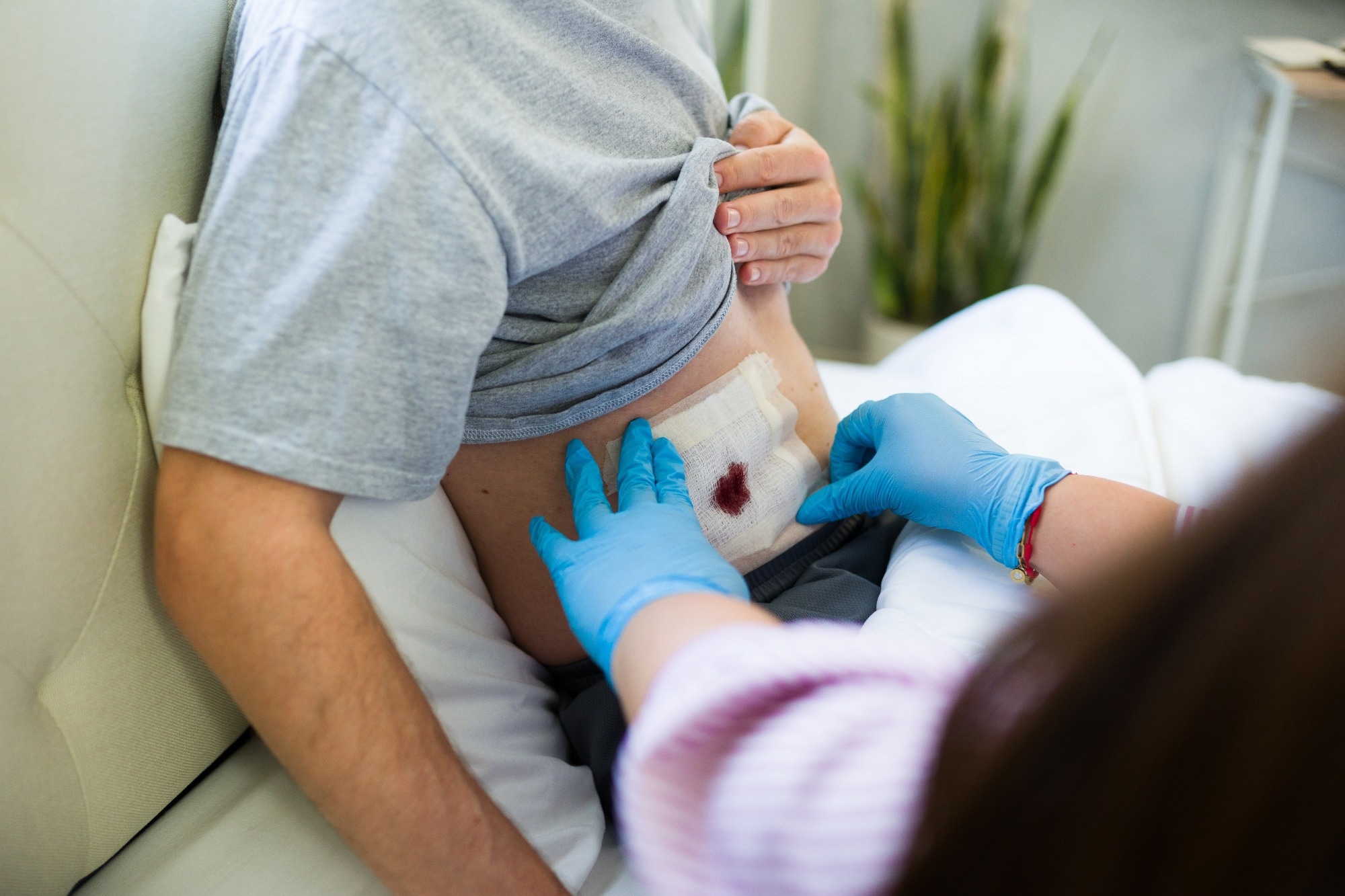 Study: Janus electrospun nanofiber membranes from bio-based furan polyamides for antibacterial wound care. Image credit: antoniodiaz/Shutterstock.com
In a recent study published in Bioactive Materials, a team investigated whether bio-based polymers could be used to create an antibacterial dressing that suppresses early bacterial colonization during the critical early phase of wound healing.
Renewable Polymers Offer A New Dressing Strategy
Wound management places a major financial strain on healthcare systems worldwide, with annual costs exceeding $100 billion. Bacteria such as Pseudomonas aeruginosa and Staphylococcus aureus frequently establish themselves in wounds in the early stages and construct biofilms that resist conventional therapies.
There is a growing demand for dressings that pair mechanical protection with targeted antibacterial delivery. Janus membranes, which are materials built with two functionally separate faces, have attracted increasing attention as a solution to infected wounds. In principle, one surface can draw in moisture and deliver medication toward the wound bed, while the opposite surface is intended to guard against outside contamination and reduce fluid loss.
However, most Janus dressings achieve this asymmetry using petroleum-derived plastics or additional manufacturing steps, such as surface coatings, prompting interest in renewable materials and simpler manufacturing routes to reduce reliance on fossil-derived raw materials. Furthermore, although renewable electrospun wound materials have been investigated, furan-based polyamides have received little attention as biomedical membranes, particularly where small chemical variations within a single bio-based polymer family could produce the same asymmetric effect on their own.
Two Bio-Based Polymers Form A Janus Dressing
In the present study, the research team synthesized two plant-derived polymers, poly(octamethylene furanamide) (PA8F) and poly(decamethylene furanamide) (PA10F), via melt polycondensation, combining a renewable furan-derived monomer with two aliphatic diamines differing only in chain length.
To construct the antibacterial layer, tetracycline was first dispersed in dichloromethane and then added to a formic acid solution of the more hydrophilic polymer PA8F, which was then electrospun onto a rotating collector using defined voltage, flow rate, distance, and humidity conditions. A solution containing the more hydrophobic polymer PA10F was electrospun directly over this layer using a different voltage and tip-to-collector distance, yielding a bilayer membrane with two functionally different surfaces. The researchers also developed drug-free control membranes for comparison.
They then characterized the membrane, using scanning electron microscopy to examine fiber morphology, infrared spectroscopy to assess chemical composition, and X-ray diffraction to evaluate crystallinity.
Additionally, the wettability of each face was tested independently using water droplets and contact angle measurement, and tensile and cyclic loading tests were used to evaluate the mechanical strength and durability. The team also examined thermal behavior across heating and cooling cycles and assessed thermal decomposition, and used confocal microscopy to track how the antibiotic was distributed through the fibers.
The team employed coarse-grained molecular dynamics simulations to model how each polymer interacted with water at the molecular scale over several nanoseconds. Drug release was monitored by immersing membrane samples in a buffer solution and measuring absorbance over time, and a custom two-chamber apparatus independently compared the release rates from each face.
Lastly, human dermal fibroblasts exposed to membrane extracts were evaluated for viability, proliferation, and inflammatory markers, and antibacterial efficacy was assessed using inhibition zone assays, biofilm models, and an ex vivo pig skin burn wound model pre-infected with bacteria.
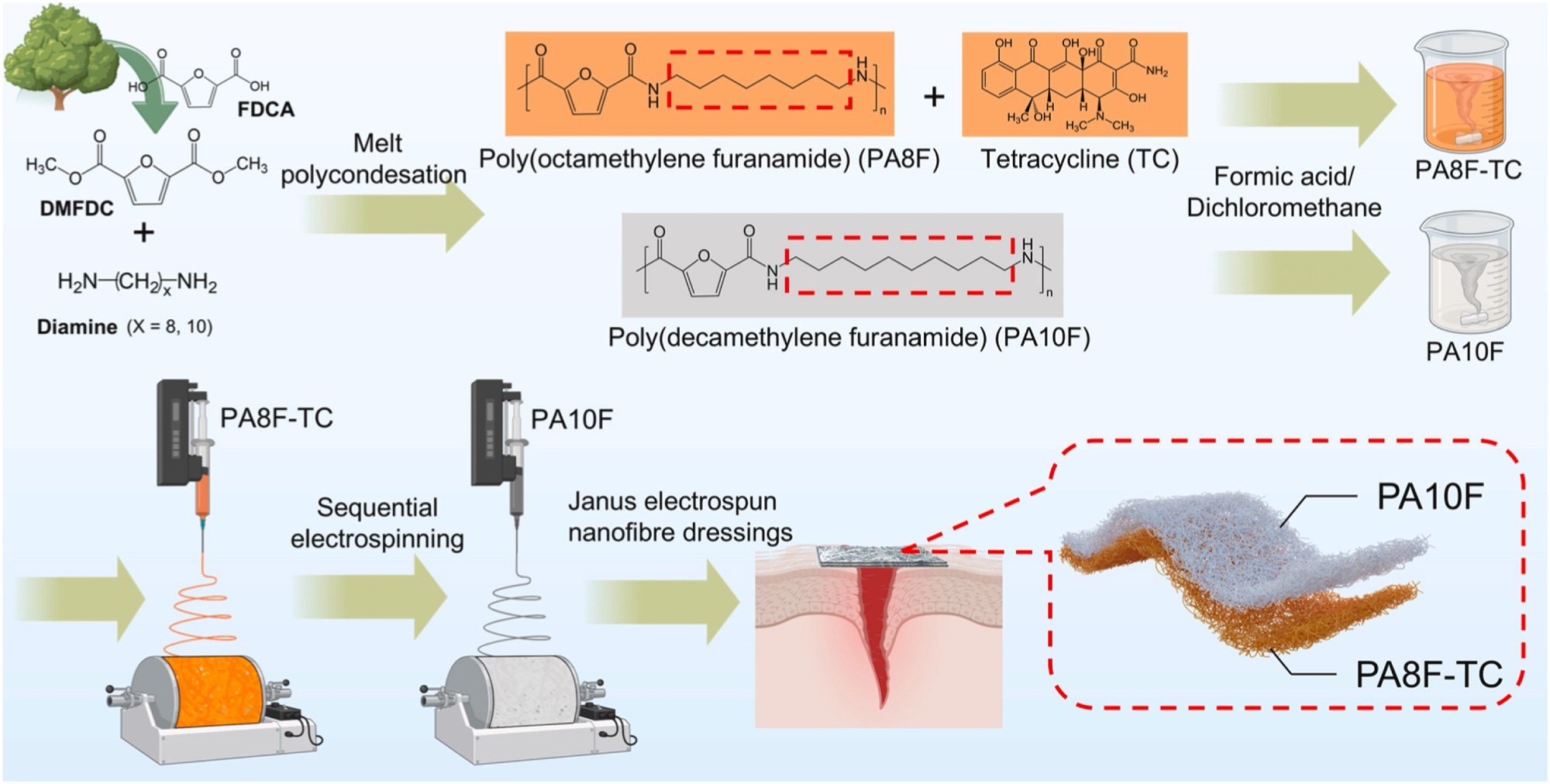 Researchers synthesised two bio-based furan polyamides that differ by just two carbon atoms in their molecular structure before sequentially electrospinning them into a Janus nanofibre wound dressing. The resulting membrane combines a hydrophilic, tetracycline-loaded inner layer with a hydrophobic outer barrier to direct antibiotic release towards the wound while helping regulate moisture and protect against external contamination. Image credit: Ding et al, 2026.
Janus Membrane Reduces Bacteria In Laboratory And Tissue Models
Despite the two polymers differing by only two carbons in chain length, the researchers found a marked difference in how each face of the spun membrane behaved, a difference that was modest in dense films but became pronounced after electrospinning. The antibiotic-loaded PA8F surface wetted rapidly and absorbed water, whereas the PA10F surface showed no noticeable water absorption during the 60-second measurement, supporting its proposed role as the more hydrophobic barrier.
Molecular simulations linked this behavior to the preferential exposure of polar chemical groups such as acetamide and furan units near the hydrophilic polymer's surface, while the hydrophobic layer had aliphatic spacer beads near the surface. Water penetrated both polymer models, but infiltration occurred earlier and more extensively in PA8F than in PA10F.
Drug release experiments showed that tetracycline concentrations in phosphate-buffered saline rose rapidly to approximately 20 micrograms per milliliter within roughly four hours before plateauing, with the treatment-facing side releasing more antibiotic early on before release from both sides converged over two days. This early, rapid release is significant because the first hours after contamination offer an important opportunity to suppress bacterial colonization before structured biofilms form.
Fibroblasts exposed to polymer extracts retained viability above the accepted cytotoxicity threshold, and the researchers detected no significant increase in the inflammatory marker IL-6 under the tested conditions. The material tolerated 100 cycles of low-strain tensile loading without mechanical failure, although the tetracycline-loaded membrane was relatively stiff and had limited extensibility compared with native skin. Against the two common wound-associated bacteria, P. aeruginosa and S. aureus, the membranes produced approximately one-log and two-log reductions in viable colony-biofilm cells, respectively.
In the more realistic ex vivo pig skin burn model, the tetracycline-loaded membrane still reduced bacterial counts by approximately 0.5 log compared with an otherwise similar drug-free Janus membrane. However, the effect was more modest than under simpler lab conditions. The team attributed this gap to the irregular surface and higher organic content of real tissue, as well as restricted antibiotic diffusion.
They also noted that being bio-based does not mean that the polymers are biodegradable. Although their biodegradation and compostability have not been directly evaluated, substantial degradation under typical environmental, composting, or physiological conditions is not expected, and recycling may represent a more realistic end-of-life option.
Bio-Based Membrane Shows Promise For Sustainable Wound Care
In summary, the study demonstrated that renewable, furan-based polymers can be used to construct experimental two-sided antibacterial wound dressings without the need for added surface treatments, relying instead on subtle structural differences between closely related molecules.
In laboratory and ex vivo models, the membranes delivered tetracycline and reduced bacterial burden, although the study did not assess wound healing or clinical effectiveness. These results suggest a promising path toward more sustainable wound care materials, though additional research is needed to establish direct tissue compatibility, longer-term safety, performance in living wound models, healing outcomes, conformability, scalable manufacture, and appropriate end-of-life pathways.
Download your PDF copy now!
Journal Reference
Ding, X., Thet, N. T., Herdes, C., Chaloner, E., Negasi, M., Kontou, I., Laabei, M., Jungwirth, U., Savage, D., Kamran, M., Zachariadis, M., Jenkins, T., Davidson, M. G., & Leese, H. S. (2026). Janus electrospun nanofiber membranes from bio-based furan polyamides for antibacterial wound care. Bioactive Materials, 65, 1043–1055. DOI:10.1016/j.bioactmat.2026.06.022
https://www.sciencedirect.com/science/article/pii/S2452199X26003580
 Invasive E. coli Strains Promote Host Invasion of Harmless Strains