Scientists at the University of California, Riverside are developing new drugs for the two major parasitic infectious diseases - babesiosis and malaria. The study will focus on advancing two potential classes of antiparasitic compounds to the preclinical development stage.
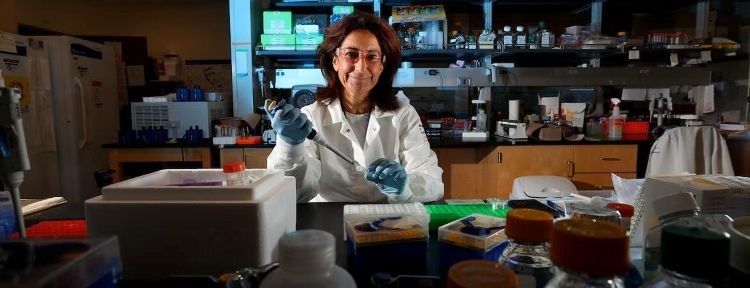 Image Credit: University of California, Riverside
The study is funded by two collaborative grants from the National Institute of Allergy and Infectious Diseases, part of the National Institutes of Health. The grants have been awarded to scientists at the University of California, Irvine, UC Riverside, and Yale University and total more than $8 million, of which UC Riverside will receive more than $2.5 million.
The objective of the projects is to focus on the tick-borne disease, babesiosis, which has become more common in the United States, owing to the expansion of the tick population, and malaria, which kills hundreds of thousands of people globally every year. As the two diseases are caused by closely related parasites that affect red blood cells, it is possible to develop drugs that target both.
The major issue is that the parasites are becoming resistant to current treatments. We definitely need the next line of defense against these infectious diseases.
Karine Le Roch, Professor, Molecular, Cell and Systems Biology, University of California, Riverside
The study builds on years of collaboration among Le Roch, UC Irvine chemist Christopher Vanderwal, and Yale University scientist Choukri Ben Mamoun. The three co-principal investigators and their research teams have expertise in genetics, animal models, parasite biology, medicinal chemistry, and systems biology to convert naturally occurring compounds into potential therapies.
We already have promising lead compounds that are highly active against both Plasmodium and Babesia. Now the goal is to move those lead compounds toward preclinical development.
Karine Le Roch, Professor, Molecular, Cell and Systems Biology, University of California, Riverside
Le Roch is also the director of UCR’s Center for Infectious Disease and Vector Research.
The first project investigates leelamine-derived isonitriles (LDIs), compounds that are synthesized from leelamine, a natural product found in pine bark.
The second project focuses on pyrroloiminoquinones (PIQs), which originate from marine sponges. Although both compounds have been extracted from different natural sources, both have shown potent activity against babesiosis and malarial parasites, including drug-resistant strains.
According to Le Roch, while natural products have been used as a foundation for many medicines, challenges exist with their complex chemical structure, which makes the manufacturing process expensive and difficult.
These compounds are usually extremely effective, but they are also very complex molecules. These two projects focus on compounds that are easier and much less expensive to synthesize.
Karine Le Roch, Professor, Molecular, Cell and Systems Biology, University of California, Riverside
In the next five years, the researchers' objective is to further optimize PIQs and LDIs, evaluate their safety, test them in laboratory and animal models, and determine their precise mechanisms against these parasites. This will enable them to further refine the compounds and analyze whether their target biological pathways differ from those targeted by existing therapies.
“We hope to demonstrate that they target completely different pathways than the treatments currently being used. That’s likely because both classes of compounds are active against drug-resistant parasite strains,” added Le Roch.
The scientists are also working to make the compounds interrupt the parasitic transmission rather than just eliminating the infection.
“We’re aiming not only to kill the parasite but also to stop transmission. Ultimately, the goal would be to develop an oral treatment,” said Le Roch.
Le Roch’s laboratory will study the compounds’ effect on parasites at the molecular level using systems biology techniques and the nature of resistance developed. Vanderwal’s team will synthesize and optimize the compounds, while Ben Mamoun’s laboratory will focus on evaluating their effectiveness in animal models and lead research studies on babesiosis.
“Today, biology is becoming so complicated that you need different types of expertise to move projects like this forward. We need the chemist to create the compounds, experts to evaluate them in animal models, and our lab to understand how they work against the parasites,” said Le Roch.
As babesiosis and malaria belong to the same parasitic group, the study results will help to identify therapies beyond these two diseases, such as other apicomplexan parasites, including Toxoplasma.
The grants will support undergraduate and graduate scientists in Le Roch’s laboratory.
“Funding projects like these is essential. It allows us to train the next generation of scientists and develop treatments that could help people,” added Le Roch.
The initial grant, "Therapeutic Potential and Mechanism of Action of Leelamine-Derived Isonitriles for Malaria and Babesiosis," provides $4.07 million in combined support, containing $1.18 million designated for UC Riverside. The secondary grant, "Optimization of the Pyrroloiminoquinone Scaffold for Malaria and Babesiosis Treatment," delivers $3.94 million, featuring $1.34 million allocated to UC Riverside.
“I really want these compounds to move to the next step in preclinical and clinical trials. We definitely need new treatments against these devastating diseases,” added Le Roch.
 Malva Platform Locates Pathogens and Tumor Driving Cells in Seconds