Engineers have built the first microscope to see inside living cells in sub-zero conditions, revealing secrets of Antarctic fish survival.
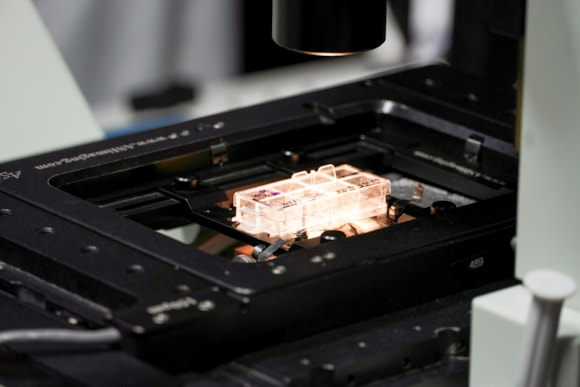
The sample lit up. Image Credit: CEB
Scientists have captured the first-ever high-resolution images of living Antarctic fish cells, using a new microscope engineered to operate at near 0 °C. The breakthrough reveals how these cold-blooded animals have adapted at a cellular level to survive year-round in the Southern Ocean, where temperatures range between -1.8 and 2 °C.
The research, led by British Antarctic Survey and the Department for Chemical Engineering and Biotechnology (CEB) at the University of Cambridge, could also offer wider insights relevant to human biology, including how cells cope with protein misfolding, a process seen in conditions like Alzheimer’s and Parkinson’s.
Studying cold-adapted cells has historically been a technological challenge. Cold-temperature microscopy has previously only produced low-resolution images, and keeping live cells from cold-adapted species at their natural temperature has proved difficult. To solve this, engineers at CEB designed a new microscope capable of performing cutting-edge fluorescence microscopy at close to 0 °C, giving researchers a never-seen-before look into living, cold-adapted cells.
The team cultured cells from the Antarctic spiny plunderfish (Harpagifer antarcticus) – a small bottom-dwelling fish, found in shallow waters in the Southern Ocean and sub-Antarctic islands. This was the first time Antarctic fish cells have ever been cultured and required scientists to develop a new cell culturing technique that can now be used in future research.
For comparison, they also cultured cells from the shanny (Lipophrys pholis), a small fish found in shallow waters around the UK. Using fluorescent dyes and the new microscope, the team were able to compare the structure and behavior of the two species’ cells.
The Protein Problem
The researchers found that the cold-adapted cells have developed several ‘workarounds’ to cope with low temperatures, and the difficulties this creates for normal cell function, especially around energy production and protein folding.
The cells’ ‘engines’ – the mitochondria – have merged into larger, connected networks, and there are more mitochondria overall. The researchers think this could be the cell’s way of producing more energy and protecting the mitochondria, because making protein is inefficient in the cold.
The lysosomes, which act as the cells’ recycling bins, were also bigger in the Antarctic fish cells. The researchers think this means the cell is working hard to break down and dispose of the higher numbers of damaged or misfolded proteins that occur in the cold.
Dr Francesca van Tartwijk, a cell biologist with the British Antarctic Survey and the University of Cambridge, is leading this research.
Protein isn’t just something we eat – it’s a critical part of basic cell biology. Proteins start off as long chains of molecules called amino acids, a bit like a string of beads. These chains then fold themselves into a precise shape, almost like origami, and this shape determines everything about what a protein can do. Low temperatures – like in the Southern Ocean – slow down and disrupt this process – and make mistakes in the folding more likely. A misfolded protein is useless at best, but can be really harmful, so these cold-adapted cells need ways of dealing with them.”
Dr Francesca van Tartwijk, Cell Biologist, British Antarctic Survey
A potentially surprising finding was that, despite cold-adapted animals being extremely slow at the whole-body level – they are slow to develop and slow to grow – movement within their cells is not. The mitochondria in cold-adapted cells move at surprisingly high speeds, and the basic process of how different molecules organize themselves inside cells still works normally. This challenges previous assumptions that adapting to the cold means everything slows down.
Professor Melody Clark is the Genetics Leader at British Antarctic Survey and co-leads the ‘Cold Fish’ project. She said:
“Antarctic animals are incredibly vulnerable to climate change – we already know this. Raising temperatures just a few degrees can be lethal. We want to unpick why Antarctic species have such low tolerances for increases in temperature – are their limits set by their cell biology, or is it their whole-body systems, like circulation.”
From Fish to Therapeutics
As well as learning more about why Antarctic species are struggling in a changing climate, the research could have implications for human biology and therapeutics.
Protein misfolding is a key feature of human neurodegenerative diseases like Alzheimer’s, Parkinson’s and Huntington’s. Understanding how Antarctic fish cope with high levels of protein misfolding may, over time, help researchers identify techniques that could be useful in therapeutics for these diseases. Learning more about the cold-resistant mechanisms at play in Antarctic fish cells could also help researchers understand how to protect donated human tissue while it is kept cold.
Another potential application is improving the sustainability of biotechnology. Currently, many biotechnical processes happen at higher temperatures, where the cells and enzymes work best. However, this requires more energy use. Studying cold-adapted cells could help us explore lower temperature, more sustainable processes.
Dr Francesca van Tartwijk added:
“Our work is exciting and important because it allows us to explore questions that have, until now, remained beyond the reach of science. Our findings have the potential to affect a range of scientific disciplines and applications, far beyond ecology and the polar regions.”
Professor Clemens Kaminski, Head of Department at CEB and co-lead on the project, said:
"It is super exciting to be able to study living cells at sub-zero temperatures and see with our own eyes what is going on. The team has established a new experimental capability and provided insights that we simply could not have gathered before. It’s a great example of how advances in scientific instruments can lead to entirely new areas of discovery.
“The next step is to develop imaging technologies that will allow us to study biological systems under controlled conditions that more closely reflect the polar environments in which they evolved."
Dynamic live cell imaging at sub-zero temperatures is part-funded by UKRI. Read more about the project on the British Antarctic Survey website. The researchers’ initial findings are available as a pre-print: Antarctic fish cell cultures show adaptation of organelle morphology and dynamics to extreme cold.
 Groundbreaking ARUP Research Clarifies Clinical Value of Atypical Cell-Free DNA Screening Results