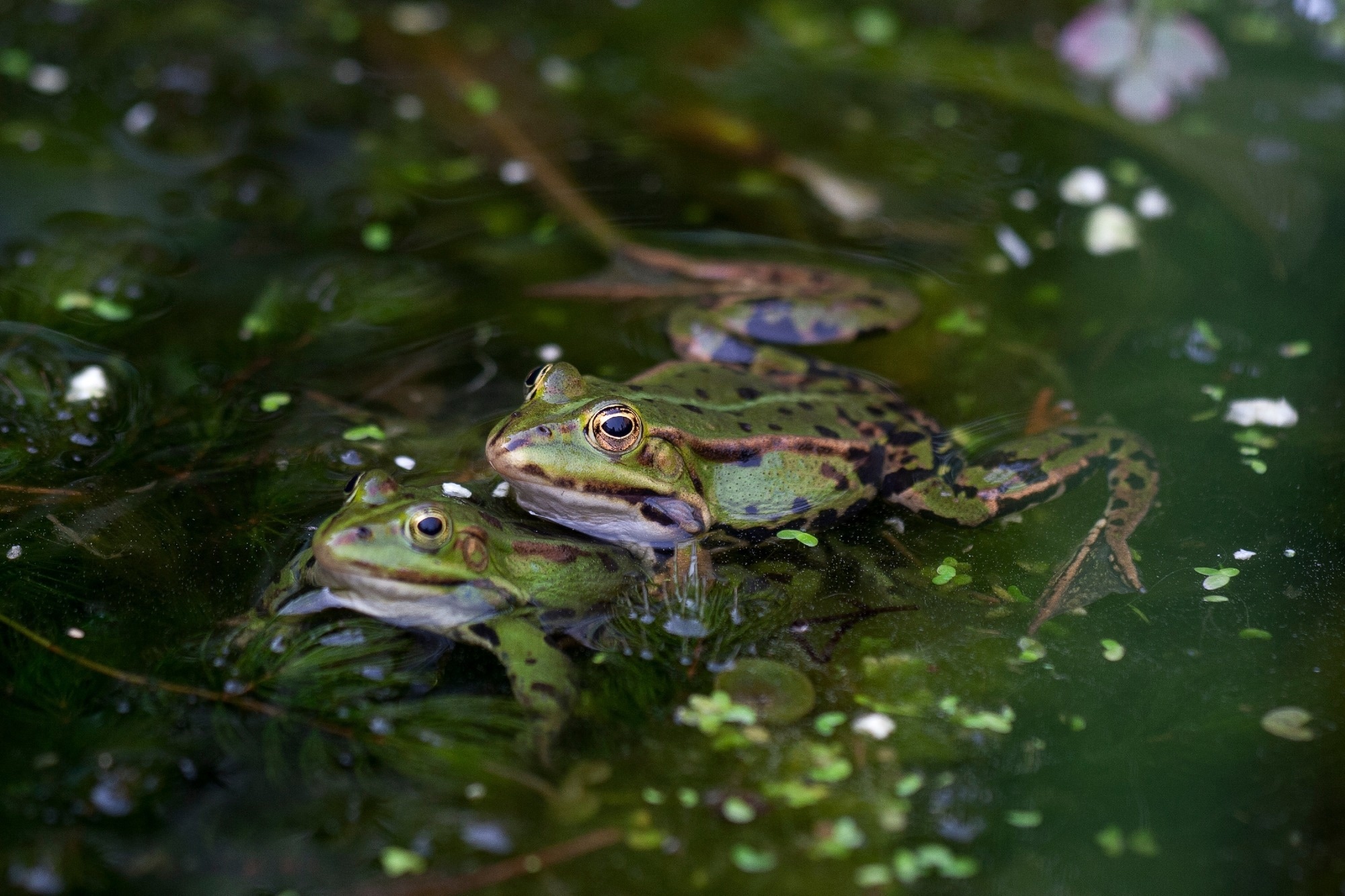
Pond frogs (Pelophylax nigromaculatus) may have a surprising edge against one of nature’s most painful defenses. A recent Ecosphere study found that pond frogs can withstand repeated stings from hornets, including the deadly Asian giant hornet (Vespa mandarinia), quickly resuming normal behavior after each encounter. This venom tolerance enables successful predation on hornet workers, offering new insights into ecology, biological control, and biomedical research on pain and toxin resistance.
 Study: Michar Peppenster/Shutterstock.com
Predation pressure has shaped a wide range of defensive strategies in prey species, including venomous stings by arthropods such as wasps, bees, ants, and scorpions. Hornets (Vespa spp.) represent an extreme example, possessing large venom reserves that can inflict intense pain, cause tissue damage, and even prove lethal to small vertebrates.
Despite these risks, adult hornets have been reported in the stomach contents of several amphibian predators, suggesting that some species may overcome these defenses. However, whether such predators actively tolerate hornet stings or avoid them has remained unknown. This gap is particularly relevant in Japanese satoyama landscapes, where hornets and pond frogs frequently overlap at the edges of ponds.
Testing Frog Responses to Stinging Hornet Workers
In the present study, researchers assessed whether pond frogs avoid or tolerate hornet stings during predation by conducting controlled laboratory experiments exposing pond frogs to venomous hornet workers from three common Japanese Vespa species: Vespa simillima, Vespa analis, and Vespa mandarinia. They collected hornet workers from grasslands and secondary forests in Hyogo Prefecture, Japan, between July and October 2024, using insect nets and bait traps. They maintained the hornets in individual cages under laboratory conditions. The hornets were fed insect jelly throughout the study.
The team also collected adult pond frogs from paddy fields and pond margins in Hyogo and Shimane Prefectures. Before experiments, frogs were fed live invertebrates and then fasted for 24 - 48 hours to standardize hunger levels. During experiments, researchers first stimulated the hornets to trigger active stinging behavior. Each hornet was then introduced into a frog’s enclosure. They recorded the interactions using digital video to capture attack, defense, and consumption behaviors.
Tongue contact with a hornet indicated an attack, while swallowing the hornet without regurgitation was classified as successful predation. Analyses of post-feeding fecal samples confirmed digestion. In total, the researchers tested 45 frogs and 45 hornets (15 of each species), assigning larger frogs to trials involving V. mandarinia to match size constraints.
The researchers used generalized linear models to examine the impact of hornet species and size, as well as frog size, on predation success. The study procedures complied with institutional animal care guidelines. There were no injuries or fatalities among the frogs.
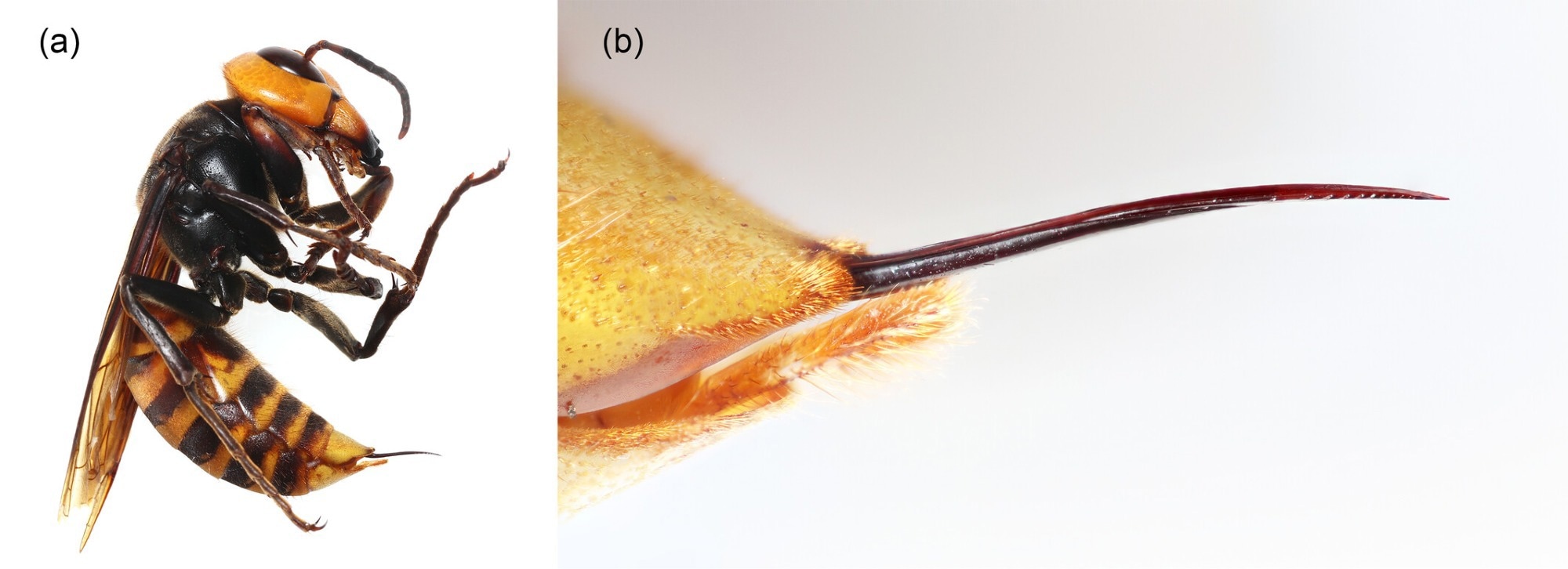
(a) A V. mandarinia worker. (b) Close-up view of the stinger of the V. mandarinia worker shown in (a). Stinger length: 4.3 mm.
High Predation Rate Across Three Hornet Species
The experiments revealed a high level of predation success by pond frogs against all three species of venomous hornets tested. Of the frogs exposed to hornets, 93 % successfully consumed Vespa simillima, 87 % consumed Vespa analis, and 79 % consumed the Asian giant hornet, Vespa mandarinia.
Most frogs actively attacked the hornets, with attack rates exceeding 90 % in all groups. During these encounters, hornets often stung sensitive areas, including the frog's face, eyes, tongue, palate, and throat. Despite repeated stings, most frogs swallowed the hornets without regurgitation.
Importantly, no hornet sting caused death or visible injury in any frog. All individuals that consumed hornets resumed normal behavior shortly after the encounters, indicating rapid recovery from venom exposure. The presence of undigested hornet body parts in frog feces after two to four days of ingestion confirmed digestive success. A small proportion of frogs abandoned attacks or expelled hornets after repeated stings, with avoidance increasing slightly for the largest species, V. mandarinia.
Statistical analyses showed that frog body size was a key predictor of predation success. Larger frogs were significantly more likely to consume hornets, suggesting a size-related increase in tolerance to venomous stings. Notably, this pattern persisted even though the frogs were much smaller than mammals, for which a hornet sting could be fatal. Overall, the results demonstrate that pond frogs exhibit remarkable resilience to hornet venom, including that of the world’s largest hornet species.
What Venom Tolerance Reveals About Predator-Prey Evolution
Based on the findings, pond frogs are surprisingly effective predators of venomous hornets, including the Asian giant hornet. Rather than acting as specialized hornet predators or population-level regulators, pond frogs appear to exploit hornets, whose venomous defenses evolved primarily to deter birds and mammals, not amphibians.
Their unusual ability to withstand venom and painful stings not only enables successful predation but also positions them as valuable model organisms for research into toxin resistance and pain modulation. The study highlights frogs as a system for investigating how vertebrates can tolerate both the painful and potentially lethal effects of venom.
Future studies could investigate the physiological mechanisms that allow frogs to tolerate venom and painful stings. Researchers could also assess whether repeated exposure affects prey selectivity. By emphasizing physiological resilience and behavioral responses, these insights may inform biological control strategies and highlight the complex adaptations that enable pond frogs, and potentially other vertebrates, to overcome the formidable defense strategies of their prey in nature.
Download your PDF copy now!
Journal Reference
Sugiura, S. (2025). Pond frog as a predator of hornet workers: High tolerance to venomous stings. Ecosphere, 16(12), e70457. DOI: 10.1002/ecs2.70457. https://esajournals.onlinelibrary.wiley.com/doi/10.1002/ecs2.70457
 How Can Stressed Mitochondria Actually Protect Your Heart?