Researchers at Northwestern University have discovered a previously unknown molecular "control switch" within a protein that plays a crucial role in the body's ability to perceive taste, regulate blood sugar levels, and protect the gut.
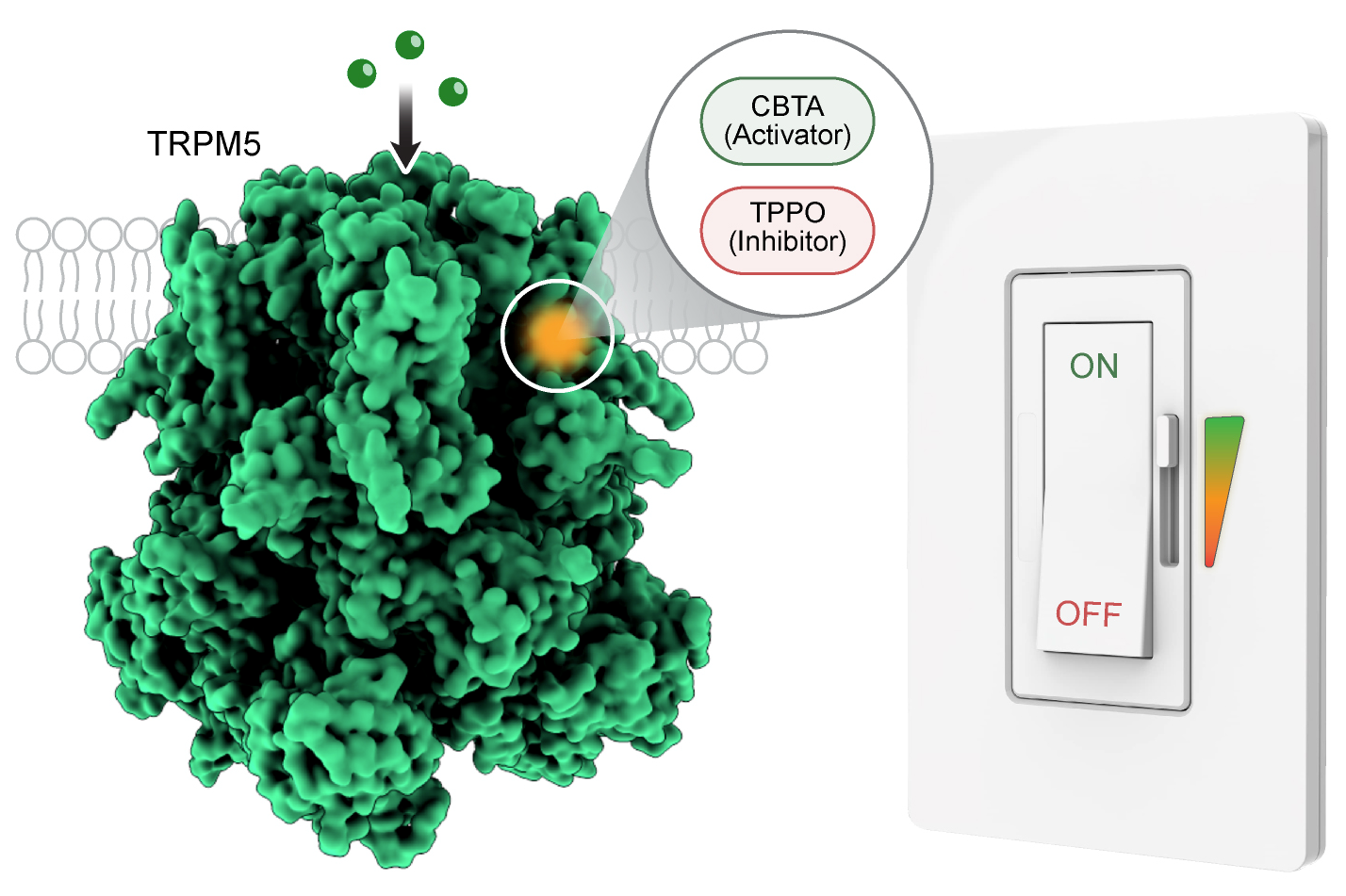
This illustration shows how the TRPM5 channel acts as a dual purpose control site. Image Credit: Juan Du/Wei Lu/Northwestern University
This switch, found within the TRPM5 protein, can function as both an accelerator and a brake, depending on the molecule that attaches to it. Previously, scientists believed that TRPM5 could only be activated when calcium levels rose within cells. However, the latest research indicates that small molecules can directly influence the protein, without the need for calcium.
The researchers pinpointed one molecule that activates TRPM5 and another that binds to the same site but inhibits its function, thus revealing a dual-purpose control mechanism.
Given that TRPM5 is integral to biological functions linking taste, metabolism, and gut health, the capacity to precisely adjust its activity opens up new avenues for therapeutic advancements. Possible applications include enhancing insulin secretion to improve glucose regulation in diabetes, altering taste perception to reduce food cravings, and managing gut immune signaling to alleviate inflammation.
The research was published in the journal Nature Chemical Biology.
TRPM5 is involved in metabolic disorders, including type 2 diabetes and obesity. If we can identify drugs that activate this channel, then we could promote insulin production to treat diseases that have problems with insulin secretion. Now that we have an overall architecture of what TRPM5 looks like and know how to activate and inhibit it, we have provided a basis for future drug development.
Wei Lü, Study Co-Lead and Corresponding Author and Professor, Molecular Biosciences, Northwestern University
TRPM5 functions as a signal amplifier and is found within various cell types. When activated, it permits the flow of sodium ions, which aids cells in transmitting electrical signals that govern essential biological functions. In the tongue, it plays a role in the detection of sweet, bitter, and umami tastes. In the pancreas, it facilitates insulin secretion following meals. Additionally, in the gut, it assists in sensing nutrients and modulating immune responses.
In 2021, Lü and Du published a research article in Nature Structural & Molecular Biology, where they presented the first high-resolution images of TRPM5, revealing two regions that could potentially be targeted for the development of new medications.
The research team employed cryo-electron microscopy (cryo-EM) and electrophysiology to observe the intricate mechanisms of TRPM5 in near-atomic resolution to gain a deeper insight into the functioning of this protein. They identified a concealed pocket that operates similarly to a universal remote control.
One specific molecule, referred to as CBTA, fits into this pocket in a manner that activates TRPM5, much like pressing the "power" button. Conversely, another molecule known as TPPO interacts with the same pocket differently, effectively locking the channel in a closed position, comparable to pressing "mute."
The molecules look alike and bind to the same pocket but play opposite roles. This pocket has never been reported before.
Juan Du, Study Co-Lead and Corresponding Author and Professor, Molecular Biosciences, Northwestern University
The team additionally discovered that when a molecule triggers TRPM5, it gains heightened sensitivity to calcium, reacting to minute alterations that would not normally influence it. This indicates that the pocket not only regulates the protein but can also enhance its activity significantly.
Source:
Journal reference:
Ruan, Z., et al. (2026) A single allosteric site merges activation, modulation and inhibition in TRPM5. Nature Chemical Biology. DOI: 10.1038/s41589-025-02097-7. https://www.nature.com/articles/s41589-025-02097-7.
 Genomic Database Analysis Identifies New Target for Triple-Negative Breast Tumors