Tardigrades, also known as water bears, could offer genuine insight into how humans could adapt extraterrestrial resources to support space exploration and whether such resources could help protect against Earthly contaminants humans might shed, in contrast to the fictional ragtag team of unenthusiastic heroes.
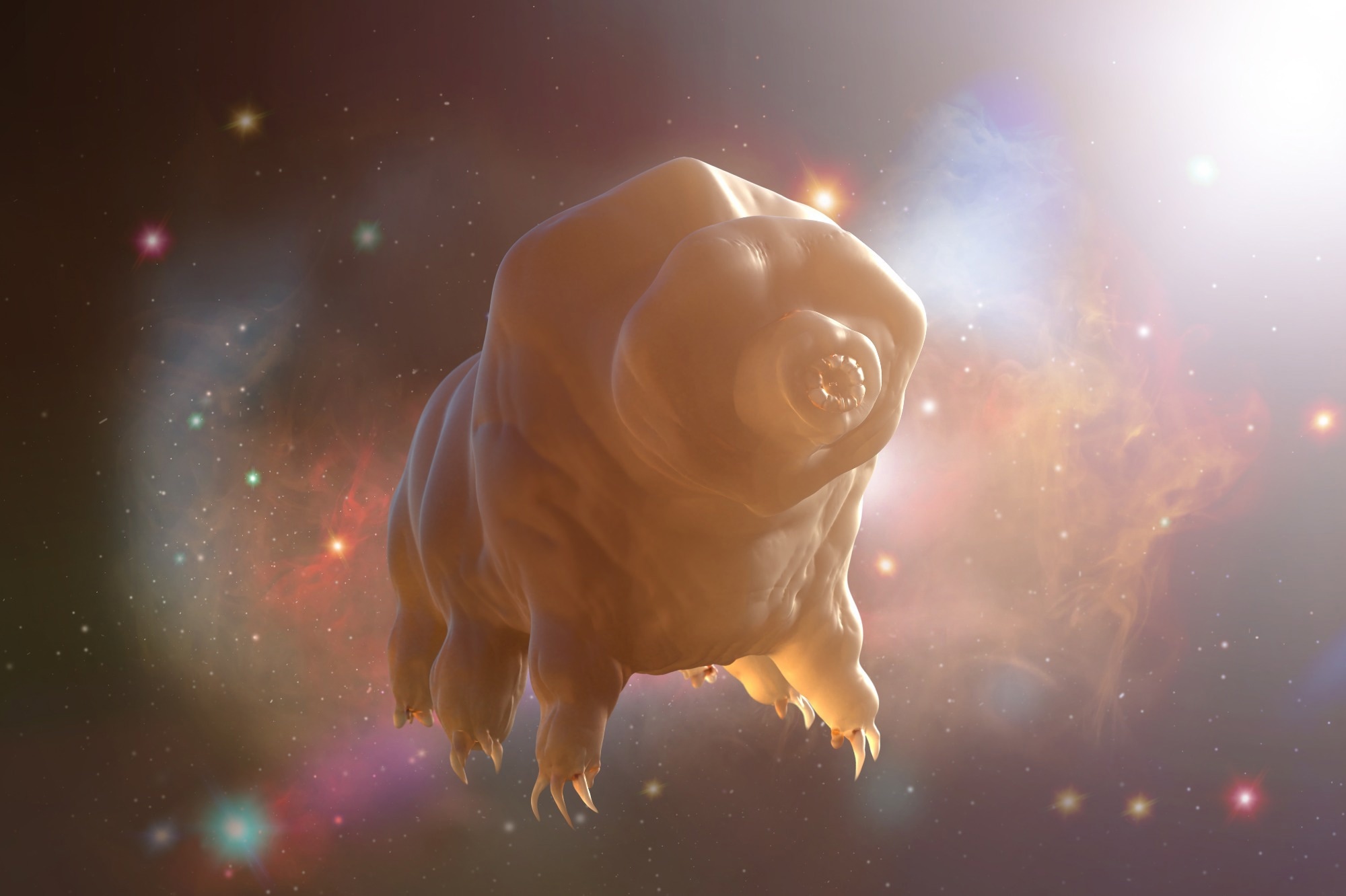 Image credit: Denis---S/Shutterstock.com
An international study team, led by Penn State Altoona Professor of Microbiology Corien Bakermans, recently found that tardigrade activity, a key indicator of their health, dropped sharply when the organisms were exposed to simulated Martian regolith, the loose layer of mineral material that blankets a planet or moon’s bedrock, much like soil does on Earth.
However, merely washing the regolith with water before introducing the tardigrades appears to eliminate certain hazardous elements and reduce the influence on their activity. Bakermans describes the results, which were published in the International Journal of Astrobiology, as a modest step toward a huge leap for humanity.
When considering sending people to non-Earth environments, we need to understand two things: how the environment will impact the people and how the people will impact the environment. With this research, we’re looking at a potential resource for being able to grow plants as part of establishing a healthy community – but we’re also looking at whether there are any inherent damaging conditions in the regolith that could help protect against contamination from Earth, which is a goal of planetary protection.
Corien Bakermans, Professor, Microbiology, Pennsylvania State University
Planetary protection refers to keeping extraterrestrial bodies safe from Earth contaminants and vice versa. It also strives to keep the science enabled by space exploration, whether by humans or robots, as free as possible of contaminants. The practice was agreed upon by multiple countries and is regulated by several space agencies, including NASA.
In other words, Bakermans stated that space mission planners may have less to worry about if a planet has its own regolith-based defense against extraterrestrial intruders. Such a system, however, would probably prevent people from adapting the regolith to meet their requirements, such as cultivating food, if they were trying to construct a base. The defense may also directly injure people if it were powerful enough.
“We know a lot about bacteria and fungi in simulated regolith, but very little about how they impact animals – even microscopic animals, like tardigrades,” Bakermans added, stating that synthetic regolith is intended to closely resemble the mineral and chemical makeup of what is found on Mars' surface.
We investigated the specific, isolated impact of the regolith on tardigrades.
Corien Bakermans, Professor, Microbiology, Pennsylvania State University
The researchers utilized two Martian regolith simulants, both of which resembled the regolith obtained by NASA's Curiosity Rover from the Rocknest deposit in Gale Crater, south of the planet's equator. One simulant, MGS-1, was initially intended to function as a "global" regolith, replicating the planet's whole surface. The other, OUCM-1, was designed subsequently to more closely resemble the specific sample region, with a focus on chemical composition in addition to mineral makeup.
Bakermans combined active tardigrades with samples of each regolith simulant and monitored their activity levels over many days using a microscope.
“For the MGS-1 simulant, we saw significant inhibition – reduced activity – within two days. It was very damaging compared to OUCM-1, which was still inhibitory but much less so,” Bakermans stated.
Tardigrades exist in two states: active and dormant. In their dormant form, which is normally attained by severe dehydration, they can withstand the vacuum of space, the depths of the ocean, and practically everything else. Tardigrades become significantly more sensitive after rehydration, although they can still survive at low temperatures, with fluctuating food supply, and in other harsh conditions. After only two days of exposure to MGS-1, the tardigrades showed no activity.
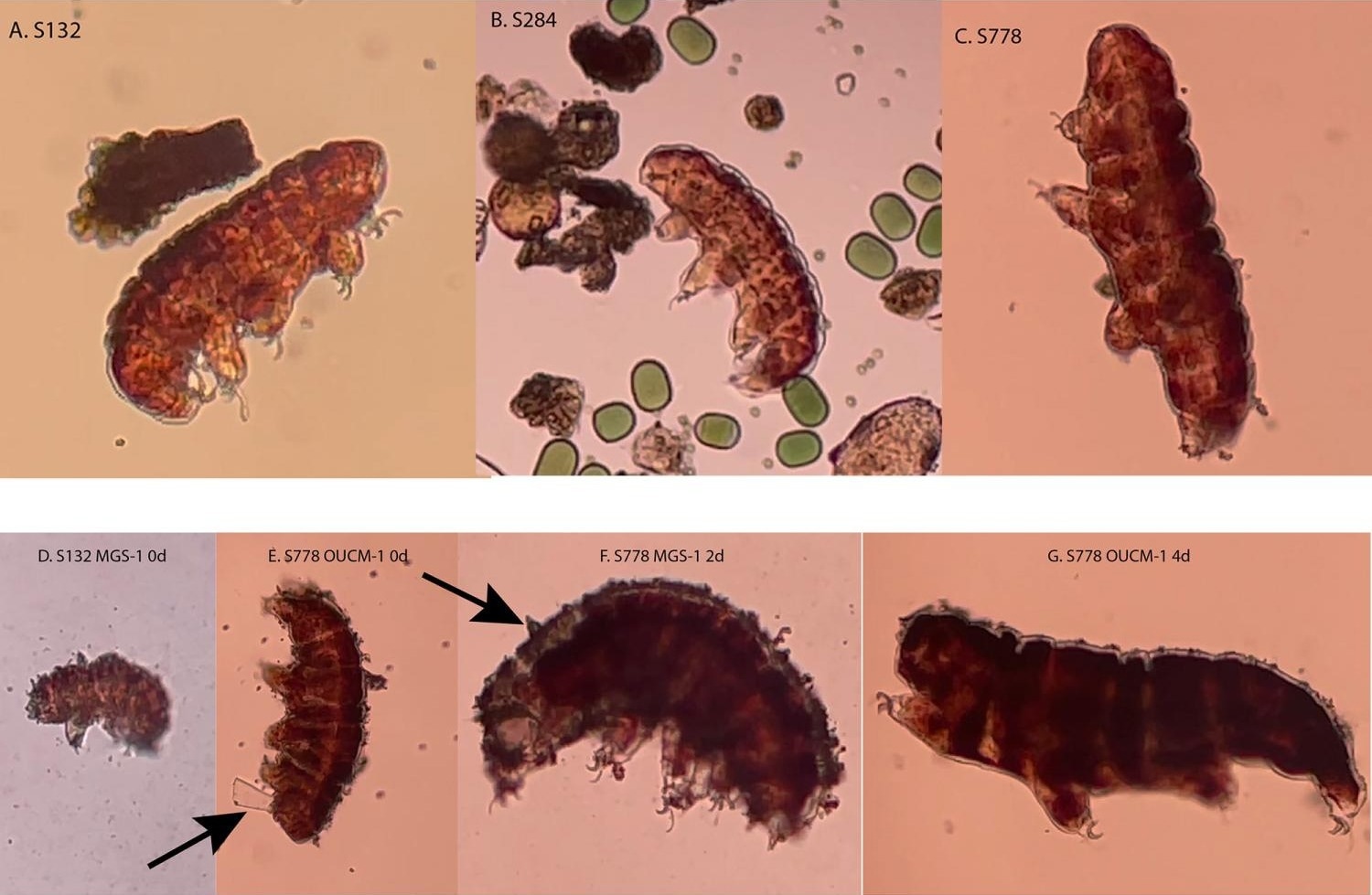 Tardigrades, a type of microscopic animal, in can reveal information about how life interacts with simulated Martian mineral deposits. The three images on top are active tardigrades in a typical Earth environment of beach sand. The bottom four images active tardigrades after some time in the simulated Martian soils, with arrows noting some mineral interactions. Image Credit: Corien Bakermans/Penn State
We were a little surprised by how damaging MGS-1 was. We theorized that there might be something specific in the simulant that could be washed away.
Corien Bakermans, Professor, Microbiology, Pennsylvania State University
The researchers rinsed MGS-1 with water before mixing it with new tardigrades. Those tardigrades showed very little decreased activity.
“It seems that there’s something very damaging in MGS-1 that can dissolve in water – maybe salts or some other compound,” Bakermans stated, noting the team was investigating further. “That was unexpected, but it’s good in a sense, because it means that the regolith’s defense mechanism could stop contaminants. At the same time, it can be washed to help support plant growth or prevent damage to humans who come in contact with it.”
Water is scarce in space, so washing regolith isn't a perfect answer, but Bakermans believes that knowing that the detrimental component can be wiped away helps to establish a beneficial knowledge base.
In addition to investigating the impacts of specific regolith constituents, the researchers are also looking at other factors that may influence activity, such as atmospheric pressure and temperature variances.
“Regolith isn’t the only component, of course. But we’re beginning to tease apart components of this overall system where any single piece could be a drawback or benefit the larger understanding of planetary protection,” Bakermans concluded.
Tardiguardians of the Galaxy
The first clip shows a tardigrade on its first day in OUCM-1, moving normally. Two days later, however, the simulant began to impact the tardigrade’s ability to move normally, as seen in the second clip. The other simulant, MGS-1, inhibited activity much earlier – until it was washed with water. Then, as seen in the third clip, it barely impacted tardigrade activity at all. The non-tardigrade bits visible in the second and third clips are simulant particles. Video Credit: Corien Bakermans/Penn State.
Source:
Journal reference:
 Research Exposes Molecular Mechanisms Dampening CD8+ T Cell Functional Efficacy