What if discarded plastic bottles could help produce life-saving drugs? A new study reveals how engineered microbes can transform waste into a vital Parkinson’s treatment, offering a glimpse into the future of sustainable pharmaceuticals.
 Study: Microbial upcycling of plastic waste to levodopa. Image credit: Adrian Tambo/Shutterstock.com
A new study published in Nature Sustainability demonstrates an intersection of environmental innovation and medical science: the conversion of plastic into a widely used Parkinson’s disease drug.
Researchers used Escherichia coli to generate levodopa (L-DOPA) from poly(ethylene terephthalate) (PET), a standard therapy for managing Parkinson’s motor symptoms. By overcoming critical metabolic bottlenecks and demonstrating proof-of-concept for carbon capture integration, the team achieved high laboratory-scale drug yields under mild conditions, offering a potentially scalable pathway, pending further validation, to transform plastic pollution into therapeutics and contributing to efforts to address plastic waste challenges.
Engineering Biology Enables Carbon Recovery From Plastic Waste
The global chemicals sector relies heavily on non-renewable fossil inputs, contributing to pollution, waste, and rising carbon emissions. In contrast, biological systems offer efficient, eco-conscious models for carbon use and chemical production. Advances in engineering biology now enable recovery and reuse of carbon from manufacturing by-products and discarded materials, supporting a shift toward a regenerative chemical system.
Notably, breakthroughs following the discovery of Ideonella sakaiensis have accelerated PET bio-upcycling into value-added products. However, despite growing demand, low-impact L-DOPA production routes remain limited, underscoring the need for scalable, broadly applicable solutions.
Engineering Bacteria to Convert PET into Levodopa
In this study, researchers developed a multi-step microbial process to convert PET waste into L-DOPA. They converted PET from industrial waste streams and discarded plastic bottles into terephthalic acid (TPA) using chemical and enzymatic approaches. The resulting TPA served as the starting material for a newly engineered bacterial biosynthetic system to produce L-DOPA.
Using a seven-gene, four-step pathway, the team guided TPA through successive conversions to protocatechuic acid (PCA), catechol, and finally L-DOPA. They organized these reactions into modular plasmids and expressed them in the modified bacterial strains, achieving high catalytic efficiency. To enhance substrate uptake, the researchers introduced a heterologous transporter, thereby improving TPA import and accelerating intermediate formation at neutral pH.
To overcome feedback inhibition and optimize yields, the investigators divided the pathway between two complementary strains: one converting TPA to catechol and the other transforming catechol into L-DOPA under optimized conditions. They refined reaction parameters, including pH, temperature, and cofactor availability, to maximize conversion efficiency, while monitoring intermediates and product formation using high-performance liquid chromatography (HPLC).
To validate the approach for carbon recycling, the researchers incorporated Chlamydomonas reinhardtii to capture carbon dioxide released during intermediate steps in a separate proof-of-concept experiment. Lastly, they scaled the process and purified L-DOPA using preparative HPLC to produce a chemically valid compound at a preparative scale using recycled plastics.
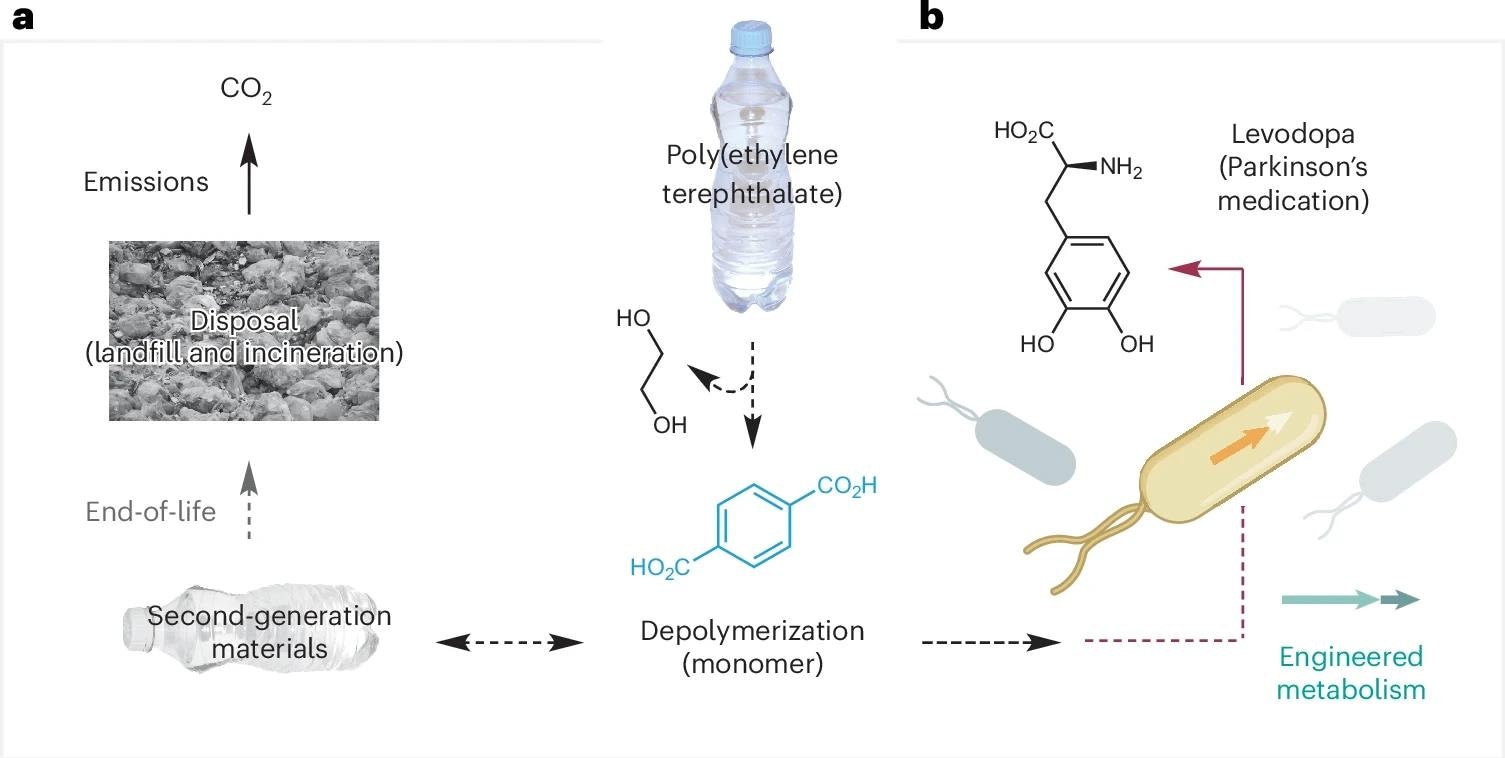 Approaches to the recycling, upcycling and environmental disposal of PET plastic waste, including the proposed bio-upcycling of PET waste to the Parkinson’s medication l-DOPA in engineered bacteria.
High-Yield Levodopa Production Achieved From Plastic Waste
The engineered system successfully converted PET-derived carbon into L-DOPA, demonstrating both high efficiency and laboratory-scale feasibility. Using optimized strains of E. coli, the researchers achieved L-DOPA titres of up to 5.0 g/L. Conversion efficiencies reached 84% under ideal conditions.
Initial experiments confirmed that over 90% of intermediates, particularly catechol, accumulated in the supernatant, enabling effective transfer between sequential microbial steps. HPLC analysis verified product formation, with a two-strain system yielding 0.68 g/L of L-DOPA and 69% overall conversion from TPA.
Mechanistic studies revealed key bottlenecks in the pathway. Both catechol and PCA inhibited critical enzymes, reducing conversion efficiency at higher substrate concentrations. Molecular modeling showed that these intermediates bind competitively to the active site of tyrosine-phenol lyase, explaining the feedback inhibition. Splitting the pathway across two strains effectively mitigated this issue and improved overall yields.
Importantly, the system performed well with real-world inputs. PET depolymerization produced TPA with 51–83% purity. Subsequent bioconversion achieved 49–55% L-DOPA yields using recycled plastic bottles and industrial PET. Scale-up experiments produced 0.9 g/L of levodopa directly from depolymerized PET.
To reduce environmental impact, the team demonstrated that C. reinhardtii could capture CO2 released during the process, reducing emissions and stimulating algal growth. However, this carbon capture was demonstrated as a preliminary, separate system rather than a fully integrated production step. Final purification using preparative HPLC yielded chemically validated L-DOPA, demonstrating the potential to transform plastic waste into high-value therapeutics.
The study overcomes key limitations in plastic bio-upcycling by improving substrate uptake and separating pathways across engineered strains, preventing inhibitory buildup. It also processes real PET waste and integrates CO2 capture via C. reinhardtii, enhancing efficiency and environmental performance.
However, further optimization and large-scale validation are required before industrial or clinical use, and the system currently represents a proof-of-concept rather than a fully optimized manufacturing process. The approach particularly targets specialized PET waste streams, such as industrial stamping foils, rather than all plastic waste.
Bio-Upcycling Offers a Sustainable Route to Pharmaceutical Production
The study positions engineering biology as a promising route to transform plastic waste into high-value therapeutics, advancing sustainable manufacturing and circular economy goals. By converting PET-derived carbon into levodopa using engineered E. coli, the approach reduces reliance on fossil-based synthesis while addressing growing demand. The integration of C. reinhardtii for CO2 capture further highlights the potential for low-emission or carbon-neutral production systems, although this integration remains at an early, experimental stage.
Future work should focus on scaling and optimization, including improving product recovery, eliminating antibiotic dependence through genomic integration, and ensuring contaminant-free outputs from complex waste streams. Life-cycle and technoeconomic analyses are critical to assess real-world feasibility. Expanding this platform to synthesize other therapeutics from plastic waste could broaden its impact, establishing bio-upcycling as a key strategy in sustainable pharmaceutical innovation.
The authors also note that this approach is not a standalone solution to global plastic waste, but rather a complementary strategy targeting specific waste streams.
Journal Reference
Royer, B., Era, Y., Valenzuela-Ortega, M. et al. (2026). Microbial upcycling of plastic waste to levodopa. Nat Sustain., DOI: 10.1038/s41893-026-01785-z. https://www.nature.com/articles/s41893-026-01785-z
 Key Cellular Complexes Drive Protein Localization Within Resistant Bacterial Membranes