Millions of tons of plastic waste build up in landfills and oceans each year. One promising approach is to engineer microbes to break plastic down into useful chemical building blocks. However, enabling a bacterium to digest plastic efficiently requires fine-tuning not just one gene, but entire clusters of genes working together, like upgrading every machine on a factory assembly line rather than replacing a single part.
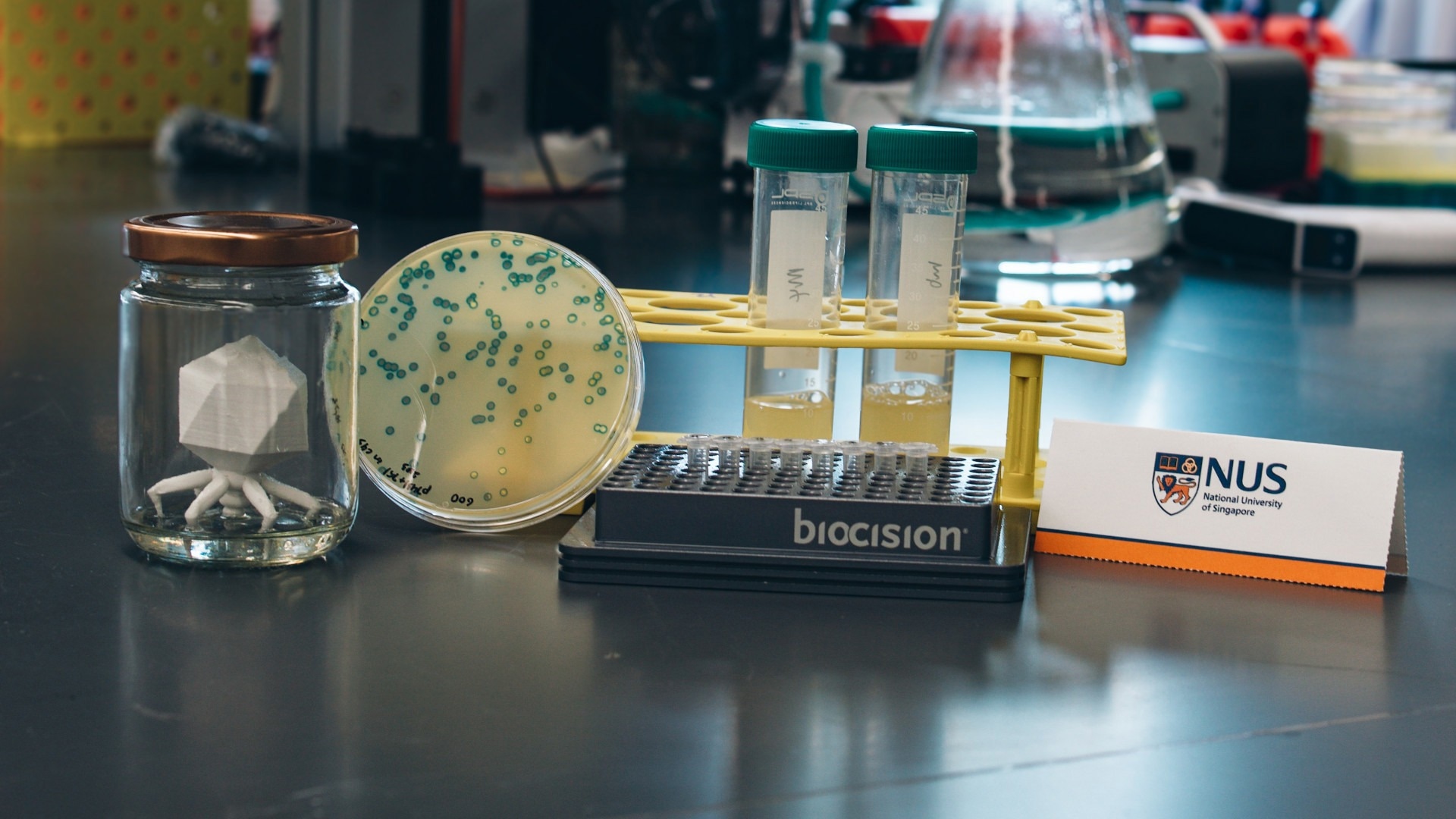 E. coli cultures and other experimental materials used in the study, shown with a 3D-printed model of the engineered phage (extreme left). Image Credit: National University of Singapore
A new platform created by researchers from the National University of Singapore could make that possible. Called Lytic Selection and Evolution (LySE), the system uses a modified bacteriophage, a virus that infects bacteria, to evaluate many small genetic changes quickly. It can enhance long segments of DNA (up to about 40,000 DNA letters), large enough to include most groups of genes required for important chemical processes in cells.
A Crash Course in Plastic-Eating
To “teach” bacteria to break down new chemicals (like in plastics), scientists provide them with a set of genes, known as a gene pathway, that function together like an assembly line. After each round (called an “evolution”), scientists retain the bacteria that perform best (for example, those that grow more effectively using the target chemical) and repeat the process. LySE is designed to accelerate this “training” process.
In a proof-of-concept demonstration, LySE enhanced a set of five genes that enable E. coli to utilize a chemical used in PET plastic production (ethylene glycol). After only five cycles, the top-performing bacteria grew more than 50 % better on ethylene glycol. Because LySE modifies only the selected genes and uses fresh bacteria each round, scientists can easily transfer the improved genes into new bacteria, a critical step toward deploying plastic-degrading microbes at scale.
The platform is described in a study published in Nature Microbiology.
Traditionally, scientists had to choose between slow but highly controlled evolution methods, or super-fast but uncontrollable continuous methods. Our goal was to create a best-of-both-worlds system: a tool that rapidly evolves large biological pathways while still letting us hit the pause button to control the process and prevent unwanted genetic errors.
Julius Fredens, Assistant Professor, Department of Biochemistry, National University of Singapore
“Sloppy” by Design
One technique used by scientists to speed up natural selection in the lab is directed evolution. A gene is randomly mutated, tested, and the best-performing versions are kept. This process is repeated numerous times.
Another approach, continuous evolution, such as phage-assisted continuous evolution (PACE), can carry out these mutation-and-selection cycles very rapidly. However, the method has two main limitations: it can only handle small segments of DNA (about 8,000 DNA letters long), and it can lead to “cheaters,” where the bacteria mutate their own DNA in a way that deceives the test and allows them to survive without actually improving the target gene.
“LySE sidesteps those two problems by exploiting bacteriophage T7, a virus that infects E. coli bacteria,” explained PhD candidate Shujian Ong.
T7 replicates rapidly and breaks the bacterial cell open within minutes. We have engineered the virus so that, when it makes new virus particles, it also packs in an extra small ring of DNA called a phagemid, which carries the group of genes they want to improve.
Shujian Ong, PhD Candidate, National University of Singapore
To generate many new versions of those genes, the phagemid is replicated by a specially engineered DNA-copying enzyme (T7 DNA polymerase) that is intentionally error-prone. A normal DNA polymerase acts like a precise photocopier: this engineered variant is deliberately imprecise, producing many “typos” (mutations), about 160,000 times more than the bacterium’s own DNA copying system.
Paradoxically, the system is controlled due to its high error rate. The polymerase also damages the virus's own DNA since it is so "sloppy." As a result, the phage weakens and loses its capacity to spread uncontrollably; it can only eradicate the bacteria when they are introduced in enormous quantities.
By altering the phage-to-bacteria ratio, the researchers alternate between a phase of mutation, during which the target genes undergo numerous new mutations and are packaged into new phage particles, and a phase of selection, during which the mutated genes are introduced into new, healthy bacteria and assessed for enhanced function.
From Antibiotic Resistance to Plastic Digestion
The team validated the LySE method in two ways. In an antibiotic-resistance test, the improved trait persisted after the genes were transferred into new bacteria, confirming the changes were embedded in the target gene cluster. Second, the researchers attempted to enhance a whole “mini-factory” in cells: a five-gene pathway that enables bacteria to use ethylene glycol for growth and energy. After five rounds with progressively less glucose, the top-performing strain produced 50.9 % more biomass using ethylene glycol as its sole food source.
Sequencing showed LySE modified both regulatory regions (switches that control how much a gene is activated or repressed) and protein-coding genes. Each beneficial mutation was verified by reintroducing it one at a time into a fresh host.
Without LySE, a bacterium’s instinct is to mutate its own entire genome to find ways to eat more plastic, but it struggles to find optimal solutions that way. LySE improves the target gene cluster tremendously without accumulating unwanted mutations in the rest of the bacterium’s DNA. Because all the improvements are strictly contained within our specific gene cluster, we can easily transfer this highly optimized pathway into entirely different bacteria.
Julius Fredens, Assistant Professor, Department of Biochemistry, National University of Singapore
Engineering New-to-Nature Biology
Applications that were previously unfeasible are made possible by the platform's ability to process gene clusters up to 40 kilobases in length, which is five times the limit of the most used phage-based evolution approach.
These include developing completely biosynthetic metabolic pathways for carbon capture, creating microorganisms that degrade environmental contaminants, and enhancing biosynthetic pathways for medications. The approach can be used in labs without extensive knowledge of phage biology or specialized laboratory equipment.
A patent application has been submitted for the LySE technology. In the future, the team intends to use LySE for completely synthetic systems that are not seen in nature.
“A key target is engineering synthetic CO2-fixing metabolic pathways, taking computationally designed routes that have never existed in the real world and optimizing them so they actually function efficiently inside living cells,” said Asst Prof Fredens. “With LySE, we can take AI-designed enzymes and metabolic pathways and rapidly optimize them to work in practice. That is where massive potential lies.”
Source:
Journal reference:
Ong, S., et al. (2026). Bridging continuous and discrete evolution through a controllable, hypermutagenic phage-bacteria system. Nature Microbiology. DOI: 10.1038/s41564-026-02346-y. https://www.nature.com/articles/s41564-026-02346-y.
 How Dying Bacteria Protect the Colony From Antibiotics