A new study reveals that microbes may navigate complex, moving environments more effectively by integrating opposing chemical signals. This is reshaping how scientists understand bacterial decision-making and survival strategies.
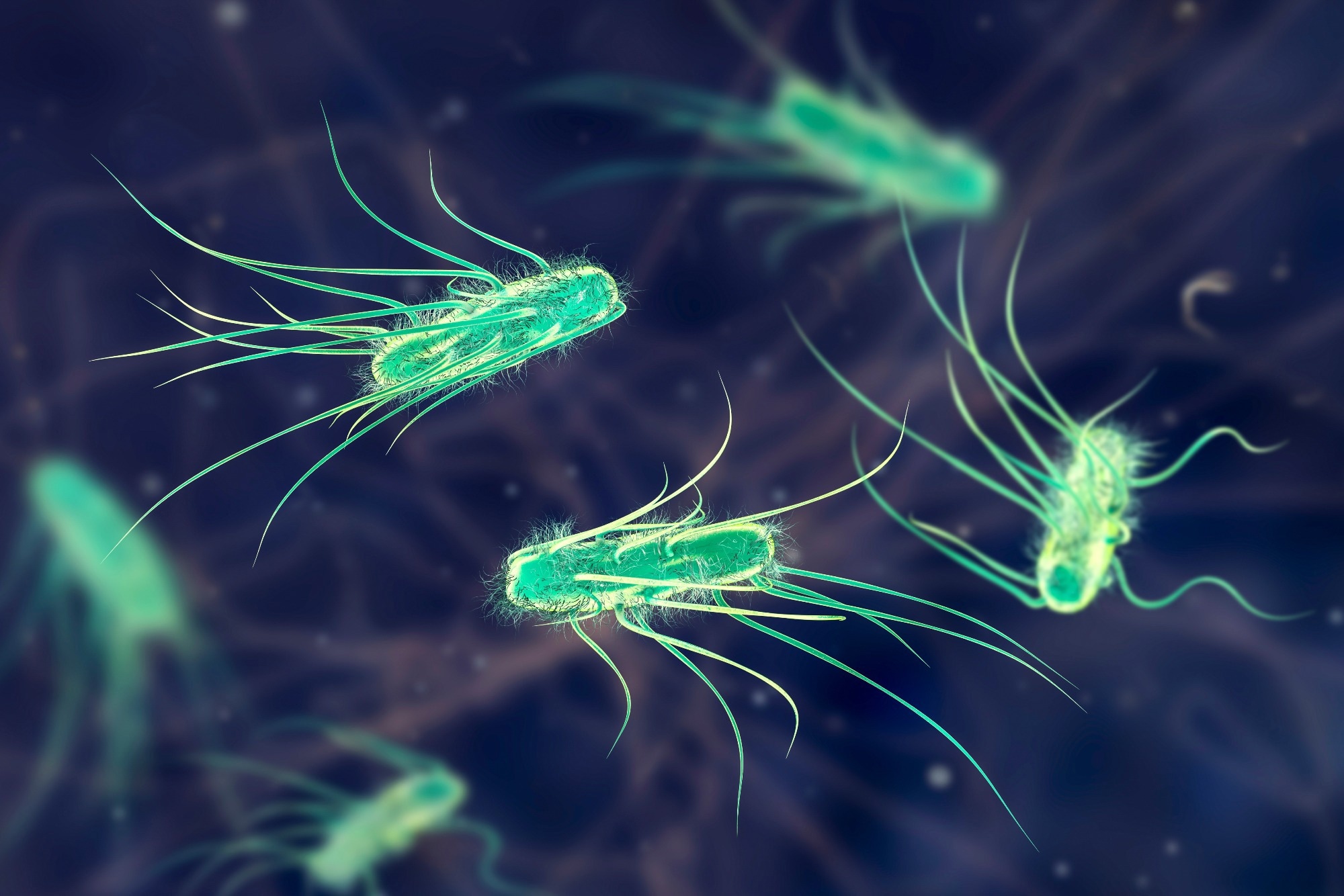 Study: Repulsion from slow-diffusing nutrients improves microbial chemotaxis towards moving sources. Image credit: Kateryna Kon/Shutterstock.com
A recent study published in Nature Communications reports that microbes can markedly improve their ability to track moving nutrient sources by combining attraction to fast-diffusing signals with repulsion from slower ones. Using simulations, researchers found this “differential chemotaxis” strategy increased interception success, with gains of more than six-fold under specific conditions.
Notably, existing data suggest that Escherichia coli may exhibit this behavior, showing movement toward rapidly diffusing amino acids while avoiding slower ones, offering a potential explanation for why some nutrients can unexpectedly trigger microbial repulsion. This challenges the view that microbial navigation relies primarily on simple attraction toward nutrient-rich regions.
Microbes Use Conflicting Signals To Navigate Complex Environments
Chemotaxis is the ability of microbes to navigate chemical gradients, and is central to locating nutrients, yet their behavior often defies simple explanations. While classical models describe movement toward higher concentrations, organisms such as E. coli can be repelled by compounds they can metabolize, and others, such as Pseudomonas aeruginosa, may even move toward harmful agents.
These findings suggest that microbes integrate multiple, sometimes conflicting signals in complex environments. In nature, where chemical cues vary in space, time, and motion, navigating overlapping gradients, particularly when tracking moving nutrient sources, remains a key unresolved challenge.
Simulating Microbial Tracking Of Moving Nutrient Sources
In the present study, researchers developed a computational model to examine microbial tracking of a moving nutrient source.
The team simulated a spherical particle releasing an attractant at a constant rate as it moved downward, alongside a motile microbe with E. coli-like swimming behavior. They initially modeled microbial trajectories under a chemotaxis strategy driven solely by attraction using a Monod–Wyman–Changeux framework. This model incorporated both deterministic gradient-following and stochastic “run-and-tumble” dynamics. Representative scenarios included microbes starting hundreds of micrometers away from the source, with swimming speeds capped at 6.0 μm/s.
The investigators then expanded the model to incorporate simultaneous sensing of a rapidly diffusing attractant and a slower diffusing repellent, mediated through heterogeneous receptor clusters. To assess system performance, they defined an “intercept kernel” that describes the spatial region around the initial locations from which the microbe could reach the moving source. They then compared interception outcomes between purely attractive chemotaxis and the differential approach across a range of particle sizes, movement speeds, and chemoeffector release conditions.
To enhance biological relevance, the researchers incorporated environmental complexity, including stochastic movement, fluid flow effects, and faster-swimming marine microbes. Lastly, they assessed model predictions against experimentally observed chemotactic responses and diffusion characteristics of amino acids in E. coli.
Repulsion From Slow Nutrients Enhances Target Interception
The simulations revealed that repulsion from certain nutrients can enhance, rather than hinder, microbial chemotaxis toward a moving source. When microbes combined attraction to a fast-diffusing nutrient with repulsion from a slower one, their likelihood of intercepting the target increased markedly compared with a purely attractive strategy.
For instance, a particle with a 10 μm radius moving at 9.0 μm/s showed a 183 % increase in the intercept kernel when the differential approach was applied, corresponding to a 2.8-fold rise in interception probability. Across a wider parameter space, overall performance gains averaged 117 %, with improvements exceeding sixfold in scenarios involving smaller sources moving at roughly twice the swimming speed of the microbe.
However, the magnitude of improvement varied across conditions and, in some cases, could be reduced or even reversed depending on factors such as repellent release rates. Such effects may be especially relevant in marine environments, where nutrient distributions are highly heterogeneous and continuously changing.
Gradient Lag Causes Microbes To Miss Moving Targets
Mechanistically, purely attractive chemotaxis often fails because nutrient gradients lag behind the target's motion, causing microbes to drift from the optimal interception trajectory. By contrast, the differential approach redirected movement toward the forward portion of the target’s path, enabling successful capture when gradient-following alone was insufficient. These advantages remained consistent across variations in particle size, speed, and chemoeffector release rates, with mean improvements reaching up to 88 %, even when repellent emission rates varied by an order of magnitude.
E. Coli Shows Patterns Consistent With Differential Chemotaxis
Notably, the advantage of differential chemotaxis persisted under more realistic conditions, including stochastic movement and simulations of faster-swimming marine microbes, where it still enhanced performance, albeit more modestly. Importantly, analysis of existing datasets indicates that E. coli shows a pattern consistent with this strategy: attraction to fast-diffusing amino acids and repulsion from slower ones, suggesting that such behavior may help explain previously puzzling microbial responses and support efficient navigation in dynamic environments.
Differential Chemotaxis Expands Microbial Navigation Capabilities
The study findings identify differential chemotaxis as a powerful strategy that enables microbes to more effectively intercept moving nutrient sources. By combining attraction to fast-diffusing signals with repulsion from slower ones, organisms such as E. coli can increase interception success by more than sixfold in specific scenarios, offering a compelling explanation for previously puzzling repulsive responses to certain nutrients.
However, the authors note that this mechanism is likely one of several factors influencing microbial chemotactic behavior. This work highlights the importance of integrating multiple chemical cues to navigate complex, dynamic environments.
Future research should validate these findings experimentally, including tracking microbial trajectories in controlled attractant–repellent gradients and exploring similar behaviors in marine systems. Investigating these strategies may further reveal how microbes optimize survival and resource acquisition in real-world conditions.
Download your PDF copy by clicking here.
Journal Reference
Bloxham, B., Lee, H. & Gore, J. (2026). Repulsion from slow-diffusing nutrients improves microbial chemotaxis towards moving sources. Nature Communications. DOI: 10.1038/s41467-026-71148-x. https://www.nature.com/articles/s41467-026-71148-x
 Engineered E. coli Strains Validate Putrescine Uptake and Systemic Host Conversion