A lightweight wearable system that combines robotic assistance with targeted electrical nerve stimulation restored touch-like sensation and improved hand function in people with neurological injuries, offering a promising new approach to personalized assistive care.
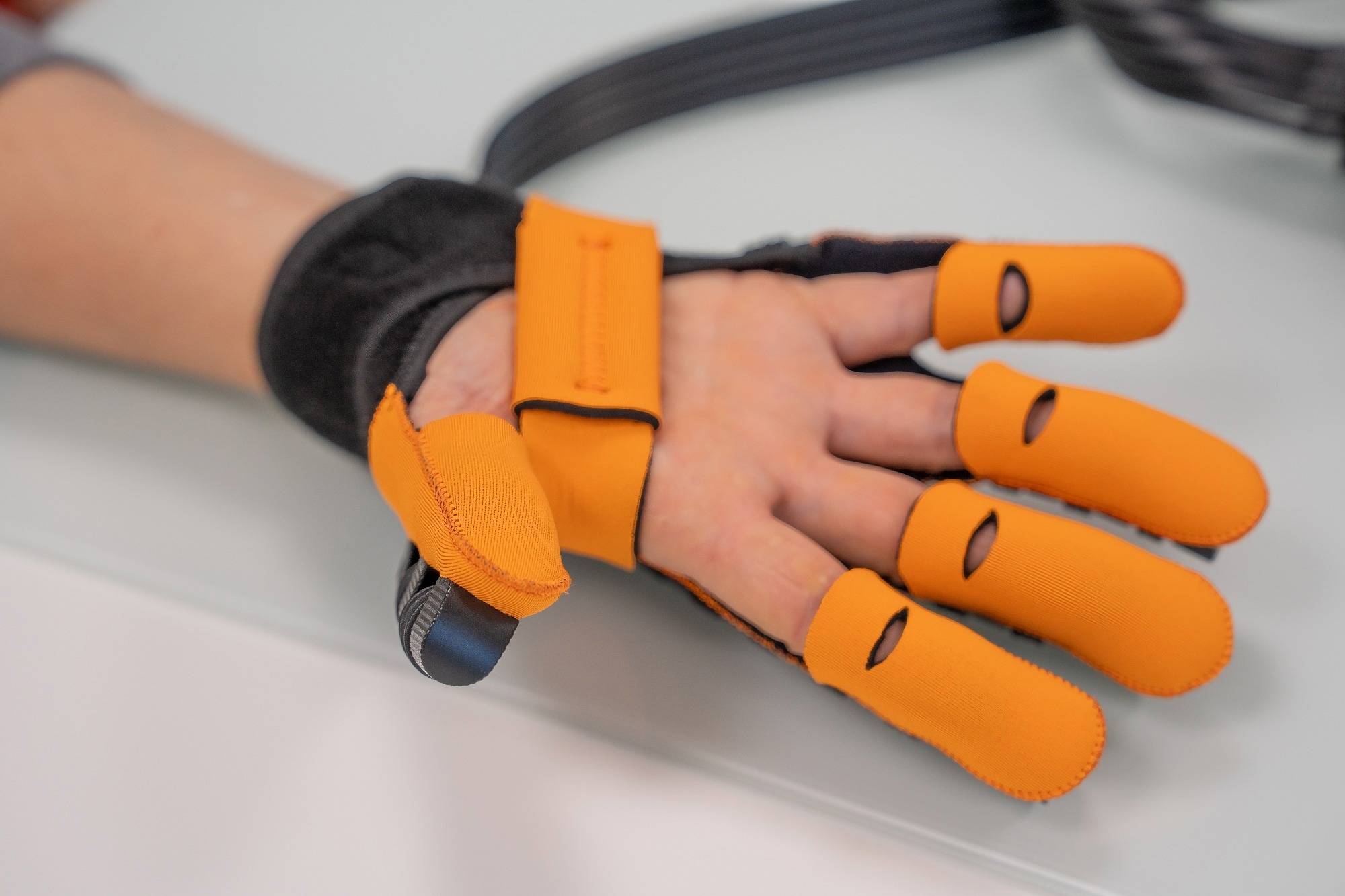 Study: Merging neural stimulation and exoskeletons to enhance sensorimotor hand functions after brain or spinal cord injury. Image credit: GagliardiPhotography/Shutterstock.com
A recent study published in Science Advances highlights the development of a wearable robotic hand to assist people with impairments resulting from brain or spinal cord injuries. The system, combining portable and lightweight exoskeletons with targeted neurostimulation, restored touch-like tactile sensation and finger mobility even among participants with complete sensory loss. The findings suggest that the system could support everyday hand function and may also have future rehabilitation potential after neurological injury.
Robotic Assistance Aims To Restore Everyday Hand Function
Coordinated hand movements are essential for everyday activities such as eating, dressing, writing, and handling objects. However, neurological conditions including stroke, spinal cord injury, and traumatic brain injury can impair both movement and sensation in the hand, making these routine tasks difficult or impossible. Many people continue to experience lasting hand impairments despite rehabilitation, affecting their independence and quality of life.
Physiotherapy remains the standard treatment for restoring hand function, but many individuals eventually reach a recovery plateau or retain only limited function. Researchers are therefore developing wearable assistive technologies that can help compensate for these persistent impairments during daily activities.
While implanted neural interfaces have shown promise, they require invasive surgery and remain unsuitable for widespread clinical use. As a result, there is growing interest in lightweight, non-invasive systems that combine robotic assistance with electrical nerve stimulation to improve hand movement and restore meaningful sensory feedback.
Researchers Tested SensoExo In People With Neurological Injuries
In the present study, researchers designed an adaptable, bidirectional neurorobotic system, SensoExo, to assist hand function. They combined compact exoskeletons with targeted neurostimulation garments via custom-made, data-optimized e-sleeves for sensorimotor assistance.
The sleeves deliver electrical stimulation through embedded electrodes, activating hand nerves and muscles and complementing the mechanical assistance provided by the exoskeleton. The anodes and cathodes were placed at 50% and 70% of the forearm length, respectively, aligned with the longitudinal disposition of the muscles, using Velcro guides.
The integrated SensoExo system combines a three-dimensionally printed exoskeleton that supports hand opening and closing movements with a NeuroSleeve that delivers sensory feedback through transcutaneous electrical nerve stimulation (TENS, 21-mm electrodes) and uses functional electrical stimulation (FES, 50-mm electrodes) to support opening and closing hand movements. SensoExo can be operated in different ways depending on the level of residual hand function.
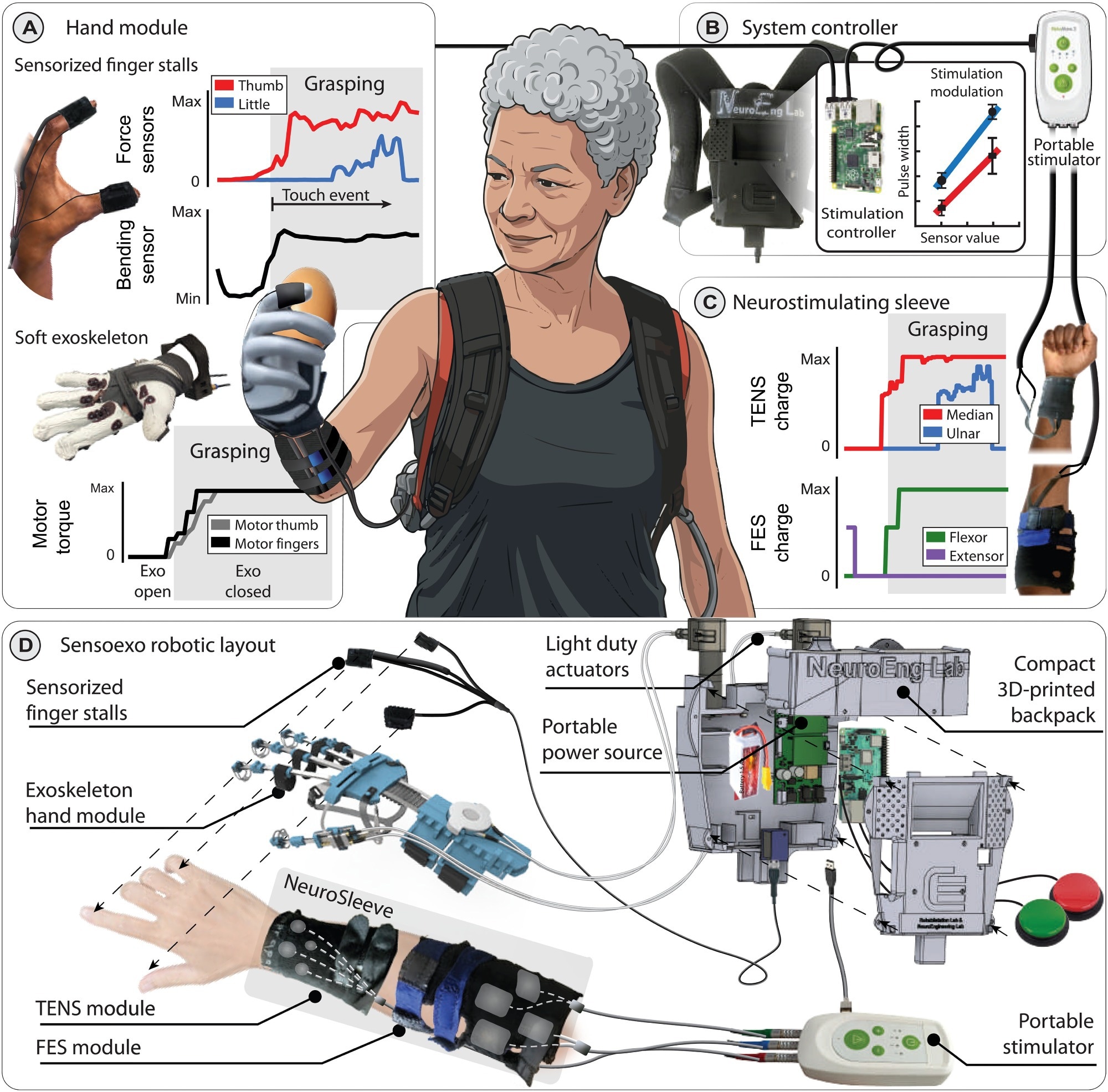 Overview of the SensoExo wearable system, showing how a robotic hand exoskeleton and NeuroSleeve work together to restore movement and touch-like sensation through non-invasive neurostimulation.
In users with limited movement, bending sensors detect finger motion by tracking range of motion (RoM). For individuals with no voluntary hand function, manual switches enable control using the opposite hand. Participants with greater residual hand movement did not receive FES because it interfered with voluntary control, highlighting the system's personalized approach based on impairment severity.
The team tested the system in 14 individuals with a history of stroke or injury in the brain or spinal cord. All participants had partial or complete sensory deficits but retained the ability to elevate their shoulder by ≥45° and flex or extend their elbows by ≥45°. Eight participants completed functional assessments. During testing, neurostimulation improved grip force and grasp performance, enabling participants to transfer fragile and bulky objects from one side to another.
The researchers assessed sensory loss by quantitative sensory testing (QST). They performed sensory, motor, and functional (grasp-and-release) tests. Participants performed each test under unassisted and assisted conditions, using the soft exoskeleton with and without the NeuroSleeve. The team measured RoM at the metacarpophalanges and mapped the sensitive area of the palm. Differences in RoM between the assisted and unassisted conditions indicated mobility restored by SensoExo.
The study participants performed 30 repetitions with a cube, a cylinder, and "virtual eggs" simulating delicate items.
Neurostimulation Restored Touch And Improved Finger Mobility
The neurorobotic system restored artificial TENS, controlled via pressure sensors in the fingers. The system improved finger mobility and gripping force via an FES module placed on the upper forearm. These effects were observed among individuals with complete sensory loss through residual peripheral pathways.
TENS restored sensation in over half of the previously unresponsive regions in participants with moderate sensory loss, covering about 26% of the total palm surface. In those with complete sensory loss, it restored sensation in 43% of the affected areas.
Sensors on the thumb, index finger, and little finger could detect grasping forces ranging from 100 to 40,000 gram-force. The modular hand improved hand opening in participants with severe spasticity who were unable to move their fingers voluntarily or generate any finger movement, without requiring active muscle control.
The integration of the exoskeleton and FES restored 55% of healthy RoM among participants with the most severe motor impairments who received FES (vs. 34% with the exoskeleton alone). The combined framework also showed superior results when participants handled bulky and fragile objects, with success rates of 90% and 79%, respectively, outperforming both the exoskeleton-only and unassisted conditions.
Integrating hand modules with electrical stimulation helped reduce finger spasticity more rapidly and simplified the fitting process. Donning and doffing the device took about half as long as standard gloves, which can require over 10 minutes. The SensoExo device can be worn for extended periods without fatigue, improving comfort and mobility during routine tasks.
SensoExo provides real-time functionality with latency under 20 ms, which is usually not detectable by users. The battery-powered system operates for six hours per charge. Using the exoskeleton together with FES reduced motor current requirements by 30%, potentially extending battery life.
Wearable Technology Shows Promise For Daily Hand Assistance
The study findings highlight the development of a system that integrates somatotopic sensory restoration via TENS in a wearable grasping assistive device. Based on the findings, personalized assistive technologies may promote independence and reintegrate individuals with neurological impairments into society.
However, because this was a proof-of-concept study involving only 14 participants with mixed neurological conditions, and only 8 completed the functional assessments, the findings should be interpreted with caution until confirmed in larger, pathology-specific studies. Advanced models that use automated processes and smart calibrations could also improve the characterization of impairment effects.
Download your PDF copy now!
Journal Reference
Cimolato, A. et al. (2026). Merging neural stimulation and exoskeletons to enhance sensorimotor hand functions after brain or spinal cord injury. Science Advances, 12, eady3144. DOI:10.1126/sciadv.ady3144. https://www.science.org/doi/10.1126/sciadv.ady3144
 Breakthrough Study Explains Developmental Origins of the Human Brain