Wine lees, often treated as waste, could become a renewable source of high-value cosmetic ingredients through a green process that turns fragile squalene into stable, functional squalane.
Red wine lees in a glass bottle, used yeast. Image Credit: PAN Michal / Shutterstock. Paper: Upcycling Winery Waste into Functional Cosmetic Ingredient: Green Recovery of Squalene from Wine Lees as a Potential In Vitro Permeation Enhancer
A research paper recently published in the journal Applied Sciences proposed an eco-friendly, integrated approach to valorize wine lees as a renewable source of squalene, then convert the squalene into high-performance, stable squalane.
Sustainable Squalene Extraction Strategies
Squalene is a triterpene hydrocarbon found in microorganisms, animals, and plants, and it serves as a vital intermediate in sterol biosynthesis. It is a significant constituent of human skin surface lipids, providing antioxidant protection against oxidative stress induced by environmental factors and contributing to skin lubrication.
Microbial sources such as Saccharomyces cerevisiae (S. cerevisiae) offer short production cycles, rapid growth, and opportunities for process intensification, making them suitable for the sustainable recovery of squalene.
Wine lees, a residue of wine production, are rich in residual lipophilic compounds and S. cerevisiae cells. Squalene has previously been recovered from wine lees using ultrasound-assisted extraction (UAE), highlighting the potential of wine lees as a renewable feedstock for producing high-value ingredients.
Traditional extraction approaches, such as Soxhlet extraction, mechanical pressing, and solvent maceration, require long processing times and large quantities of solvent. However, green methods like microwave-assisted extraction (MAE) and UAE are more eco-friendly and efficient.
Among these techniques, UAE is particularly advantageous for yeast-rich matrices, providing scalable, mild, and fast extraction conditions.
Squalene Conversion into Squalane
Native squalene is chemically unstable and is highly vulnerable to oxidative degradation, which restricts its formulation stability and shelf life. Thus, squalene is transformed into squalane, which is a more stable and fully saturated derivative of squalene.
Squalane offers enhanced oxidative stability while retaining the exceptional skin compatibility, moisturizing, and emollient properties of squalene. Recent developments in green hydrogenation approaches offer low-cost, eco-friendly, and efficient alternatives for squalene hydrogenation with high selectivity under mild conditions.
The Proposed Conversion Approach
In this work, researchers proposed a sustainable, integrated approach to valorize wine lees as a renewable source of high-value cosmetic ingredients.
Initially, an optimized UAE process was applied to a compositionally complex, real winery residue to address a crucial research gap regarding the strong influence of matrix-specific parameters on extraction efficiency.
Then, the extracted squalene was converted into stable squalane via a green hydrogenation process using heterogeneous palladium catalysts supported on natural clay minerals, including sepiolite, montmorillonite, and palygorskite.
These materials offer significant advantages over conventional catalytic systems in terms of functionality, environmental impact, and cost under mild conditions.
Finally, researchers assessed the in vitro performance of squalene and upcycled squalane using Franz diffusion cells with quercetin as a poorly permeable model antioxidant.
This approach is a reproducible early-stage screening alternative to ex vivo systems. The objective was to demonstrate that both upcycled squalane and squalene can enhance the transport of cosmetic actives across an artificial membrane, going beyond stabilization and production.
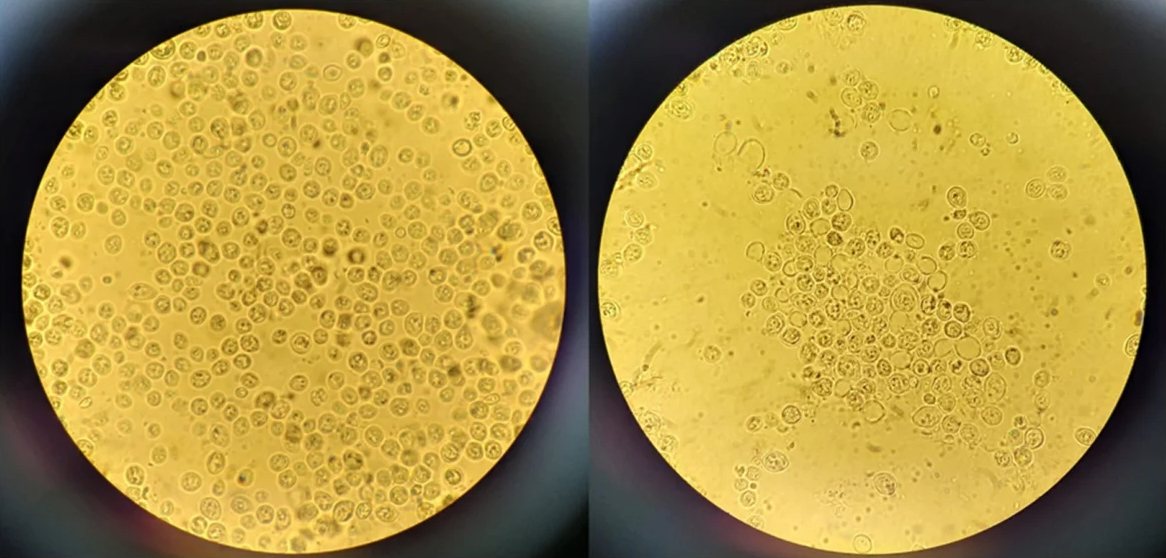
Optical microscope images (100×) of yeast cells before and after the sonication for the squalene extraction. Cell lysis, as evidenced by cell wall breakdown and cellular aggregation, releases squalene into the extracellular environment.
Study Design and Methods
Wine lees, quercetin hydrate, squalene analytical standard, cyclohexane, acetonitrile, n-hexane, ethyl acetate, palladium(II) nitrate hydrate, palygorskite, sepiolite, montmorillonite, and deionized water were used as starting materials.
Initially, squalene was extracted from wine lees through the UAE process. Then, high-performance liquid chromatography coupled with diode-array detection (HPLC-DAD) was employed for quantitative determination of squalene in lipid extracts.
Chromatographic separation was carried out and maintained at 30 °C on a C18 reversed-phase column. Subsequently, squalene was purified by thin-layer chromatography (TLC) and column chromatography, followed by green catalytic hydrogenation to squalane.
Researchers then used Franz diffusion cells for in vitro transport studies and performed an oxidative stability assessment.
Effectiveness of the Approach
Researchers successfully developed a sustainable strategy to valorize wine lees as a renewable source of high-value cosmetic ingredients.
Using UAE, chromatographic purification, and green catalytic hydrogenation, squalene was efficiently recovered from yeast-rich winery waste and converted into the more stable squalane, using palladium supported on natural clay minerals.
The extraction process enabled efficient recovery under mild conditions, while HPLC-based analysis ensured accurate quantification and high purity for further processing.
Additionally, the hydrogenation process showed high efficiency and selectivity at low pressure and temperature, demonstrating the potential of clay-supported palladium catalysts as environmentally friendly alternatives to conventional catalysts.
In vitro permeation studies using quercetin showed that both winery-derived squalane and squalene increased transport across the artificial membrane compared with water and glycerin. Squalane showed slightly greater transport than squalene, although the difference between the two vehicles was not statistically significant, indicating their potential as functional transport-enhancing excipients in early-stage formulation testing.
Because the study used an artificial cellulose membrane rather than biological skin, these findings do not establish enhanced skin penetration and require validation in skin-mimicking or biological models.
Accelerated-aging studies also confirmed squalane’s superior oxidative stability over native squalene, supporting improved cosmetic formulation stability and shelf life.
In conclusion, the study provided a proof-of-concept for upcycling winemaking by-products into stable, sustainable, and multifunctional cosmetic ingredients, offering a potentially scalable framework for developing advanced sustainable formulations.
Journal reference:
- Hoti, E. et al. (2026). Upcycling Winery Waste into Functional Cosmetic Ingredient: Green Recovery of Squalene from Wine Lees as a Potential In Vitro Permeation Enhancer. Applied Sciences, 16(8), 3893. DOI: 10.3390/app16083893, https://www.mdpi.com/2076-3417/16/8/3893
 Innovative Screening Platform Uses Automated Liquid Handling Solutions to Research Aging