Jocelyn Malamy first witnessed jellyfish cells "walk" toward each other to close a wound at the Marine Biological Laboratory a decade ago. The transparent, dime-sized medusae of the species Clytia hemisphaerica were from Evelyn Houliston's group at the Marine Observatoire in Villefranche.
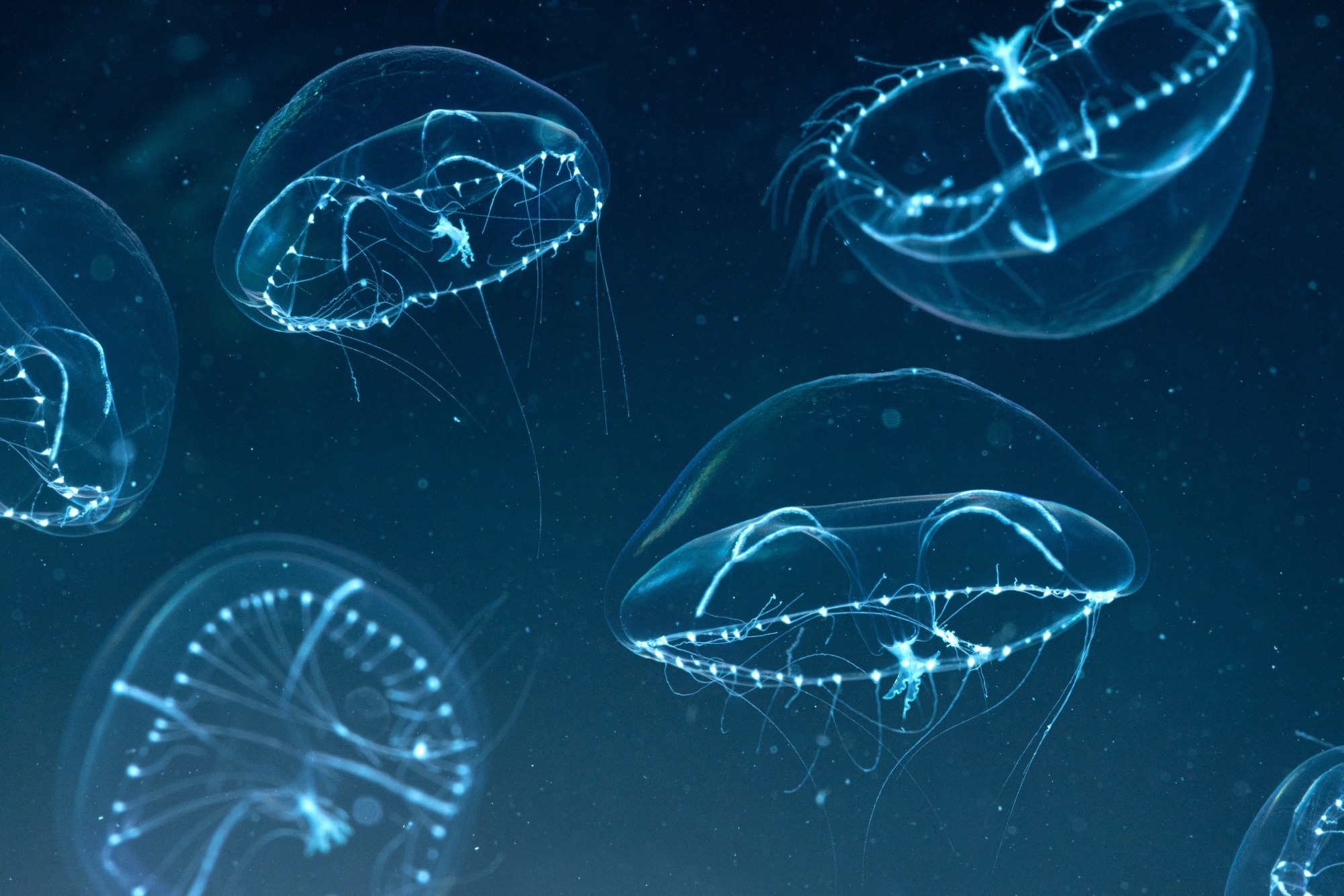 Image credit: Zhane Luk/Shutterstock.com
The free-swimming form that most people associate with jellyfish, the medusa, is only one stage of the animal's life cycle.
Clytia are hydrozoans, so mostly they exist as polyp colonies that grow along the surface of rocks or on docks or the underside of underwater leaves.
Jocelyn Malamy, Associate Professor, Molecular Genetics and Cell Biology, University of Chicago
The colony will eventually begin releasing young medusae. In Clytia, the long-lived polyp colony is much like a shrub that produces flowers, with the medusae representing the flowers. Although we tend to think of the jellyfish as the organism itself, the medusae are actually reproductive units, while the polyp colony is the primary life stage.
In Clytia, the long-lived polyp colony is the primary life stage. The medusae it produces are short-lived, surviving only a few months, much like flowers. By contrast, the polyp colony can persist indefinitely, like a perennial shrub that blooms year after year.
However, in contrast to other species, Clytia medusae can heal wounds so quickly that you can see them heal in a matter of minutes. Larger wounds heal in less than an hour, a rate of healing that is unimaginable for humans. And in contrast to humans, no scar tissue is formed. Instead, Malamy says “healing in the jellyfish looks more like embryonic healing, which is scar-free.”
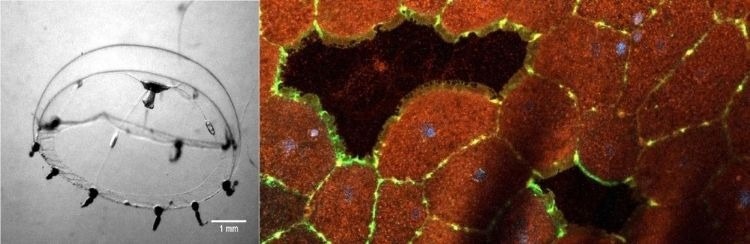 A Clytia hemisphaerica medusa (left). Two small wounds can be seen in the sheet of epithelial cells in this confocal image (right). Membranes (red), nuclei (blue) and actin (green). Image Credit: Jocelyn Malamy
These features offer Clytia as a unique window into wound healing. The medusae are transparent, allowing scientists to observe cell movement in living animals in real time. Their wounds heal swiftly, and unlike humans, there is no immune system to induce inflammation around a wound or capillary regrowth to obscure the underlying mechanics of repair.
As a result, researchers can witness epithelial cells stitching torn tissue back together. Most importantly, many of the core wound healing mechanisms appear to be unchanged.
A lot of the processes that we see in Clytia’s wound healing are really similar to what you see in all other systems, including mammalian systems. When you're staring at these epithelial cells, you wouldn't know this was a jellyfish. It could be any kind of squamous epithelial cell sheet, and that's nice, because it means that hopefully what we learn in jellyfish can give us insights into other animals as well.
Jocelyn Malamy, Associate Professor, Molecular Genetics and Cell Biology, University of Chicago
Epithelial cells cover the entire body's surface. They line the inside of structures like the gut and make up the skin. The skin and interior epithelial tissues are a major focus of wound-healing research since they are both frequently damaged and need to mend themselves.
In 2017, Malamy began working with a group of students to define Clytia epithelial wound healing. Clytia is used in Malamy's recent work in the journal Molecular Biology of the Cell to address the field's misunderstanding regarding the multiple mechanisms that have been demonstrated to mend epithelial wounds in distinct animals and wounds of varied sizes and shapes.
She demonstrates how two essential cellular structures in Clytia drive all epithelial wound healing by acting sequentially to seal a wound, and she outlines a mechanism that explains how these structures are coordinated in all kinds of wounds.
The first structures to form in response to a wound are lamellipodia, which Malamy describes as “foot-like feelers that are actin-rich extensions of the cell.” These feelers act as explorers and have an almost fluid-like motion, similar to amoebas. Lamellipodia extend out of cells at the edge of wounds and crawl across the basement membrane, “a protein sheet that's underneath all epithelial cells in all systems,” she explains.
As they “walk”, they drag the cells that produced them forward, eventually stretching the cell body over a wound to close it. These lamellipodia form even in tiny wounds internal to a single cell.
A second wound-healing mechanism is activated as the lamellipodia move forward by forming an actomyosin cable at their rear. The cable contracts as soon as the lamellipodia cover the basement membrane.
If there is damage to the basement membrane, an actomyosin cable structure is especially crucial. If the “lamellipodia have run into some debris or a tear in the basement membrane, and they can't go any further,” Malamy adds, “the actin cable can pull the cells over the basement membrane damage and also expel wound debris.”
Lamellipodia will progress as long as there is a basement membrane, but if the wound is too large, they will not be able to reach one another, no matter how much they extend their cells. This results in a collective cell migration being activated, where the entire sheet of epithelium “lifts itself up and starts walking,” Malamy explains. Once the lamellipodia at the leading edge meet, the large wound closes in the same way as smaller wounds.
This is a truly elegant mechanism where the system can rapidly adapt to heal all the kinds of wounds that might occur in nature.
Jocelyn Malamy, Associate Professor, Molecular Genetics and Cell Biology, University of Chicago
Malamy intends to investigate the mechanisms behind basement membrane repair in the future. “It's great that you can heal a wound by dragging the cells over it,” she notes, “but at some point, a damaged basement membrane has to get fixed.” Since it is currently unknown how basement membrane repair occurs in any system, she intends to learn how that occurs in Clytia.
Source:
Journal reference:
Malamy, J. E., et al. (2026) The basement membrane determines the choice of wound healing mechanism across wound scales in the basal eukaryote Clytia hemiphaerica. Molecular Biology of the Cell. DOI: 10.1091/mbc.e26-02-0094. https://www.molbiolcell.org/doi/10.1091/mbc.E26-02-0094.
 New Study Reveals How Skin Immune Cells Shape Long-Term Health