From first touch to after-feel, a review reveals how scientists measure cosmetic texture, control human bias, and combine trained assessors with emerging technologies to improve product development.
Review: The hidden science of haptics: A pedagogical review of tactile evaluation in cosmetics. Image Credit: Ekaterina_Klishevnik / Shutterstock
In a recent review article published in the International Journal of Cosmetic Science, researchers provided a comprehensive pedagogical review of tactile sensory evaluation in cosmetics, highlighting the biological mechanisms, standardized methodologies, instrumental techniques, and emerging technologies that shape the field of haptics in cosmetic product development.
Haptics in Cosmetic Science
Sensory analysis is fundamental to developing cosmetic products but remains underrepresented in the academic literature compared to domains such as food science. While sensory evaluation in food primarily relies on taste and smell, cosmetics focus predominantly on touch and sight.
The skin, as the largest sensory organ, plays a pivotal role in the perception and assessment of cosmetic products, requiring a detailed understanding of its physiology and sensory mechanisms. Despite shared methodological roots with food sensory science, tactile sensory evaluation in cosmetics faces unique challenges due to the complexity and subjectivity of touch perception.
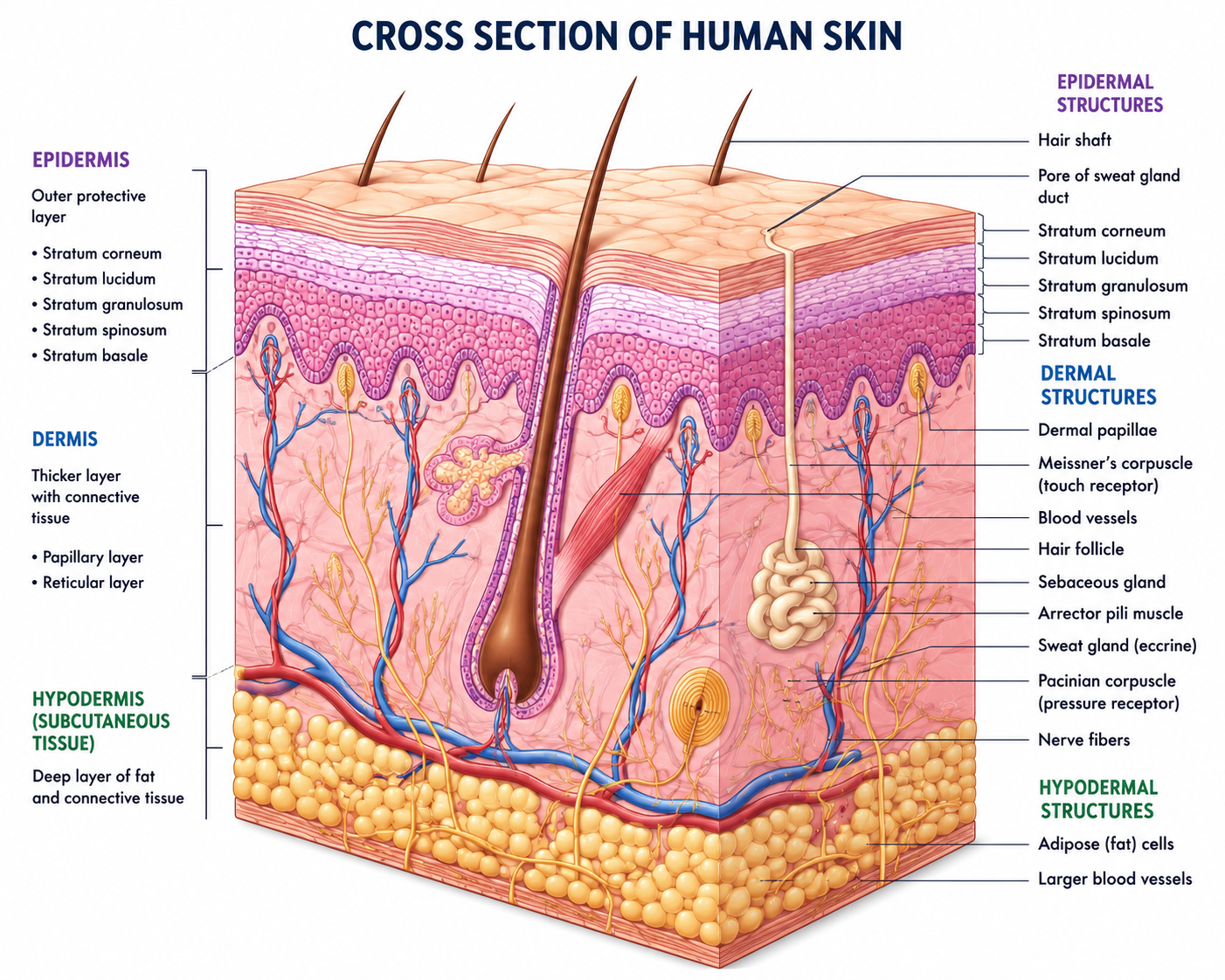
Cross section of human skin anatomy
Key Sensory Methodologies Discussed
The paper first revisits the biological foundations of tactile perception, emphasizing the epidermis, dermoepidermal junction, dermis, and the underlying hypodermis (often considered subcutaneous tissue rather than part of the skin proper), as well as the associated mechanoreceptors that detect tactile, mechanical, and thermal stimuli.
These receptors convert physical stimuli into nerve signals that the brain interprets via complex neural pathways. It distinguishes sensation, the physiological detection of a stimulus, from perception, which is shaped by expectations, previous experiences, preferences, and sociocultural context. Alongside the skin, the eye plays a secondary but significant role, especially in perceiving attributes like color, gloss, transparency, and whitening or soaping effects that may appear during product application.
Regarding sensory methodologies, consumer preference testing gauges liking and acceptance, while methods like Check All That Apply (CATA), Rate All That Apply (RATA), and Home Use Tests (HUT) capture consumer perceptions and product experiences in controlled or real-world settings.
The authors also explore newer, faster profiling techniques such as free-choice and flash profiling, which offer increased flexibility but face limitations related to variability and interpretive challenges.
Instrumental techniques, including texture analysis, rheology, tribology, and biometrological measurements, provide quantitative data that correlate with standardized sensory assessments and complement rather than replace trained-panel evaluations.
Emerging technologies are highlighted as a promising but still developing area in cosmetic sensory science. Virtual and augmented reality platforms may provide immersive and controlled testing environments, while artificial intelligence (AI) algorithms could identify relationships among formulation parameters, instrumental measurements, sensory ratings, and consumer responses. Electronic devices, including fingertip-mounted tactile sensors, tribological tools, and chemical-sensing systems, may eventually complement human assessments of texture, viscosity, fragrance, and product consistency, although tactile and chemical sensing technologies evaluate different aspects of product performance.
Challenges and Innovations in Haptics
The review critically addresses persistent challenges in cosmetic tactile evaluation. Unlike the food sector, where sensory evaluation benefits from well-established standards and widely accessible literature, the cosmetics sector faces methodological fragmentation.
Many cosmetic sensory methods and findings remain confined to internal industrial use, limiting cross-industry dissemination and comparability. Traditional techniques, although rigorous, require substantial time and resources and often depend on trained panels. Although perception is influenced by cultural and personal factors, standardized terminology, controlled procedures, and repeated calibration are used to reduce assessor variability.
The complexity of tactile perception itself contributes to the difficulty in standardizing evaluations. Texture, as a core attribute of cosmetics, is multidimensional, encompassing visual appearance, pick-up or initial product handling, rub-out or application dynamics, and after-feel or residual sensations. These phases involve different sensory and physical parameters and are often influenced by individual variability.
Bias management is another fundamental issue. The authors underline the importance of blinding, randomization of samples, consistent test conditions, and rigorous panel recruitment and training to minimize systematic errors. Ethical considerations, including informed consent, assessors’ well-being, and data privacy protection under the European Union's General Data Protection Regulation (GDPR), are also detailed as essential components in conducting trustworthy sensory studies.
While instrumental approaches offer appealing complements to human testing, their applicability remains primarily confined to certain product types, such as emulsions, with other categories, like lipsticks or eyeshadows, less explored. Texture analysis, rheology, tribology, and biometrological measurements can provide quantitative proxies that correlate with sensory attributes, enhancing accuracy and reproducibility. However, they often fail to fully capture the holistic sensory experience that human evaluation provides.
Although virtual reality and artificial intelligence offer potential benefits, their application in cosmetics remains at an early stage. These technologies may support product testing by creating controlled sensory environments or predicting aspects of tactile and consumer responses from formulation, instrumental, and sensory data. However, issues such as technological costs, ethical concerns regarding the manipulation of perception, and the need to maintain authentic real-world sensory experiences remain critical points for future research and implementation. Much of the evidence supporting virtual reality applications currently comes from food sensory research, and direct validation in cosmetic tactile evaluation remains limited.
Throughout, the review emphasizes the need for enhanced academic recognition of tactile sensory evaluation within cosmetics. Bridging methodological gaps requires wider publication of research, improved methodological comparability, carefully validated tools, and continued collaboration between academic and industrial researchers, alongside investment in both human sensory evaluation and instrumental methods.
Future Directions in Tactile Evaluation
This review positions tactile sensory evaluation as a central yet underappreciated field in cosmetic science. By outlining the physiological basis, methodological landscape, instrumental tools, and emerging technologies, the authors provide a robust pedagogical framework for understanding and advancing touch-based sensory analysis.
Greater academic visibility, methodological transparency, ethical rigor, and collaboration between researchers and industry could further strengthen tactile sensory evaluation as an important component of cosmetic development and consumer experience. Pursuing these directions may reinforce sensory science as an essential pillar supporting the differentiation and success of cosmetic products in the evolving beauty market.
 AI Decodes Spatial DNA Packaging Patterns Invisible to Researchers