A human brain–spinal cord organoid model reveals that regenerative capacity declines surprisingly early in development, and points to a clinically approved drug that could help injured neurons regrow damaged connections.
 Study: A human corticospinal organoid-slice connectoid model informs enhancer strategies for post-injury axon regrowth. Image credit: Kateryna Kon/Shutterstock.com
In a recent study published in Cell Reports, researchers developed a human stem cell-derived brain-spinal cord model to uncover biological mechanisms that limit nerve regeneration. The model also identified lynestrenol, a clinically approved synthetic progestin and hormone-related drug, as a promising candidate for promoting nerve repair after injury.
Since this drug is already licensed for human use and could be repurposed, it may serve as a starting point for future nerve repair research, although it has not yet been tested for this purpose in humans.
New Human Model Mimics Brain-Spinal Connections
Before birth, nerve fibers called axons grow rapidly to form connections between the brain and spinal cord, which together form the central nervous system (CNS), enabling normal bodily functions. However, during late fetal development and after birth, these nerve cells have a very limited capacity to regrow damaged axons. This is relevant because nerve fibers often cannot repair themselves after injury, causing impairments in movement, sensation, and other neurological functions to become long-lasting or permanent.
Scientists are trying to identify the biological processes that limit nerve regeneration. Current laboratory models may not always accurately replicate the diverse cell types and intricate connections between the human brain and spinal cord. Some advanced models integrate multiple brain regions, making it difficult to identify the specific cell types responsible for the growth-limiting effects.
Stem Cell Organoids Recreate Human Motor Circuits
In the present study, researchers developed a laboratory model of the human corticospinal system using human stem cells to uncover mechanisms that limit nerve regeneration after injury and identify potential treatments.
The researchers built miniature brain and spinal cord tissues known as organoids. Cortical organoids resembled the motor cortex, the part of the brain that controls movement. Spinal cord organoids were enriched with motor neurons, the nerve cells that transmit movement-related signals from the brain to muscles. The team linked these organoids with a soft gel bridge to simulate nerve pathways.
Over time, the nerve fibers (axons) from the brain organoids grew across the bridge and connected with nerve cells in the spinal cord organoids. Although functionally connected, these tissues remained physically separate. This setup allowed researchers to study each cell type individually while also observing intercellular interactions.
As the organoids matured, the team observed how axon growth changed over time. They then simulated injury by damaging axons in the model and observed axonal changes in real time by live imaging. To analyze gene activity linked to neuronal maturation and growth, they performed single-cell ribonucleic acid sequencing (scRNA-seq) and gene co-expression network analysis (WGCNA). The researchers analyzed the data using computational methods. They then tested several compounds and repurposable drugs to determine whether they could restore axon regrowth after injury.
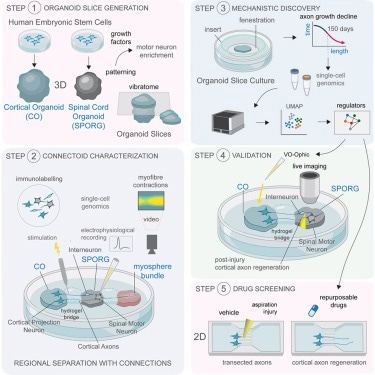 As the organoids matured, the team observed how axon growth changed over time. They then simulated injury by damaging axons in the model and observed axonal changes in real time by live imaging. To analyze gene activity linked to neuronal maturation and growth, they performed single-cell ribonucleic acid sequencing (scRNA-seq) and gene co-expression network analysis (WGCNA). The researchers analyzed the data using computational methods. They then tested several compounds and repurposable drugs to determine whether they could restore axon regrowth after injury. Image credit: Gibbons, G et at (2026).
Approved Hormone Drug Boosts Injured Neuron Regrowth
The lab-grown model closely resembled human nerve circuits and comprised many of the cell types present in the human nervous system. These included motor neurons, interneurons, and glial cells. The spinal organoids also displayed molecular features associated with multiple spinal cord levels. This makes the model relevant for studying conditions such as spinal cord injury and amyotrophic lateral sclerosis (ALS).
Electrical activity tests showed that the neurons generated electrical signals similar to those seen in mature human nerve cells. Neurons in brain organoids could send signals to neurons in spinal cord organoids via functional synapses, as in real corticospinal pathways.
When the team connected the model to lab-grown human muscle tissues and stimulated the brain or spinal cord portion, the muscles contracted. When they cut the nerve fibers connecting the tissues, these contractions stopped, suggesting that signals transmitted through the built nerve circuits could regulate muscle activity.
Comparing younger and older neurons showed that neuronal maturation alters the activity of several genes. The researchers found that regenerative capacity declined surprisingly early, at developmental stages corresponding to late fetal maturation rather than only in fully mature neurons. These genes are involved in cell structure and growth, energy production, protein transport, DNA repair, synapse formation, and cell adhesion. These changes, collectively, create a coordinated maturation program that helps stabilize brain and spinal cord circuits but also makes regeneration after injury much more difficult.
Nevertheless, the researchers found that consistent with previous regeneration studies, inhibiting PTEN activity using a PTEN inhibitor helped injured neurons regain some of their ability to regrow axons. Among drugs tested, the researchers found that lynestrenol was particularly effective at stimulating axon growth in human cortical neurons.
Human Organoids Offer A New Regeneration Testbed
The findings suggest that poor nerve regeneration in the adult brain and spinal cord is not simply an unavoidable consequence of aging. Instead, it appears to be driven by specific genetic programs that can potentially be manipulated. The model could serve as a valuable platform for studying spinal cord injuries and other neurological disorders. It could also help in screening future therapies aimed at restoring damaged nerve connections.
However, further research is required to determine whether the findings apply broadly across different patients and whether people might respond differently to potential treatments. The study also used a single human embryonic stem cell line and did not include blood vessels, immune cells, or connective tissue, which are important components of the injury environment in the human CNS. Future versions of the model could incorporate blood vessels, immune cells, and connective tissues to provide a more complete picture of nerve repair after injury.
Download your PDF copy by clicking here.
Journal Reference
Gibbons, G., Fuchsberger, T., Abdelgawad, M. et al. (2026). A human corticospinal organoid-slice connectoid model informs enhancer strategies for post-injury axon regrowth, Cell Reports, 45, 6, 117399, DOI: 10.1016/j.celrep.2026.117399. https://www.cell.com/cell-reports/fulltext/S2211-1247(26)00477-8
 New Open-Source Resource Maps Adolescent Brain Development Across Large Datasets