In research published in Science, USC researchers combined a biological finding with an engineering achievement to produce organoids: lab-grown kidney structures derived from stem cells that are more faithful and reproducible.
 Study: sasirin pamai/Shutterstock.com
By creating a detailed map of the developing human kidney, the researchers uncovered a previously unknown developmental axis that guides the formation and organization of nephrons, the kidney's filtering units. They also engineered "synthetic organizer" cells that recreated key features of this developmental signaling environment within kidney organoids.
The resulting organoids more closely resemble natural kidney development and provide a more consistent platform for investigating disease and testing potential therapies. The approach could also contribute to future efforts to generate kidney tissue suitable for transplantation.
“It is important that we’re starting to get good reproducibility from organoid models that can lead to robust preclinical models of cell function and disease to benefit patients,” said the paper’s co-corresponding author Nils Lindström.
For more than a decade, organoid research has relied on the natural ability of cells to organize themselves into tissue-like structures, typically by exposing the entire organoid to signaling molecules such as proteins and other chemical factors. In this study, however, the researchers took a different approach by engineering a synthetic organizer that delivers controlled amounts of specific Wnt proteins from a precise location within the organoid.
Because Wnt proteins are essential signals during kidney development, this localized source more closely replicates the environment of a developing kidney. As a result, researchers can better direct where kidney structures form and how they develop, producing organoids that more faithfully mimic natural kidney development.
“With our approach, we are trying to control self-organization, and work with it as opposed to try to completely override it,” said co-corresponding author Leonardo Morsut.
Following the Signal
The work began with the development of tools designed to recreate the signaling cues that guide kidney development. As part of this effort, postdoctoral researcher Fokion Glykofrydis engineered a "synthetic organizer" cell that released a kidney-associated Wnt protein. Graduate student Connor Fausto then proposed testing how this localized Wnt signal would influence nephron development in kidney organoids.
The experiments showed that the synthetic organizer supported two fundamental processes involved in organ formation: directing cell identity and shaping developing tissues.
The researchers expected the Wnt signal to alter nephron cell identity so the cells could form connections with the kidney's urine drainage system. Instead, they found an additional effect: the nephrons also elongated and grew toward the localized Wnt source. This behavior is not seen when developmental signals are applied uniformly throughout an organoid and more closely resembles the pattern of kidney development observed in the embryo than in conventional kidney organoids.
A single, localized signal did two things at once. It changed what the cells became and physically pulled the tubules toward the source. You would not see that with a uniform chemical bath of signals.
Nils Lindström, Assistant Professor, Stem Cell Biology and Regenerative Medicine, Keck School of Medicine, University of Southern California
Organizing an Organoid
The researchers also identified a previously unrecognized developmental axis that describes another way the growing kidney is organized. Until now, developmental biologists had primarily focused on the nephron's well-established proximal-distal axis, which extends from the blood-filtering portion of the nephron to the end that connects with the urine drainage system.
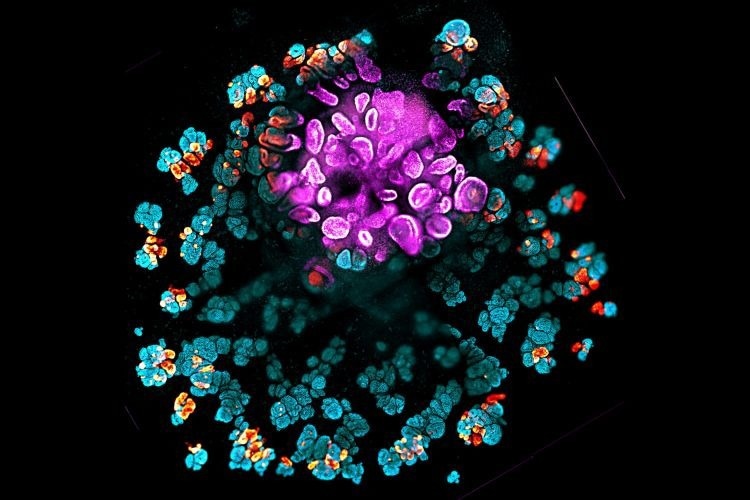 Lab-grown kidney organoid. Image Credit: Lindström Lab
The newly identified axis is based on each region's position relative to the collecting duct, the network of tubes that carries urine and releases Wnt signaling molecules during kidney development. These localized signals help determine both the structure of the nephron and its orientation as it forms.
The study shows that there’s an undiscovered axis that sets up how a nephron looks and forms. It’s not every day that you find something new in human development at that level.
Nils Lindström, Assistant Professor, Stem Cell Biology and Regenerative Medicine, Keck School of Medicine, University of Southern California
The majority of kidney organoids have no such axis and are arranged in a radially symmetrical fashion because they just contain nephrons and do not have the collecting duct that provides this local Wnt signal.
The team used the synthetic organizer to replicate the environment in organoids by tracking how kidney cells react to Wnt at certain sites in the developing kidney. This resulted in structures that are more repeatable and developmentally faithful.
For Morsut, the synthetic organizer is one of several tools his team is designing to control how tissues form, and the one he is most enthusiastic about, because it controls development in a way that is powerful but not obtrusive.
The synthetic organizer is just a little cluster of cells that don’t build anything themselves. But they produce a powerful field that aligns the stem cells and gives them a direction.
Leonardo Morsut, Associate Professor, Stem Cell Biology and Regenerative Medicine, Viterbi School of Engineering, University of Southern California
He pointed out that embryos constantly align cells as they develop, and the study demonstrates that this process may now be used in an engineering context to guide the process toward a desired result.
“At the beginning of my talks, I always show a video of embryonic development,” says Morsut. “You start from a single cell, and you get to a complete organism, and that’s as close to magic as it gets. Now, we open a possibility of controlling this magic technology for building organs. This study shows that we can do that, and I’m excited to see what others will do in other contexts.”
Source:
Journal reference:
Fausto, C. C., et al. (2026) Patterning human kidney organoids with synthetic Wnt-secreting organizers. Science. DOI: 10.1126/science.adu9122. https://www.science.org/doi/10.1126/science.adu9122.
 Novel Organoid Platform Reveals Non-Immune Drivers of Diabetic Renal Injury