Amino acid-based surfactants form a resilient fibrous network that thickens, stabilizes, and foams like a shampoo without relying on conventional polymeric rheology modifiers.
Study: From Fundamental Self-Assembly Studies to Applications in Everyday Life: The Formation of a Supramolecular Shampoo
A recent study published in the journal Gels reports the development of a polymer-free supramolecular shampoo based on the self-assembly of amino acid-derived surfactants. The formulation uses sodium cocoyl glycinate as both a cleansing agent and a supramolecular gelator, creating a stable gel network without conventional polymeric thickeners. The resulting shampoo exhibits desirable rheological properties, generates abundant foam, and maintains excellent stability under accelerated aging conditions, demonstrating a potentially more sustainable approach to cosmetic formulation.
Designing a Sustainable Alternative to Polymer-Based Shampoos
Developing high-performance shampoo formulations requires careful control of both cleansing efficiency and rheological properties. Suitable viscosity, storage stability, ingredient suspension, and ease of application are all essential for product performance. Manufacturers typically achieve these properties by adding synthetic polymeric thickeners such as polyacrylates. Although highly effective, many of these polymers are non-biodegradable and face growing environmental scrutiny, including under emerging microplastic regulations.
Amino acid-based surfactants have emerged as promising alternatives because they are derived from renewable feedstocks, are generally considered mild and skin-compatible, and readily self-assemble through reversible non-covalent interactions. However, it remains unclear whether these self-assembled networks can provide sufficient mechanical strength to replace conventional rheology modifiers in practical shampoo formulations.
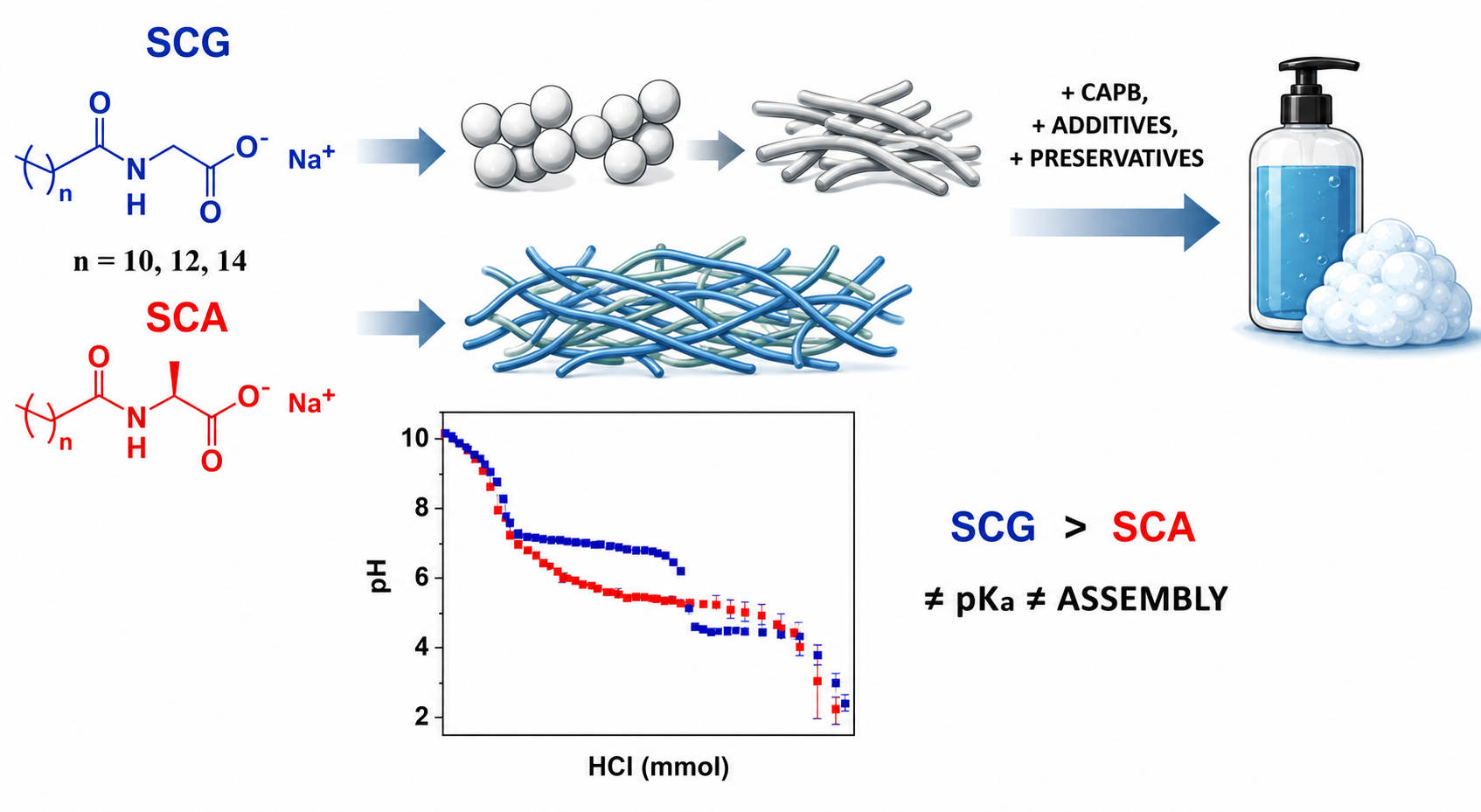
To address this question, the researchers at the Università di Bologna, Italy, investigated two commercially available amino acid-based surfactants, sodium cocoyl glycinate (SCG) and sodium cocoyl alaninate (SCA). They evaluated these materials as both cleansing agents and supramolecular gelators. Through hydrogen bonding, hydrophobic interactions, and other reversible molecular forces, the surfactants assembled into three-dimensional networks. The researchers then examined how these networks influence gel formation, mechanical properties, and formulation stability.
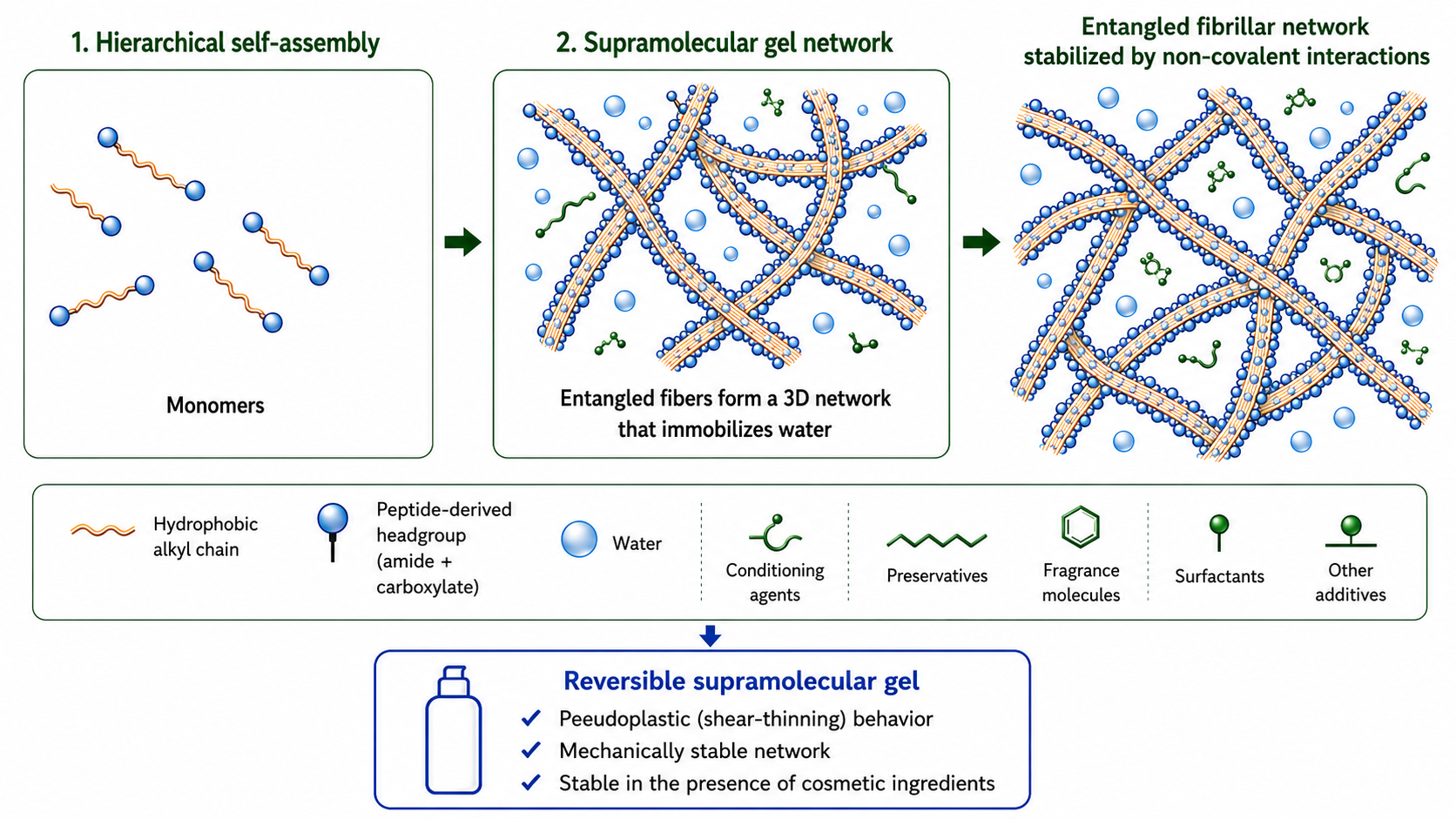
Schematic illustration of the proposed supramolecular assembly of SCG/SCA in supramolecular shampoo gels.
Building and Evaluating a Supramolecular Shampoo
The researchers adopted a stepwise approach that combined fundamental self-assembly studies with practical formulation development. They first investigated the physicochemical properties of SCG and SCA by measuring their apparent pKa values using acid-base titration.
Then the team prepared gel systems at approximately pH 5-5.5, a range relevant to skin, scalp, and cosmetic formulations. They used rheological measurements to evaluate viscosity, storage modulus, and viscoelastic behavior, providing insight into gel strength and mechanical stability. Optical microscopy visualized the self-assembled fiber networks, while temperature-dependent rheology assessed thermal stability and structural recovery after heating.
After identifying the strongest-performing surfactant, the researchers progressively incorporated ingredients commonly used in commercial shampoos. These included cocamidopropyl betaine (CAPB), preservatives, conditioning agents, non-ionic surfactants, and fragrance. They monitored rheological properties at each formulation step to determine how the additional ingredients affected the supramolecular network.
Finally, the researchers evaluated the complete formulation through accelerated aging, freeze-thaw cycling, and foaming tests. Particle-suspension tests were conducted separately on the simpler SCG/CAPB and SCA/CAPB gel systems. These experiments assessed stability and practical performance under laboratory conditions. The comprehensive evaluation directly linked molecular self-assembly to the rheological and functional properties required for an early-stage, laboratory-scale, polymer-free shampoo prototype.
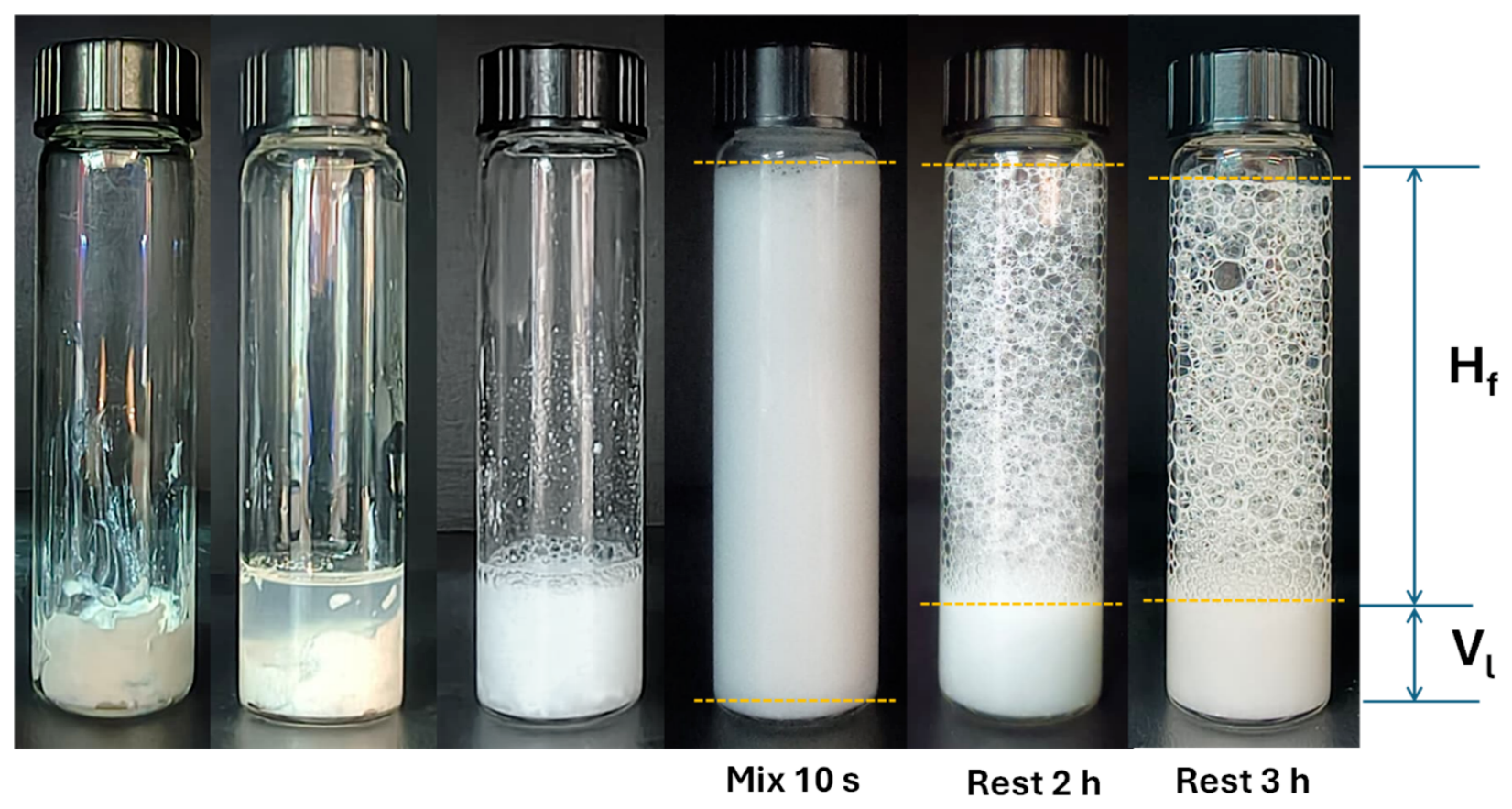
Photos of foam formed immediately after shaking the 20 mL vial with a solution of the final shampoo G8 in sink water (4 mL). The dashed lines highlight the limits of the foam, separating it from the bottom layer of liquid reformed after shaking and from the air layer on the top.
Self-Assembly Creates a Robust and Stable Shampoo Network
The experiments revealed clear differences between the two amino acid-based surfactants. SCG consistently formed stronger and more stable supramolecular gels than SCA. At the formulation pH, SCG remained partially protonated, promoting hydrogen bonding and the formation of interconnected fiber networks. By comparison, SCA exhibited protonation behavior closer to the formulation pH. The authors proposed that competing protonation equilibria may have hindered the formation of stable fibrillar structures.
These proposed molecular interactions were consistent with the observed differences in the gels’ mechanical properties. SCG exhibited a substantially higher storage modulus, indicating a stronger three-dimensional network. Optical microscopy revealed long, thin fibers in the SCG/CAPB gel. In contrast, SCA formed shorter and thicker structures with lower mechanical stability. Temperature-dependent rheological measurements further showed that SCG largely recovered its structure after heating, whereas SCA underwent irreversible weakening.
The researchers then incorporated additional cosmetic ingredients into the SCG system. Although these ingredients gradually reduced gel strength, the formulation retained its characteristic shear-thinning behavior. As a result, the shampoo remained viscous at rest but flowed more easily under the shear generated during application. The supramolecular network also preserved sufficient mechanical integrity throughout the formulation process.
The final polymer-free shampoo performed well under practical testing conditions. It retained its rheological properties after three months of storage at room temperature and 45 °C and after three freeze-thaw cycles. In separate suspension tests, the simpler SCG/CAPB gel kept both lighter jojoba beads and heavier silica particles suspended for more than three months at room temperature and 45 °C. The final shampoo also produced abundant, persistent foam, even in hard water, during a preliminary laboratory foamability test. These results suggest that supramolecular self-assembly could provide an alternative to conventional polymeric thickeners while maintaining several rheological, stability, and foaming properties relevant to shampoo formulations.
Expanding the Role of Supramolecular Materials in Consumer Products
The study shows that supramolecular chemistry offers a potential route for developing more sustainable cosmetic formulations. It also highlights the importance of molecular properties, such as pKa and self-assembly behavior, in the design of functional soft materials. Among the surfactants investigated, SCG emerged as the best-performing supramolecular gelator. Its strong gelation behaviour and compatibility with all tested additives make it a useful building block for polymer-free formulations and other sustainable soft materials.
The findings also demonstrate the broader potential of supramolecular materials design. Reversible non-covalent interactions may enable the formation of mechanically robust materials while maintaining stability in complex multicomponent systems. These design principles could inform other applications in cosmetics and personal care products, although their relevance to pharmaceutical formulations and biomedical hydrogels would require separate investigation.
Future research should compare the formulation directly with conventional polymer-thickened shampoos and assess cleansing efficacy, preservative performance, biodegradability, safety, sensory properties, manufacturing reproducibility, and longer-term shelf stability.
Overall, the study shows how molecular self-assembly can help address practical formulation challenges using surfactants derived from renewable feedstocks. It also highlights the growing role of supramolecular chemistry in developing high-performance soft materials that could support industrial development and more sustainable formulation strategies.
Journal reference:
- Chinelli, S., Stile, R., Giuri, D., and Tomasini, C. (2026). From Fundamental Self-Assembly Studies to Applications in Everyday Life: The Formation of a Supramolecular Shampoo. Gels, 12(7), 589. DOI: 10.3390/gels12070589, https://www.mdpi.com/2310-2861/12/7/589
 Undigested Cellular Waste Secretes Toxic Signals That Zombify Surrounding Tissue