Researchers at the University of California, San Diego, and their colleagues have discovered a critical cellular mechanism that causes brain degeneration in both a rare childhood condition and the far more prevalent Alzheimer’s disease. The study, published in Immunity, illustrates how the brain's immune cells respond to waste accumulation and offers a unique approach to studying and treating neurodegenerative diseases.
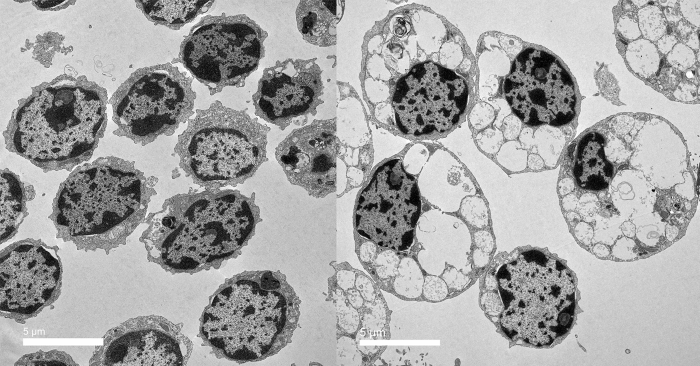
Microglia cells from the brain of a healthy mouse, left, and microglia cells clogged with cellular waste from a mouse model of Sanfilippo syndrome type A (MPS IIIA), right. Image Credit: UC San Diego Health Sciences
Children with Sanfilippo syndrome type A, also known as Mucopolysaccharidosis Type IIIA (MPS IIIA), have seizures and dementia, among other symptoms, which can lead to premature mortality. A single gene variation causes the disorder by inhibiting the synthesis of the enzyme sulfamidase.
Normally, tiny structures within cells known as lysosomes employ sulfamidase to convert nutrients into usable energy, eliminate unwanted intruders such as bacteria, and recycle old cell components for reuse. Without this enzyme, debris accumulates.
The researchers investigated a mouse model of MPS IIIA and discovered that, while this waste accumulates in numerous cell types, microglia - the brain’s devoted immune cells - are the most affected. These cells increase when they become clogged with fats and proteins, reducing their capacity to protect neurons.
The researchers discovered a family of proteins known as MITF/TFE, which function as master genetic switches. When lysosomes in microglia become overwhelmed and stressed, these switches are changed from the “off” to the “on” position, causing a significant shift in the microglia’s genetic program to defend the brain. However, this reaction eventually becomes maladaptive, causing inflammation and leading to the death of neurons.
Surprisingly, the researchers discovered that waste buildup activates the identical MITF/TFE switches in the microglia of human Alzheimer’s patients. This shows that the stress response induced by lysosomal failure in MPS IIIA is similar to what occurs in the aging brains of Alzheimer’s patients. However, unlike complicated neurodegenerative disorders of aging, MPS IIIA has a clear-cut cause.
It gave us a really clear framework to study what we see in common neurodegenerative diseases and try to figure out mechanisms that are causing them.
Christopher Balak, PhD, Study First Author and Postdoctoral Researcher, UC San Diego School of Medicine
Amyloid plaques, which are external to microglia, are considered by many researchers to be the source of lysosome failure from the “outside in.”
However, we show in this paper that the damage can come directly from inside the cell. We know lysosomes alone are sufficient to cause neurodegeneration from rare disorders like MPS IIIA. The same thing could be happening in, or at least contributing to, major diseases like Alzheimer's disease.
Christopher Balak, PhD, Study First Author and Postdoctoral Researcher, UC San Diego School of Medicine
The discovery identifies the MITF/TFE protein family as the main drivers of this process, suggesting a new target for drug development. By adjusting these genetic switches, scientists may eventually keep microglia in a protective state and stop them from causing further brain damage.
Most microglia-targeted drugs go after receptors on the cell surface. I think this work points to a little bit of a different strategy, instead going after the lysosomal program inside the cell.
Christopher Balak, PhD, Study First Author and Postdoctoral Researcher, UC San Diego School of Medicine
The researchers discovered that microglia try to reduce damage early in the disease process before becoming overwhelmed. This implies that early intervention in neurodegenerative diseases, such as enzyme replacement or cell treatments, may be most successful when provided before the immune cells’ “genetic switch” flips into a detrimental state.
Source:
Journal reference:
Balak, C. D., et al. (2026) Lysosomal dysfunction drives a transcriptional and epigenetic signature found in disease-associated microglia in neurodegenerative diseases. Immunity. DOI: 10.1016/j.immuni.2026.07.008. https://www.cell.com/immunity/fulltext/S1074-7613(26)00307-9.
 Study Links Maternal Infections to Fetal Brain Development