For many people, a trip to the zoo is a chance to watch playful otters dart through the water and chatter with one another. But while we may may worry that crowds could stress the otter community, a new Australian study shows that the happy onlookers may indeed be helping them to flourish.
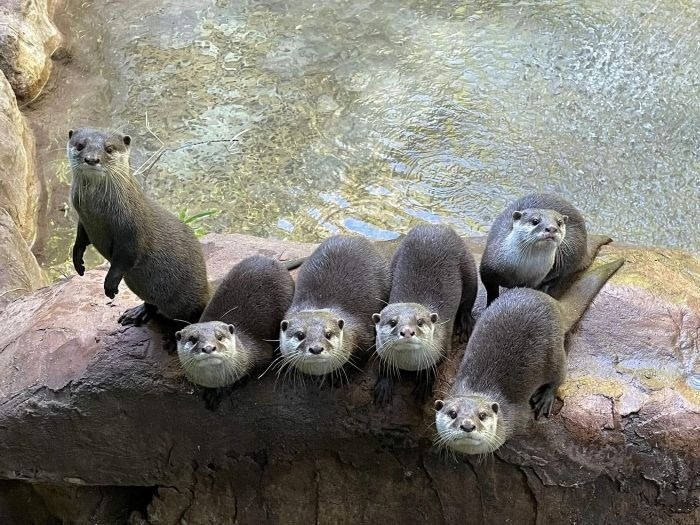 Asian small-clawed otters are among the most social and vocal members of the otter family. Image Credit: Adelaide Zoo
The Adelaide University study, published in the Journal of Zoological and Botanical Gardens, examined six Asian small-clawed otters over a six-month period to better understand how zoo visitors and staff influence the animals’ behavior and vocalizations.
Researchers observed the otters over 146 one-hour sessions, recording their activity, whether they made any sounds – including squeals, chirps, screams and barks – and whether visitors or zoo staff were nearby, compared with visitors alone.
Co-lead author Paige Klingner, a Ph.D. candidate in the School of Animal and Veterinary Sciences, said the findings challenge assumptions that humans automatically have a negative impact on zoo animals.
Our study found no evidence that visitors were associated with stress-related behaviors in these otters. Instead, we found the otters were generally more active and more visible when people were present. That raises the possibility that visitors may actually have a positive or enriching effect on their welfare, although more research is needed before we can say that with confidence."
Paige Klingner, Co-Lead Author and Ph.D. Candidate, School of Animal and Veterinary Sciences, Adelaide University
While the otters were slightly more likely to make noises when people were around, the study did not identify the specific types of calls being made. Previous research has shown different vocalizations can signal anything from excitement and social interaction to stress.
Klinger’s co-author Bridget Cooper-Rogers said they looked at whether the otters vocalized, rather than what they were saying.
"The next step is to identify different call types to better understand whether particular vocalizations reflect positive experiences, anticipation or stress,” Cooper-Rogers said.
The presence of zoo staff made little difference to the animals' vocalizations compared with visitors alone, despite suggestions that otters may respond differently to familiar keepers.
Asian small-clawed otters are listed as vulnerable in the wild and are among the most social and vocal members of the otter family. Zoos play an important role in their conservation through breeding programs, education and public engagement.
Senior author Dr. Eduardo Fernandez said the findings add to growing evidence that interactions between zoo animals and visitors are more complex than previously believed.
"People often assume visitors are stressful for zoo animals, but that isn't necessarily the case," Dr. Fernandez said.
However, Dr. Fernandez cautioned that the research was observational, meaning it cannot determine whether visitors made the otters more active, or whether active otters simply attracted larger crowds.
"Future studies need to examine other factors such as feeding times, weather and different types of vocalizations so we can better understand what's really driving these behaviors."
‘You Otter Not Talk: A Preliminary Study of Asian Small-Clawed Otter Vocalizations and Activity in the Presence of Visitors and Staff’ is published in the Journal of Zoological and Botanical Gardens.
 Novel Chemical Probes Improve Capture of Elusive DNA Repair Proteins