The genetic code sets the relationship between genetic instructions and amino acids, the building blocks that form proteins. How this relationship first emerged is a key unresolved topic in evolutionary biology.
 Image credit: Love Employee/Shutterstock.com
A study led by Dr. Lluís Ribas de Pouplana, an ICREA researcher at IRB Barcelona, and Dr. Paul Schimmel, with contributions from teams at MIT and Scripps Research, reported conserved signals in transfer RNAs that may help reconstruct early steps of this system. The study is published in PNAS.
Transfer RNAs, or tRNAs, link genetic instructions to amino acids during protein synthesis. In one region, they contain the anticodon, made up of three RNA “letters” that recognize a genetic instruction. At the other end, the matching amino acid attaches. These two positions are separated by distance in tRNA, which leads to the question of how their connection was created during evolution.
In current tRNAs we have identified signals compatible with a simpler system that linked RNA sequences to amino acids. These results provide new insights into how the genetic code developed.
Dr. Lluís Ribas de Pouplana, ICREA Researcher, IRB Barcelona
A Prediction About the Origin of tRNAs
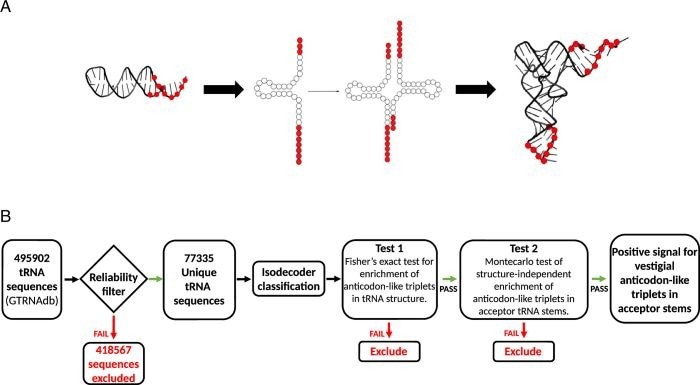
Proposed model of transfer RNA evolution from simpler RNA molecules called mini-helices. Image Credit: IRB Barcelona
One leading hypothesis suggests that tRNAs evolved from small RNA structures folded into a hairpin called mini-helices. In this model, the three-letter anticodon region found in today’s tRNAs would already have been present in these early RNAs near the site where the amino acid attaches. The idea therefore predicts that modern tRNAs may still carry copies of these triplets in that same location, the acceptor stem.
To test this idea, the team analyzed more than 70,000 tRNA gene sequences from nearly 5,000 genomes across bacteria, archaea, and eukaryotes. The dataset was assembled after filtering almost half a million sequences and is the largest datset used so far for this type of analysis.
To determine whether the observed patterns could be explained purely by RNA structure, the researchers compared the real sequences with simulated sequences that had the same structure. In several groups of tRNAs, the triplets occur more often than expected from these simulations, which further supports the idea that they may be remnants of an ancestral system.
The key was to verify that the signal persisted when taking into account the structural constraints of the molecule. This control supports the interpretation that the observed patterns may contain information about their evolutionary history.
Dr. Lluís Ribas de Pouplana, ICREA Researcher, IRB Barcelona
Insights Into the Expansion of the Genetic Code
The researchers then compared the strength of these signals with proposed timelines for when difference amino acids werer incorporated into the genetic code. In general, the signals tended to be stronger in tRNAs associated with amino acids thought to have entered the code earlier, such as glycine, alanine, or valine,and weaker in tRNAs linked to later additions, such as tyrosine and tryptophan. This alignment is consitent with a gradual expansion of the genetic code.
The study also found triplets in other regions of the tRNA. This observation is not explained by the mini-helix hypothesis by itself. The results help clarify features of an early system, but the precise route that produced today’s molecules remains an open question.
Source:
Journal reference:
Royo, N. A., et al. (2026) Molecular fossils of an ancestral code revealed by large-scale analysis of tRNAs. Proceedings of the National Academy of Sciences. DOI:10.1073/pnas.2627541123. https://www.pnas.org/doi/10.1073/pnas.2627541123.
 Switching on Healthy Silent Genes Reveals New Way to Treat Rare Genetic Disorder