A tiny, magnetically guided robot uses biodegradable microneedles to deliver insulin directly into intestinal tissue, delaying its release and lowering blood sugar in pigs. But researchers still need to prove it works when swallowed.
 Study: An Oral Biodegradable Spiny Milli-Ball Robot for Targeted Intestinal Delivery of Biologics with Delayed Onset and Sustained Action. Image credit: Pixel-Shot/Shutterstock.com
In a recent study published in Cyborg and Bionic Systems, researchers explored the possibility of a tiny, swallowable robot as a potential replacement for insulin injections. The researchers are developing a biodegradable, magnetically controlled robot designed to deliver insulin directly into the intestinal lining, with a delayed onset of release.
Why Oral Delivery Remains Challenging for Biologic Medicines
Biologics are medicines based on proteins and other complex biological molecules, and many are administered by injection. Although oral delivery would be less invasive, the digestive tract presents significant challenges. A biologic must survive stomach acid and reach the right part of the intestine, where it needs contact with the intestinal mucosa to work.
Most oral delivery systems, such as coated tablets and hydrogels, travel passively through the gut and release their contents once local conditions permit. They improve protection and access but offer little control over where a carrier settles, how firmly it contacts the lining, or when it begins to take effect. Early release can lower delivery efficiency and shorten the therapeutic effect. Novel methods such as ingestible robots offer more control over movement and tissue contact, but many use materials that do not degrade, and few offer timed release.
Building a Biodegradable Robot With Insulin-Filled Microneedles
In this study, the research team built the spiny milli-ball robot (SMB-bot) through micromolding aided by 3D printing. A 3D-printed resin template defined the microneedle shape, and they cast a poly(dimethylsiloxane) mold from it.
The researchers used an Eudragit L100-55 shell mixed with calcium carbonate and sodium citrate to cast the shape, and then loaded the drug powder into each microneedle cavity. A backing of hyaluronic acid methacrylate was cast and cured with ultraviolet light, followed by a poly(vinyl alcohol) binder.
A tissue adhesive mixed with poly(vinyl alcohol) was then used to seal the hemispherical shell, which also enclosed a magnetic skeleton made of gelatin and iron oxide nanoparticles. The team measured the shell material's hardness with a nanoindenter and tested the microneedle's compressive strength. The team then tested SMB-bot insertion in agar.
Fluorescent markers were added to the shell and model payloads, including fluorescently labeled insulin, to follow the breakdown and release of the SMB-bot. Insulin loading was measured in robots with different microneedle heights using an enzyme-linked immunosorbent assay (ELISA). For release testing, robots spent 30 minutes in simulated gastric fluid at pH 1.2 before transfer to simulated intestinal fluid at pH 6.8. The researchers also checked biocompatibility by exposing L929 fibroblast cells to robot extracts at several concentrations and measuring cell viability.
They then tested the robot in four Bama pigs under general anesthesia. In one pig, a bulge was created in the intestinal wall by injecting gelatin beneath the intestinal lining. After closing the surgical opening, the robot was delivered through an endoscope and tube, then guided to the bulge with magnets. In the other three pigs, insulin-loaded robots were placed in the duodenum, and blood glucose and serum insulin were tracked against subcutaneous injection and passive placement without magnetically assisted insertion.
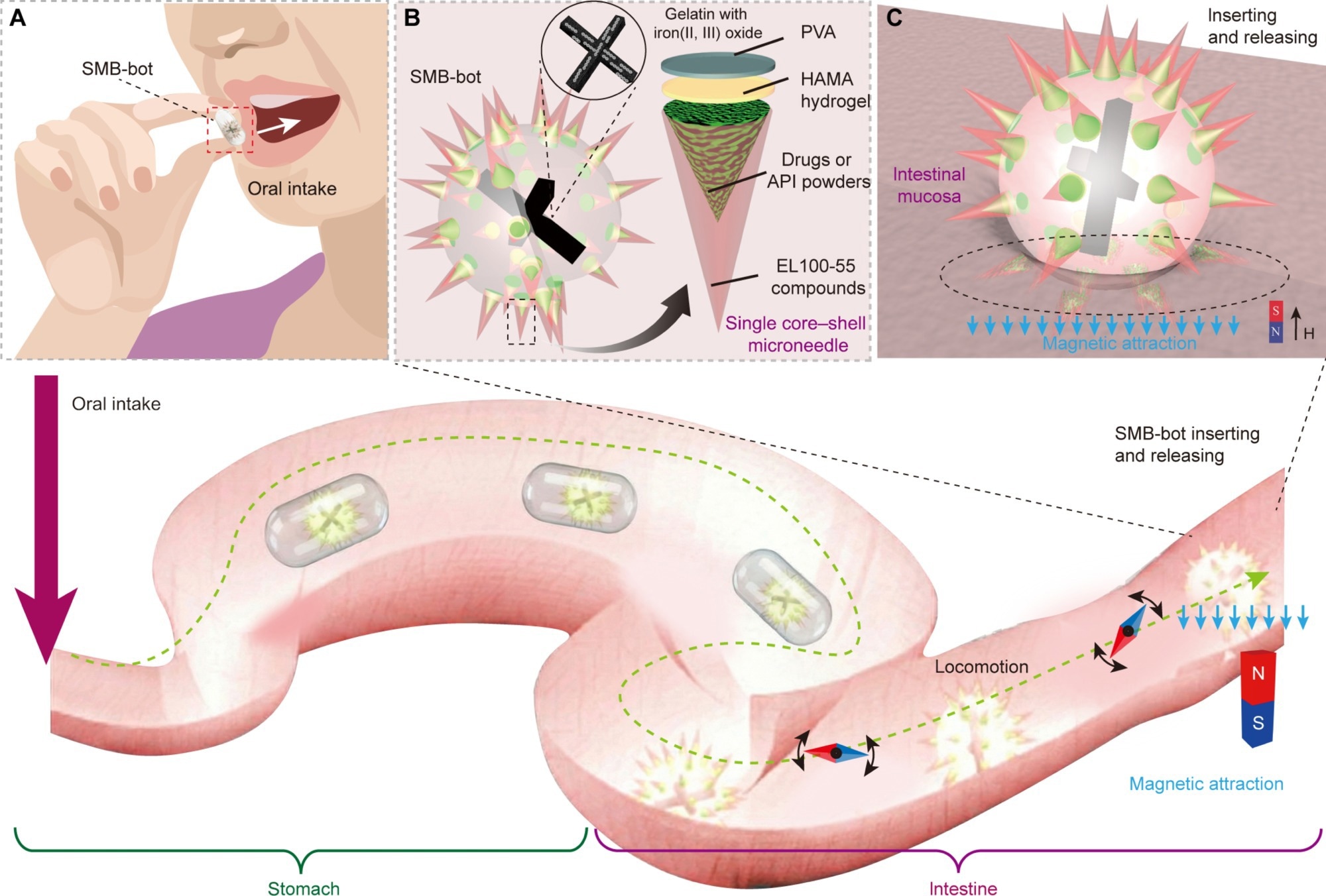 Schematic illustration of the biodegradable spiny milli-ball robot (SMB-bot), designed to be swallowed in a capsule and magnetically guided through the intestine. The robot uses drug-loaded microneedles to penetrate the intestinal lining and release medication after a delay. Although designed for oral administration, the device was delivered endoscopically during the pig experiments. Image credit: Tan et al., (2026).
Magnetic Robot Delays Insulin Release and Lowers Blood Sugar
The study found that the SMB-bot could be guided by magnets to a chosen spot in the pig intestine and made to release insulin after a delay instead of all at once. The robot measured 6.5 millimeters across, which was small enough for a standard size 00 capsule. Its microneedles stood about 600 micrometers tall and withstood roughly 1.25 newtons each, and the shell material was harder than various tissues.
The rolling speed rose with the frequency of the magnetic field and reached 180 millimeters per second under laboratory test conditions, and the robot kept moving on three test surfaces and through mucus on an isolated pig stomach.
The insulin capacity was based on microneedle height and reached nearly 7 international units at 800 micrometers. In simulated stomach fluid, almost no insulin escaped over 30 minutes. After transfer to intestinal fluid, insulin release stayed low for about 20 minutes, then increased quickly and was nearly complete by 90 minutes. Cell viability also remained comparable to controls across the tested concentrations.
In pigs, endoscopic images showed the robot being guided to a gelatin-filled bulge and inserted there. Histological examination confirmed that the microneedles penetrated the intestinal mucosa. Insulin was undetectable in blood during the first 20 minutes after robot delivery, then peaked near 96 milliunits per liter at 80 minutes, compared with about 214 milliunits per liter at 80 minutes observed after subcutaneous injection. Blood glucose fell about 24% at 80 minutes and 27% by 190 minutes, while injection produced a 34% drop at 80 minutes. The robot therefore produced a smaller glucose-lowering effect than injection, although its delayed insulin response demonstrated the potential to control the timing of drug exposure.
Only 4.27% of the robot's total measured insulin exposure occurred between 20 and 40 minutes, compared with 14.66% of the total exposure occurring during the first 40 minutes after injection. A further 27.88% of the insulin exposure occurred between 40 and 85 minutes, and the remaining 67.67% occurred between 85 and 190 minutes.
The authors suggested the platform could support protein and peptide therapies and the treatment of intestinal disease. However, they noted that large-scale manufacturing and long-term safety still need to be studied. The authors also need to assess efficacy via oral delivery, as the animal model tests relied on endoscopic delivery.
The study involved only four pigs, including three used to evaluate insulin delivery, limiting the conclusions that can be drawn about therapeutic effectiveness. Further research is also needed to establish complete biodegradation in living animals, assess long-term effects on the intestinal lining, and optimize magnetic navigation through deeper intestinal regions.
Magnetic Robot Shows Promise
The researchers developed a biodegradable robot that protected insulin under simulated acidic stomach conditions and, when placed directly into the intestines of pigs, penetrated the intestinal lining and released insulin after a planned delay.
Compared with injection, the robot SMB-bot produced a slower and more gradual insulin profile. The study showed that targeted delivery and timed release can be combined in one experimental device designed for oral administration. However, successful delivery after swallowing, reproducible large-scale manufacturing, long-term biodegradation, and mucosal safety must still be demonstrated before human trials can be considered.
Reference
Tan, R., Yang, X., & Shen, Y. (2026). An oral biodegradable spiny milli-ball robot for targeted intestinal delivery of biologics with delayed onset and sustained action. Cyborg and Bionic Systems, 7, Article 0716. DOI:10.34133/cbsystems.0716. https://spj.science.org/doi/10.34133/cbsystems.0716
 Optimizing Laser Pulse Energy for Deep-Brain Imaging Without Tissue Damage